It's one of those true stories you couldn't make up: in 1920s Kentucky, Floyd Collins, visionary cave explorer, happens across the spectacular sand cave of his dreams only to become trapped on the way back to the surface.
Will he or won't he make it back into the light? While the carnival arrives above ground, Floyd's dark night of the soul is played out below. Billy Wilder turned it into a rather good movie, Ace in the Hole, but it was never on the face of it the stuff of which musicals are made.
 Well, not until composer Adam Guettel and book writer Tina Landau took it to heart. Guettel's extraordinary gifts may or may not be related to his distinguished heritage, but the odds of inheriting the "genius gene" rise exponentially when your grandfather is the great Richard Rodgers. Guettel is not prolific - frustratingly, quite the reverse. But his two produced theatre pieces (three if you count the major song-cycle Myths and Hymns, which does get staged) - Floyd Collins and The Light in the Piazza - are both unquestionable masterpieces, and it is tempting to presume that new work waiting, as it were, in the wings will not see the light of day until it, too, is honed to such a status.
Floyd and Piazza inhabit different universes, musically speaking, but they belong clearly to the same composer. Guettel's voice – his searching melodic lines (he prefers the journey to the arrival), wavering as they do between key centres – are uniquely his own. The beauty of Floyd Collins rests in its complexity, and yet the bluegrass tone and homespun directness sound thoroughly authentic. So much so that you don't notice that the piece is dicing with atonality and that the band (MD Tom Brady) seems to have cross-fertilised its country accenting with that of Stravinsky.
Guettel miraculously writes the haunting cave echoes into the yodeling scat of Floyd's vocal lines. And there's even a nod to the city-slicking close-harmony groups of the 1920s when Guettel wittily gives the stage to a quartet of reporters whose talent for misinformation knows no bounds.
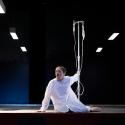
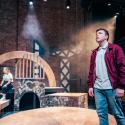
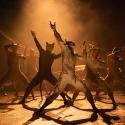
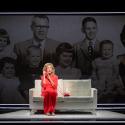
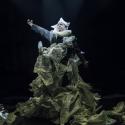
 The genius of the piece lies in its intimacy, i.e. in those quiet moments where Floyd (the excellent Ashley Robinson, pictured above), his brother Homer (Samuel Thomas) and sister Nellie (the wonderful Rebecca Trehearn, late of Show Boat) reflect in isolation or in concert. One of the joys of Jonathan Butterell's terrific revival has to do with the still-mystical space that is Wilton's Music Hall, whose aged dustiness, weathered facade and hollow acoustic – occasionally obtrusive to clarity – are generally so welcoming to the piece. Trehearn (pictured above left with Sarah Ingham) perfectly catches the telling vocal aches and breaks and sobs of her numbers, while Robinson and Thomas make something truly brilliant of the sensational act one closer "The Riddle Song" – but why no song or cast list in the programme?
This remains one of the most exhilarating moments in contemporary musical theatre, and Stephen Sondheim is documented as having said he wishes he had written it: Floyd imagines he is free and reliving childhood games with his big brother, a device which will recur at the climax of the piece where the imaginary "Grand Opening" of the Great Sand Cave assumes, in Butterell's staging, an almost religious pageant-like quality, with the entire Collins family attired in their Sunday best. And then suddenly the cave echo fails to return Floyd's jubilant vocals and he is alone again.
There's an eleven o'clock number, "How Glory Goes," in which Robinson breaks your heart, but by then the show is no longer happening on the Calvary-like scaffolding on which Floyd is in a sense crucified but in our heads and hearts. That's the genius of Guettel and the simple truth of this production.