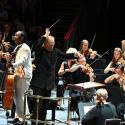
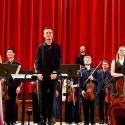
It’s Christmas already at Wigmore Hall. Or advent at least – this concert of Bach Advent cantatas was presented by the English Concert without apology or qualification, despite it still being the middle of November. But it proved a welcome fillip for a wet and dreary November evening, with the energetic and engaged playing of the small ensemble bringing out all the life and playfulness in Bach’s scores.
Balance was a problem though, with the players often overpowering the singers (no choir here, the chorales and choruses all sung one to a part). The orchestra was bigger, with two desks each of first and second violins, and a bold, imposing tone, rounder and warmer for the gut strings and Baroque bows, but no quieter. Arias fared better than tuttis, but the whole arrangement seemed unbalanced, especially for its mix-and-match approach to period convention.
Bach’s three famous Advent cantatas all share a common chorale, and it’s a beauty: Nun komm, der Heiden Heiland. The chorale gives its name to the first two, BWV 61 and 62, and the programme concluded with the more substantial two-part Schwingt freudig euch empor, BWV 36. In BWV 61, the tenor and soprano get an aria each. Tenor Nick Pritchard has an elegant voice and sophisticated delivery. He lacks power though, and his intonation wasn’t always secure. Soprano Dorothee Mields is a specialist in this repertoire, and knows just how much colour and flair she can apply without disrupting the Baroque conventions, so daring swells at phrase openings and a bright upper register at cadences. But she too struggled against the muscular sound of the strings.
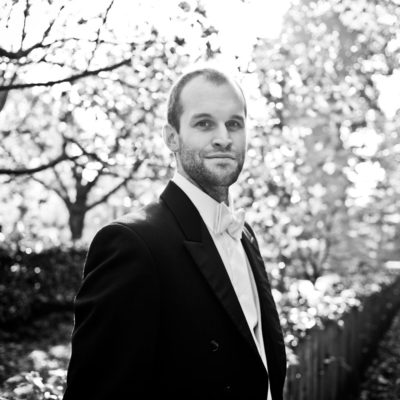 Much better was bass Ashley Riches (pictured right by Debbie Scanlon), whose recitative “Behold I stand at the door and knock” is this cantata’s most famous moment, the strings playing pizzicato to represent the knocking. Riches was last seen in London in the BBC Symphony’s concert performance of Turnage’s The Silver Tassie, where he stole the show with his impassioned and lyrical performance of the lead role. No surprise that he was the best voice in this programme too, his tone deep and rich, his delivery suitably atmospheric and mysterious for this recitative.
Thankfully, there was plenty more for Riches in the later cantatas, and his extended recitative and aria proved the highlight of BWV 62. After the string-only accompaniment of the first cantata, BWV 62 added oboes and bassoon, but the textures seemed clearer here, and the balance improved. The ensemble’s director, Harry Picket, led from a chamber organ, but the continuo group was dominated by the agile, lithe cello of Joseph Crouch.
In the second half, the programme jumped back a generation, with a suite, the Ouverture No 6 in G Minor by Philipp Heinrich Erlebach (1657–1714). Most of Erlebach’s prolific output was destroyed in a fire in 1735, but this orchestral suite is representative of what remains: lively high Baroque instrumental writing, as colourful and energetic as Bach, but less ambitious in counterpoint. The orchestra here consisted of six strings, with Bicket transferring to a modestly voiced harpsichord. Good ensemble throughout, with the elegant string tone satisfyingly bass-heavy. The star here was leader Nadja Zwiener, delivering energetic and nimble melodies, and just a touch of vibrato to colour the longer lines.
Zwiener also gave a memorable obbligato in one of the arias of the final cantata, BWV 36, subtly ornamenting the da capo, but without intruding on the melodic contour. The oboists also excelled here, putting down their oboes for more wieldy oboes d’amore, but never seeming encumbered in Bach’s long and complex accompanying lines. The cantata has something for everybody, and the most interesting number is a duet for soprano and alto based on the Nun komm, der Heiden Heiland melody. This was the only number to feature countertenor James Hall, whose clear, focussed tone suited the music and blended well with Mields. But, predictably, the highlight was the bass aria, Ashley Riches giving an authoritative “Willkommen, werter Schatz!”. An evening of mixed musical fortunes, but elevated significantly every time Riches stood to sing.