Forget the cloak in the puddle. Never mind potatoes and tobacco. The children's book cliché of Sir Walter Raleigh (or Ralegh as he seems to have preferred in an age of changeable spelling) represents little of the real man and is at best misleading. The cloak incident was a later invention and potatoes and tobacco were already known before Ralegh's adventures in the New World. He did, however, popularise the smoking of tobacco at court.
Good-looking and courageous, Ralegh was a favourite of Queen Elizabeth. He fought with the Huguenots in France, helped quell rebellion in Ireland, attempted to establish a colony in what is now North Carolina and was knighted in 1585. He received lucrative positions and estates, but displeased the queen sufficiently to be imprisoned in the Tower when his secret marriage to one of her ladies-in-waiting, Elizabeth Throckmorton, was discovered in 1592. After his release he mounted further expeditions, including a search for the legendary land of gold, El Dorado, in modern Venezuela. Back in favour, he was made Governor of Jersey in 1600.
 Elizabeth's successor, James I, was less charmed by the undoubtedly ambitious and outspoken soldier-poet: he was accused of treason within months of the new king's accession. It is the 1603 trial for his supposed implication in the "Main Plot" to kill the king and his "cubs" that actor-director Oliver Chris has dramatised.
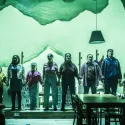
The result is a fascinating mixture, both more and less than a play, a "verbatim" account which daringly offers members of the audience the opportunity to act as jurors. The actual trial was held in the great hall of Winchester Castle, during an outbreak of plague in London. The Globe's production, first seen in its original location on the anniversary earlier this month, now arrives - all-too-briefly - at the Sam Wanamaker Playhouse, which, despite its wood-panelled, candle-lit warmth, acquires, in Jessica Worrall's design, the formality of a court room. The tone is set by Amanda Wright as an authoritative clerk of the court: we all stand obediently when she directs us to do so.
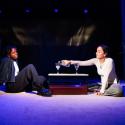
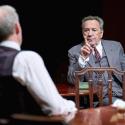
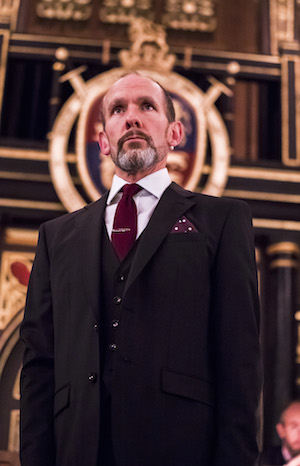
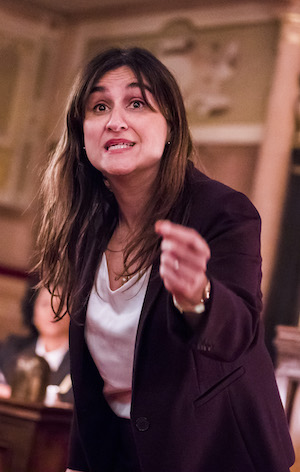
Simon Paisley Day's Ralegh (pictured above), his penetrating gaze betraying justified nerves, leans on a stick before the commissioners, including Lord Chief Justice Popham (Pooky Quesnel), and prosecuting council Coke. Continuing the admirable Globe policy of providing more parts for women, Chris (who also directs) has transformed Sir Edward Coke into Elizabeth Coke (Nathalie Armin, pictured right) as well as altering the gender of the Lord Chief Justice, Coke's assistant, Heale (Fiona Hampton) and the clerk. This is only one indication that we are not to expect an escapist departure from modern concerns. All the actors are in modern dress, including two uniformed police officers. Day wears a sober suit and tie with only a tiny pearl earring to hint at Jacobean extravagance. No specific "relevance" needs to be drawn; human pettiness and political expediency will always threaten justice to a greater or lesser extent.
 The outcome was a foregone conclusion. Ralegh's only accuser, Lord Cobham, who had confessed to his own part in the plot, was not permitted to be called to give evidence. The jury took less than fifteen minutes to convict Ralegh, who was condemned to death. This does provide a difficulty. The audience can scarcely not sympathise with Ralegh, so how can the jurors honestly arrive at the guilty verdict stipulated by history and the script? Apparently, some bold juries have on occasion refused to bow to expectation only - one presumes - to be over-ruled.
Chris has drawn on transcripts and reports of the trial to produce an admirably clear account. Day embodies the faded glamour of Ralegh, weakened by a wound to his leg sustained while fighting the Spanish at Cadiz and by his incarceration in the Tower, but still witty and passionate as he fights for his life. Nathalie Armin as Coke and Pooky Quesnel as Popham are as unbending as their originals must have been.
The event concludes with Day quoting from two of Ralegh's poems, including the lines: "Say to the court, it glows/ And shines like rotten wood". It is the right dramatic moment on which to end. In fact, Ralegh's sentence was commuted and he lived another fifteen years, spending twelve of them in the Tower writing the first part of a history of the world, before being released to make one last misjudged expedition to South America, during which a Spanish settlement was destroyed. King James, who was attempting to improve relations with Spain, finally had him beheaded almost exactly 400 years ago, in October 1618.