

A new commission, a Romantic tone poem and a choral spectacular – standard fare for the First Night of the Proms. Traditionally, the First Night sets out the themes for the season ahead, but the rationale behind much of this programme was paper-thin. Janáček’s Glagolitic Mass was included because Henry Wood had conducted it, part of a series featuring pieces Wood introduced to the UK. Dvořák’s The Golden Spinning Wheel was played because Henry Wood had not conducted it, a Proms first performance “reflecting Wood’s fondness for expanding the repertoire”.
Zosha Di Castri’s Long is the Journey, Short is the Memory, commemorated the 50th anniversary, almost to the day, of the Apollo 11 moon landing (the composer pictured below with condictor Karina Canellakis). The piece is scored for chamber choir, the ever-versatile BBC Singers, and large orchestra. The texts have a suitably lunar theme, from Sappho in Ancient Greece to the contemporary Chinese-British writer Xiaolu Guo. The words were inaudible anyway, but the lunar theme was unmistakable from the eerie, nocturnal mood of the music. Harmonies are broadly consonant, but the long lines are subtly coloured by sustained dissonances in the choir and a variety of extended performing techniques in the orchestra.  The percussion writing was clearly conceived with the spacious Albert Hall acoustic in mind, and the heavy thud of two bass drums in tandem had impressive impact. More delicate string effects were lost though, the energetic bowing contributing only spectacle, and the woodwind accompaniments eventually became tedious, especially the repeating clarinet glissandos. Skilful choral writing compensated, and was well delivered by the BBC Singers, who managed to dominate the orchestra despite their small size.
Dvořák’s The Golden Spinning Wheel is big on orchestral colour, with imaginative orchestration spotlighting many of the instrumental sections, but it struggles to tell its story, and the reasons for its neglect are clear – an indulgent half-hour duration that the drama and invention barely justify. Canellakis made a reasonable but hardly compelling case for the score. The folk-song opening was presented in such a casual way that it was not even clear that the music had begun, and the ending was ragged, too. Along the way, some scrappy woodwind ensemble suggested a need for clearer guidance. But otherwise, much of the orchestral playing here was very fine. The BBC Symphony strings were on top form, delivering a plush, elegant tone, as were the trombones, whose warm, rich chorales punctuate the score.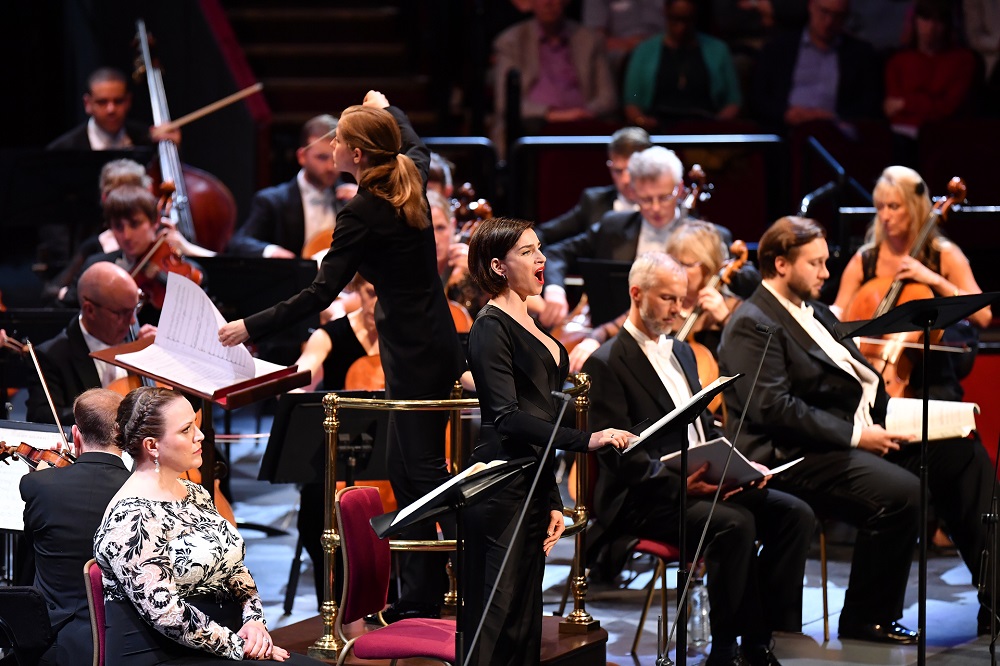 Canellakis brought firmer control to the Glagolitic Mass. There were no great interpretive insights here, but balances were fine and tempos well judged, all of which allowed the music’s glorious eccentricity to speak for itself. The cascading brass fanfares of the opening were well balanced, but without being overly restrained. Timpani outbursts were similarly frenetic. And the music’s erratic stops and starts were all delivered with an impressive unity of intent. A fine solo from Peter Holder put the Albert Hall organ through its paces. Best of all was the singing: the soloists (Jennifer Johnston, Asmik Grigorian, standing above, Ladislav Elgr and Jan Martiník) all made distinctive contributions, especially tenor Elgr, whose complex emotional delivery suits Janáček’s disturbing solo lines, but who also has the projection to fill the hall. An excellent performance, too, from the BBC Symphony Chorus, their combined tone weighty but nimble, providing both the power and the grace that Janáček’s massive but often intimate score demands.





Add comment