Virtuosity and a wildly beating heart are compatible in Richard Jones’s finely calibrated production of Renaissance woman Sophie Treadwell’s Machinal. It hits hard as a 1920s mechanical symphony with a lyrical slow movement and words/cliches used like musical refrains. There’s an army of generals at work in the team of 16 actors, led by fearless Rosie Sheehy, and in the genius lighting, movement, sound, design. You rarely see such meticulous, detailed work in the theatre.
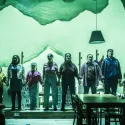
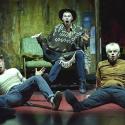
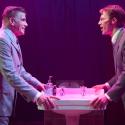
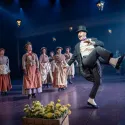
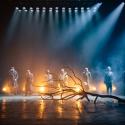
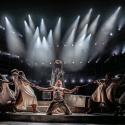
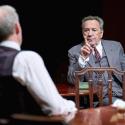
The polar opposite in scale to Stephen Daldry's 1993 National Theatre production with Fiona Shaw, this one started life in the Theatre Royal Bath’s 150-seater Ustinov Studio, and still manages to feel horrifyingly claustrophobic in the Old Vic. Total darkness envelops us at the start – it will be stretched out to minutes in a pivotal scene until a dim bedside light slowly gets brighter – before lights and sound go up and down at the flicks of a switch on a crowded subway, a cramped office room. Bilious yellow walls receding to a cramped space at the back predominate. Treadwell’s Young Woman, identified later as Helen Jones, stands out as a model of confused, sometimes shy, sometimes aggressive humanity, every twitching gesture and fiddling with her hair (a leifmotif) keenly focused; in the following scene with her mother (Buffy Davis), violence explodes and we see she needs psychological help, not an option in the relentless metropolitan world the playwright has chosen to convey. 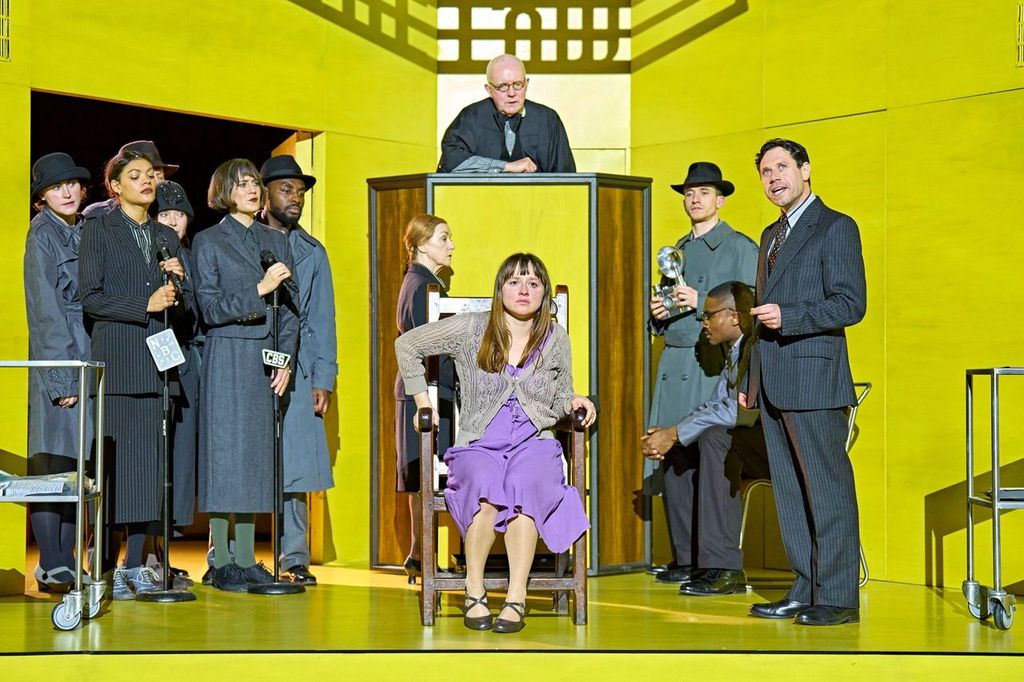 Treadwell was present, as a non-reporting member of the press, at the 1927 trial of Ruth Snyder and her lover for the murder of Snyder's husband Albert ("Law" scene in the play pictured above). The story Machinal tells is tangential to that; though the outcome is inevitable, the trajectory is not. We see the Young Woman sleepwalking into a marriage with a man she can’t even bear to touch her – the boss loves her hands, she’s repelled by his – and if the honeymoon scene is painful, the delineation of post-natal depression proves excruciating. Jones has Sheehy lying on a trolley like a body in a morgue, convulsed at intervals by the shattering noise of a pneumatic drill, responding with the most minimal gestures to the nurse’s chatter. Husband and medical team look down on a space below them, as if she’s not in the room; the trolley is then moved centre-stage and goes vertical for another of the monologues Sheehy delivers with maximum impact.
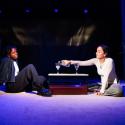
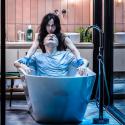
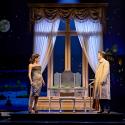
Between this and the monstrous later stages of her elliptically-told story, the protagonist finds freedom with the kind of young man she’s dreamed of marrying, and though their pillow talk is at cross purposes, we see the transcendence (Rosie Sheehy and Pierro Niel-Mee pictured below). She says she feels “purified” – there’s an ironic correspondence in the next scene, where the husband tells her how he was attracted to her “purity” – but all the cues are set up for catastrophe. A tense trial is followed by the terrible endgame: seared on the mind’s eye now for ever, the caged woman is caught between a fellow prisoner singing a spiritual and the cant of a priest, though Jones spares us the full-on horror of the electric chair, as Daldry did not. It's still sick-making. Some members of the audience shot to their feet at the end, but the shock left me unable to move, and jelly-legged for some time after. 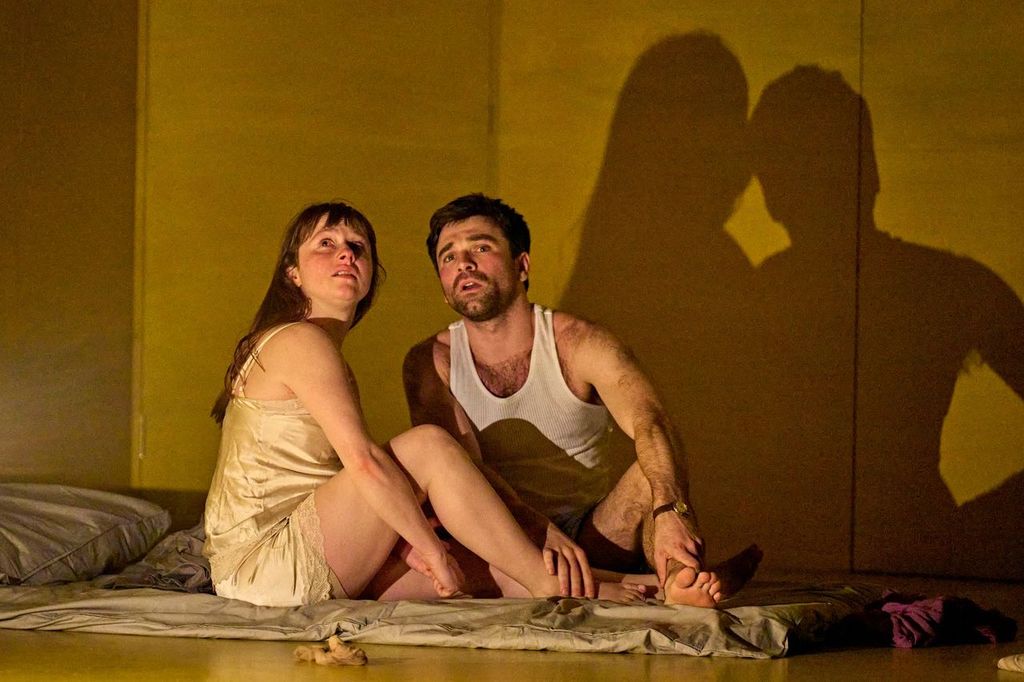 Credits due are simply too many to include everyone. Sheehy, of course, is central, visceral when she needs to be yet precise and controlled - the sort of performance you wonder how an actor can sustain night after night. Tim Frances' boss-husband and Pierro Niel-Mee's Young Man may spout cliches, but the performances humanise the only sustained characters. The other seven main actors are all note-perfect; singling out under such circumstances is difficult, but Carla Harrison-Hodge's Telephone Girl, Emilio Iannucci's creepy edge in several roles, and Daniel Abelson and Sam Alexander as Defence and Prosecution Lawyers respectively all have a special sharp definition. Even non-speaking roles like Steven Beard's stalking speakeasy bartender command attentiion. The spiritual delivery of Daniel Bowerbank, spine-tinglingly beautiful in the awful final scene, transcends the setting.
Shin's sets have a stifling, spare fascination - windows open on to nothing, the crucial lily in a bowl during "Intimacy" is carefully placed - and Jones demands quick-change skill from Adam Silverman (lighting, the full gamut), Benjamin Grant (sound, treated 1920s music included) and movement (Jones regular Sarah Fahie, who's proved her metal in direction with the recent Giant). Like Jones's sorely-underrated Pygmalion last year at The Old Vic, this is theatre that demands so much of team and audience, maybe even changes your perspectives. Unmissable.