Lionel (Paul Mescal; played as a child by Leo Cocovinis) has perfect pitch and is able to name the note his mother coughs each morning. He can harmonise with the barking of the dog across the field. “Early on I thought everyone could see sound.” Sounds bring shapes, colours, tastes too: “B minor and my mouth turned bitter.”
Directed by Oliver Hermanus (Moffie; Living), The History of Sound, adapted by Ben Shattuck from his own short story about a gay couple in the 1920s, starts promisingly but its tone is too tasteful and restrained and its faded painterly palette of brown and white, though beautifully lit, is too unvaried. A lifeless feel pervades in spite of strong performances. And Lionel’s interesting synesthesia is never developed after this first scene in rural Kentucky in 1910.
Lionel’s exceptional voice – and Mescal does sing quite well; remember, Hermanus got Bill Nighy to sing in Living – is noted by a teacher and in 1917 he goes to the New England Conservatory in Boston on a scholarship, leaving behind the simplicity of life on his parents’ smallholding. In a pub he meets fellow student David (Josh O’Connor), who’s playing the piano, a tune called A Dead Winter’s Night that Lionel’s father used to play on the fiddle. David’s small, flickering smile is constant and becomes intensely annoying, partly because we’re never shown what lies beneath it.
David asks Lionel to sing. He takes off his specs and does so, reluctantly: the haunting Silver Dagger (Bob Dylan and Joan Baez both covered it in the early Sixties, as did Dolly Parton in the Nineties, and it’s quite an ear-worm). Its lyrics, “All men are false, says my mother/They’ll tell you wicked loving lies/The very next evening/ They’ll court another…” are the film’s refrain and a kind of foreshadowing. David, of course, is stunned at Lionel’s gift. (Folk singer/songwriter Sam Amidon taught O’Connor and Mescal to sing and arranged the songs.)
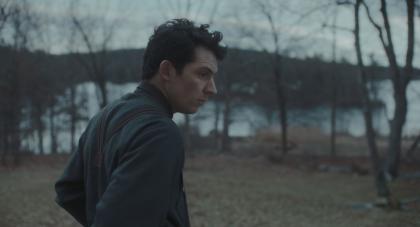
The two stay up all night and fall into bed together in David’s apartment. The sex is very restrained, bloodless and dull with no feeling of danger. Lionel says he feels no guilt, which seems too easy; David is more enigmatic. Things do come to life when the two go off on a mission, arranged by David after he comes back from World War One in 1919, to record folk songs in Maine on wax cylinders using a phonograph. This is apparently commissioned by Bowdoin College, where he’s teaching. (Lionel is exempt from fighting due to his bad eyesight.) David needs Lionel to help him carry this new technology, and the contrast between David’s well-appointed leather luggage and Lionel’s minimal amount of stuff, which includes a pillow that starts leaking feathers, retrieved by David (is this symbolic?) is marked.
They sleep in a tent, walk for miles across the brown leaves of a barren, frozen-looking Maine (the actual filming took place in New Jersey because of tax credits). They seek out people in various remote backwaters, including Malaga Island, a place whose interracial inhabitants were forcibly evicted, and ask them to sing down this mysterious tube while Lionel moves the stylus to the wax and turns a crank. There are whole families involved, children included, all with a wealth of folk songs that have been handed down through the generations, but although listening to these songs is pleasant enough, they’re very similar and do tend to blur into one.
And there’s something rather smooth and cosmetic about the process, with very little comment on the songs or the singers, which seems odd for two passionate music students. But perhaps it’s because the relationship between the men takes centre stage – though that relationship remains somewhat veiled and dim. At the end of the recording expedition, David seems remote. He has to return to Bowdoin, leaving Lionel sitting blankly at the station in Augusta, Maine.
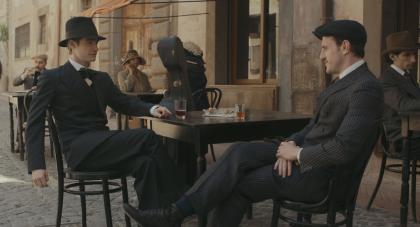
But not for long – suddenly Lionel’s in Rome in 1923 (the palette employs very similar faded tones as in Maine and Kentucky), dressed smartly in a pinstriped suit (pictured above, left), singing in a prestigious choir. A few relationships with men and women, all in picture-perfect houses, follow. But happiness doesn’t, and it’s not until the end that there’s some resolution, appropriately revealed by those old wax cylinders. (An older Lionel, now a celebrated ethnomusicologist at Harvard, is played by the brilliant Chris Cooper.) But the film’s emotional life remains about as sealed as those cylinders themselves.