“Your term is about to end,” Italian president De Santis (Toni Servillo) is told, with implications which extend far past politics. Director Paolo Sorrentino is second only to old maestro Marco Bellocchio in his current fascination with Italian power, from The Young Pope (2016) to Berlusconi satire Loro (2018). His muse Servillo’s bunga-bunga act in the latter contrasted with his gnomic reserve as post-war Machiavelli Guilio Andreotti in Il Divo (2009) and now this fictional sphinx, lizard-still even as damped passions threaten to finally erupt.
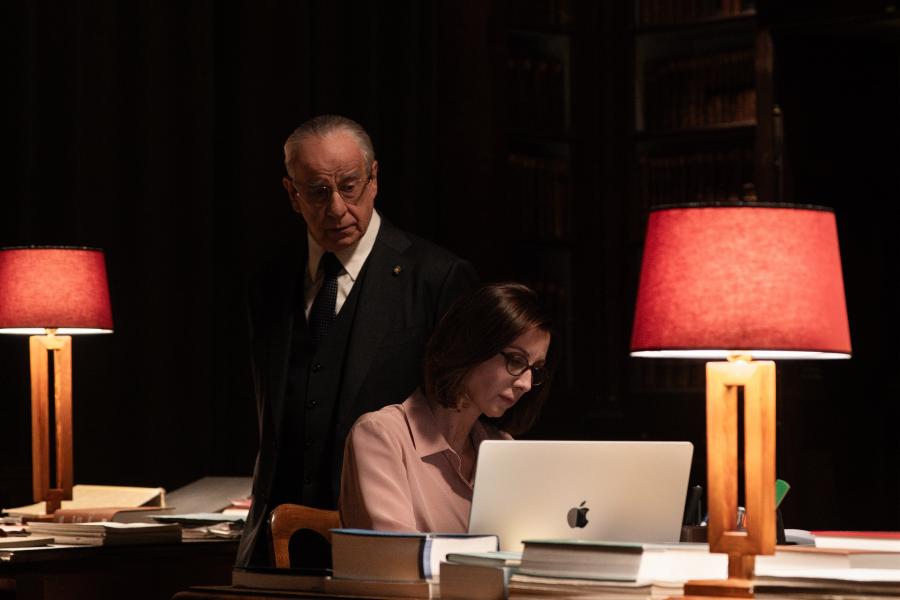
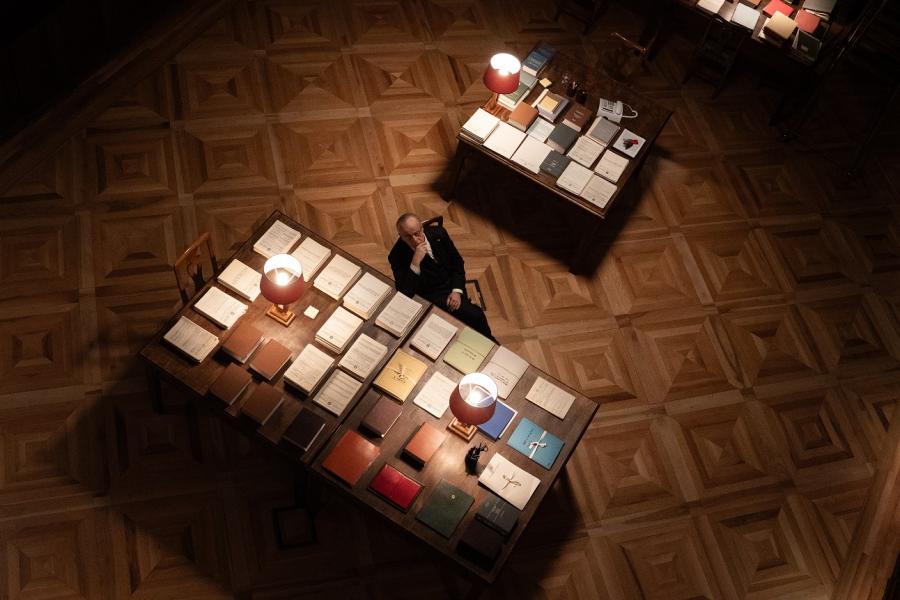
Servillo was a volcanic Naples theatre great before Sorrentino extracted a talent for stillness balanced by his own taste for excess, a modern style which helped revive Italian cinema from its post-Fellini, Berlusconi-oppressed doldrums. Like De Santis’s occasional explosions of rage as a lifetime of strategizing nears its end, the director sparingly punctuates his new film’s wintry austerity with set-piece fireworks. The ancient Portuguese president’s slow-mo march across a ceremonial courtyard under a storm’s hailstone fire, red carpet wrapping python-like around him, sees De Santis sadly stand his ground, faced with the farce of state pomp and power. At other times he views the stars from his Roman palace like Servillo’s enervated roué in The Great Beauty (2015), or sinks into its heavy shadows, archaic trappings he secretly pricks by rapping along to crude hip-hop.
Sorrentino affects disinterest at his real-life politicians’ guilt or worth. De Santis’s fictional technocrat, favouring legalistic finesse and bureaucratic delay, is though cheered by La Scala’s grateful crowd as their saviour from a presumably more populist government. The director’s attraction to incremental process and composed manoeuvre seems perverse given his gaudy maximalism, but De Santis is his Andreotti as hero, cleansed of the latter’s corruption. One of La Grazia’s most moving scenes sees him roar an anthem with ageing elite soldiers, suggesting his service is patriotic.
De Santis is haunted by his late wife, still a youthful sweetheart when she stalks the misty hills of his dreams, but whose affair with an unknown friend corkscrews in his heart. He muses that the obvious response would have been to kill her, rhetoric indicating the old-fashioned machismo behind his pain, a dangerous cultural trait fuelling Italian femicide. He is in practise, like Sorrentino, a harmless man of his time, sent comically deranged detecting the cuckolder.
“La grazia” has several meanings: the pardons De Santis contemplates, and the spiritual grace offered by an avuncular, black Pope (Rufin Doh Zeyenouin), adding to The Young Pope’s Trumpian American. “Who owns our days?” is the question. “God,” Il Papa advises. “He keeps up alive with mystery.” The president makes his true confession to a journalist in a phone-call finally expressing his widower’s love, voice grasping for truth and words warming his blood as power wanes.
Sorrentino maintains his customary distance, as if withdrawing his directorial touch from his script’s subtle character study, and letting his muse supply its tragicomic heart. La Grazia’s style and novelistic intent meet in Servillo’s inscrutable face as it opens, finding answers only slightly nearer.