Silence. Near-darkness. Oozy weeds of orchestral strings twist in the mind of Edward Fairfax Vere (John Mark Ainsley), remembering the tragic events of 1797 when he was Captain of the HMS Indomitable. From that awe-inspiring start through to one of the most upsetting of onstage murders, perhaps the greatest parade of major and minor chords in all opera and beyond to some kind of redemption, Michael Grandage's Glyndebourne production - his first in the operatic sphere - of Britten's grandest opera moves with a simplicity and grace which fit this tight little craft of an opera house very well indeed. It's the singing and the orchestra in perfect balance which packs the punches, rather than any one idea in the staging, but that's not necessarily any defect.
Grandage avoids (or implies) the symbolic baggage carried by one of Britten's closest-to-the-bone operatic choices of subject, but since plenty of previous productions have dealt with that, I didn't miss it too much. For Melville, Britten and E M Forster, who adapted the novella with experienced librettist Eric Crozier, there was much to be made of the naive, beautiful William Budd and the tussle for his soul - and maybe more - between the depraved Master-at-Arms John Claggart and Captain Vere. It's a given here. Grandage seems more interested in what Budd's much harped-on "goodness" might mean, and in Jacques Imbrailo's refreshingly natural characterisation, its essential flaw would seem to be not a mere stammer but an inability to comprehend the evil that, in turn, understands it all too well.
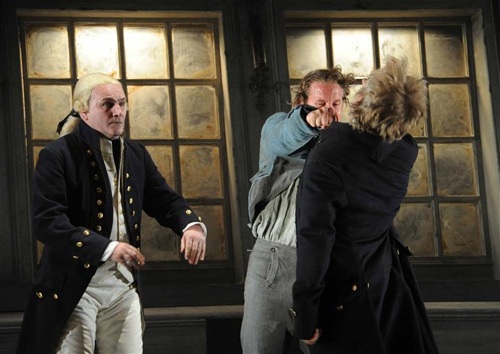 All paths, then, lead to the stupendous tension of Claggart's accusation. Fear of the dread word "mutiny" brings the Act One scene in the Captain's cabin to a halt, brilliantly abetted by two leaders among the uniformly fine male voices in the ensemble, Matthew Rose and Iain Paterson. Rose would no doubt make a fine Claggart himself; the present incumbent, Phillip Ens, has the low money notes but not quite the inky-black seeping evil which gave the character a Satanic dimension in the hands of John Tomlinson over the years. Instead Ens brings a certain sensuousness, a not-too-buttoned-up luxuriance of desire for the handsome sailor.
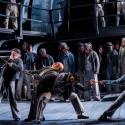
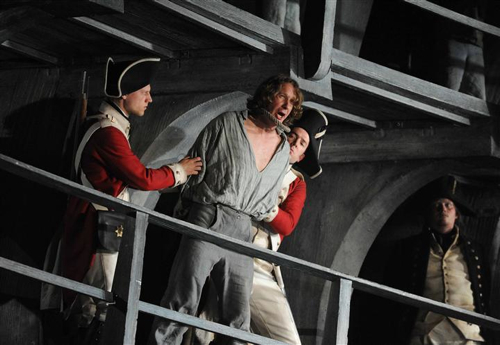
So in the crucial scene (pictured above, Ainsley's Vere, Imbrailo's Billy and Ens' Claggart), it's the flabbergasted incomprehension of Imbrailo's febrile innocent which rivets us, not the outrageousness of the snaky charge of mutiny. The torch then passes to the moral confusion of Ainsley's Vere. He has the ideal physical tension and urgency for the role, but not quite the ability to carry it up to the top register which so distinguished Pears's and the late lamented Philip Langridge's unforgettable impersonations. Something else is needed to take their place, and I'm not sure it happened here, though Ainsley's torment as his elder self looking on the hanging of Billy is certainly compelling (pictured below, Billy goes to his death). A slight judder in Imbrailo's stalwart baritone is sometimes helpful in projecting his flailing enthusiasm, but ultimately gets a little in the way of his condemned-cell meditations.
 What really carries the emotion through to the quiet final bars is the total authority of Mark Elder's conducting. Every chord-colour, every little woodwind solo that protests or mutters around the male voices makes its mark. You always hear the inner detail of the London Philharmonic Orchestra at Glyndebourne, but I've never been more aware of the team as absolute equals with their counterparts on stage. Of course there are big, arching, if leanly scored climaxes in all the interludes, but Elder never misses a trick in Britten's near-flawless score (if there's a weakness, it's the Act One curtain, and there seems to be nothing anybody can quite do about that).
A much-expanded male Glyndebourne chorus pulls out all the stops, too, complementing the careful pageantry of the pursuit of the French, the point of which, of course, is its fizzling out in misty indecision; but it has to be handled as grand opera while it lasts (one wonders, incidentally, what a Gallic friends-of-Glyndebourne group being forged this evening made of "Don't like the French! Don't like their hippity-hoppity ways"). Though I've seen some cameos more strongly taken in previous productions, there's no weak link in the ensemble; even Peter Gijsbertsen's Maintop makes his mark. And Christopher Oram's claustrophobic inside of a ship fits well into its setting, as all wood-dominated designs seem to do at Glyndebourne (this one even mirrors the opera house auditorium). The sea is out of sight below deck as well as on the other side of the South Downs, but we certainly caught a strong whiff of it here.
- Billy Budd continues until 16 June
- See what's on at Glyndebourne 2010