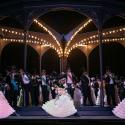
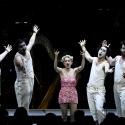
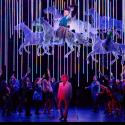
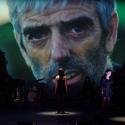
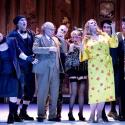
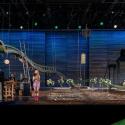
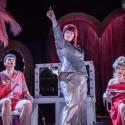
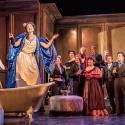
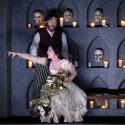
Two 1950s Mozarts in one weekend might seem like pressing the contemporaneity of great art unnecessarily far. But Jonathan Kent’s Glyndebourne Don Giovanni, revived on Sunday, is a much less crude update than the WNO Così. True, the dramatis personae might have wandered in from a Fellini film set vintage 1960, with Giovanni recast as Marcello Mastroianni, but the setting itself, by Paul Brown, is at least quasi-classical, columned and arcaded, with a whiff of Hellfire Caves and, in the end, a sort of Chirico-esque fragmentation, none of which conflicts too drastically with the social and sexual meltdown depicted in this astonishing score.
I missed the production when it was new last year, but by all accounts the staging (Lloyd Wood) is now tighter and the casting less variable. Some of the goings-on, especially in the later scenes, remain messy; some decisions look perverse. Why is there already a grave in the “dark courtyard” where Leporello (alias Giovanni) brings Elvira in the second act (and why, incidentally, does whoever decides such things prefer the dull Vienna version of this scene to the Prague original)? Why, above all, is there no statue (the “pierre” of Molière’s “festin”; Tirso de Molina’s and Pushkin’s “stone guest”), but instead a decaying corpse that rises from the grave. This really is to abandon the crucial symbolism of the cold classical monument suddenly coming to life and crushing those who imagine you can imprison the human spirit in a stone edifice.
Marita Solberg’s Zerlina, robbed of her peasant status in favour of a little tarty-party girl, sings like an angel of coaxing untrustworthiness
As usual, though, with modernised settings of classical opera buffa (or dramma giocoso, as Mozart actually labelled the piece: Emanuele Senici’s programme-book article on this topic, though a trifle learned for a windy afternoon on the lawn, is well worth reading), the crucial question of class – so basic in 1787, so distressing to us now – goes down the plughole, taking with it the attendant issues of class betrayal, manners versus behaviour, and noblesse oblige. For a film star, Giovanni’s activities would hardly raise an eyebrow, or even a super-injunction. For Mozart’s Europe they stood for a social and political earthquake: “Long live liberty”, as Giovanni and his aristocratic guests are made to sing, like kidnap victims in an internet video.
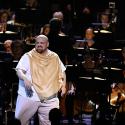
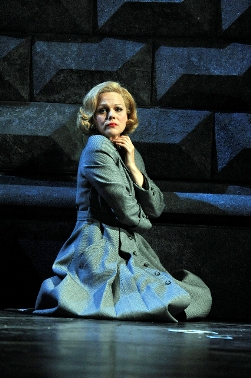 Whatever its dramatic credentials, this is a strongly cast revival which should moreover improve with the uncorking. Lucas Meachem is a suave, relaxed anti-hero, given to outbursts of extreme violence; the beating he hands out to the Commendatore strays well outside any imaginable code of honour. But his singing belies his manners: consistently elegant, refined in timbre, and struggling only, like most baritones, in the breathless pace of his champagne aria. Matthew Rose is an excellent Leporello, too tall, I suppose, for a servant who’s lived on husks but OK for Fellini’s Rome. Toby Spence sings “Dalla sua pace” very nicely and otherwise stands around amiably – all Ottavio can do when deprived of “Il mio tesoro”, which Mozart scrapped for Vienna. David Soar does the wronged, sulky Masetto to a tee.
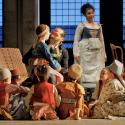
But the most memorable performances are in the female half. Miah Persson (pictured above) is a wonderfully listenable-to Elvira, with lovely, easy tone in her great entrance aria and her stern, Handelian advice to Zerlina, “Ah, fuggi il traditor!” She needs to tidy up her miniature cadenza in the Act I quartet, but that’s a detail. Albina Shagimuratova’s Donna Anna is low on stage presence but high on vocal allure, slightly lacking in the darker colourings for my taste, but immaculate and musicianly throughout. Marita Solberg’s Zerlina, robbed of her peasant status in favour of a little tarty-party girl, sings like an angel of coaxing untrustworthiness. No wonder Masetto can’t stay angry with her for five minutes under the caress of her “Batti, batti” and especially “Vedrai, carino”, a treatment for cuckolded husbands that ought to be marketed in bottles.
This is, of course, an early-music Don Giovanni, with the Orchestra of the Age of Enlightenment presiding under Robin Ticciati: very relaxed but mostly quite pacey, as perhaps befits the transparent sounds of these instruments, though it doesn’t suit the singers in every case. Nor, oddly enough, does it always match the production, which has its pauses and longueurs, at least some of them obviously intentional. Mozart’s wit has been better served, but his music is in good hands.
- Don Giovanni at Glyndebourne until 15 July
- Find other performances by the Orchestra of the Age of Enlightenment