A Masked Ball – note the English title given by the EIF, even though this is sung in Italian, an indication, I expect, of moves towards further accessibility – has a reputation as Verdi’s masterpiece of chiaroscuro. In none other of Verdi’s mature operas does tragic darkness sit so close to breezy laughter, most obviously at the end of Act 2 when the conspirators who want to kill Riccardo are shocked into laughter instead of murder.
Unfortunately, however, half of this memo appears to have gone missing on its way to Adele Thomas, the Co-General Director and CEO of WNO, and also the director of this production from the Zurich Opera House, which arrives for four performances at the Edinburgh International Festival. Instead of carefully balancing the comedy and the tragedy, Thomas goes headlong into the light-hearted which, predictably, only works about half of the time.
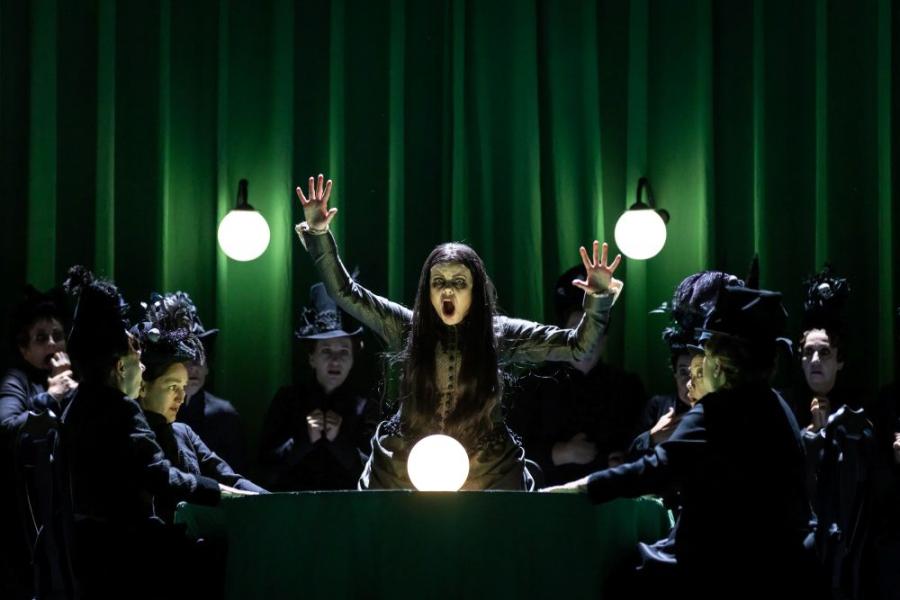
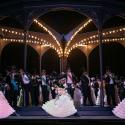
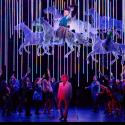
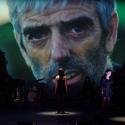
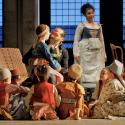
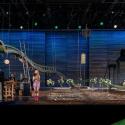
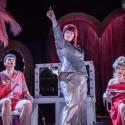
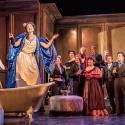
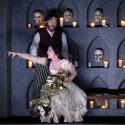
She sets the production in the USA of the Gilded Age of the 1880s, where Renato is running for election. His “courtiers” wear stovepipe hats and the ladies wear hoop skirts. The action takes place in a huge cylindrical drum that revolves to reveal each setting, most effectively Ulrica’s garish sitting room (Yulia Matochkina pictured above), where she reads her illuminated crystal ball, or the final dance which takes place in what feels like an outdoor bandstand. Bizarrely, however, Act 2 takes place at the dismally blank rear of the drum where there is only shadow and darkness, never coming near the passionate level of the music.
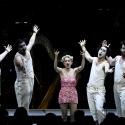
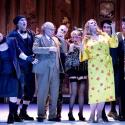
The direction of the characters is zany to a fault, to the extent that it feels like watching Offenbach rather than a mature Verdi tragedy. Thomas’ tone is a mix of music hall and silent movie, with every opportunity taken to dial up the comedy and top it off with jazz hands, not to mention an unseemly quantity of coordinated lurching in the crowd scenes. This grates from an early stage, and she doesn’t have a different register for the darker scenes, all of which are either uncomfortably light-hearted or, as in Act 2, simply blank. Only the start of Act 3, as we watch the crisis of Renato and Amelia’s marriage, finds something close to a register that matches the music. Otherwise this feels repeatedly as though Thomas hasn’t grasped the opera’s dual tone; or, worse, that she doesn’t care about it.
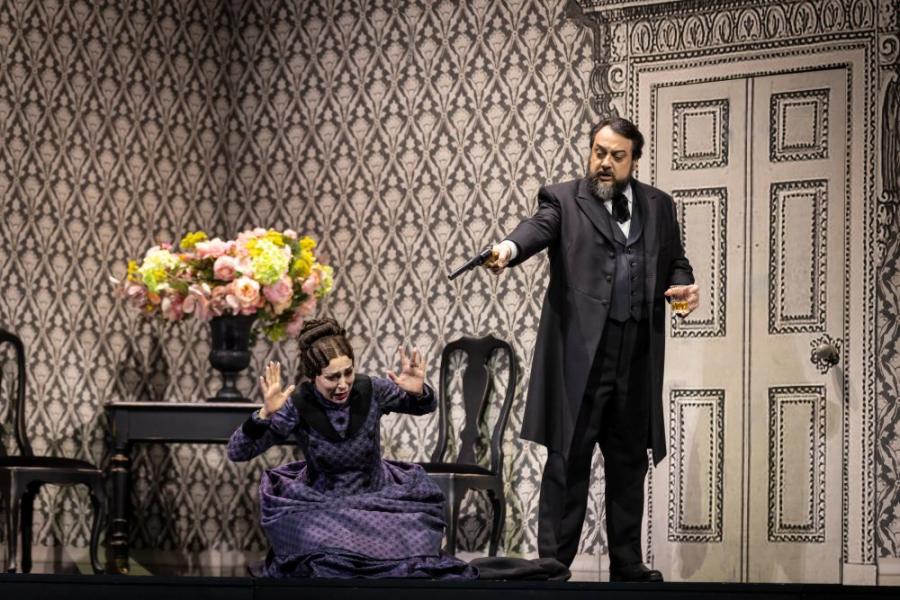
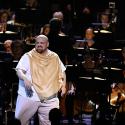
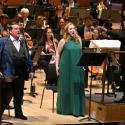
The musical consolations are considerable, if not quite sufficient. There are two casts for this run. The one for opening night featured Stephen Costello’s glowing tenor as Riccardo, a little compromised by the time of his big Act 3 aria, but otherwise sounding confident and flexible. Elena Stikhina had a beautifully rich voice as Amelia, though she seemed oddly reticent about letting it rip. Not so Dalibor Jenis, whose rich, warm baritone was ideal for Renato, vigorous but poignant in “Eri tu” (Jenis pictured above with Stikhina). Rebeca Olvera made a slightly brittle Oscar, but Yulia Matochkina was a powerhouse Ulrica with a chest voice that could make your scalp prickle. Credit also to Brent Michael Smith and Stanislav Vorobyov, who made an unusually memorable pair of conspirators.
The orchestra sounded rich and lovely in the pit, cooking up a storm in the lot-drawing scene, and Gianandrea Noseda kept everything moving in a pacy way, though the coordination between stage and pit was dreadful in Act 1. Overall this was a Ball where the tragedy was masked by a curdling grin.