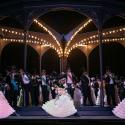
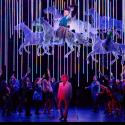
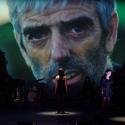
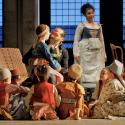
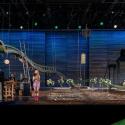
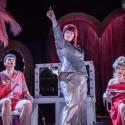
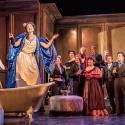
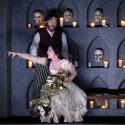
Very few of the staged goings-on in Covent Garden’s revival production of La Bohème this weekend rose above the level of mediocrity. The singing was blighted by illness and Eastern European bad habits. The 1970s set was as fresh as a fridge full of condemned meats. The 1970s vision of 19th century costume was extraordinary, as if the set of Abigail's Party had been emptied over the singers' heads. And yet, what an enjoyable evening. In the pit, the never resting hands of the Latvian conductor Andris Nelsons was whipping this warhorse into some sort of damn appealing shape.
While the stage creaked and groaned with tiredness and decrepitude, the orchestra beamed with life and energy, drama and modernity, dragging this production into a position of musical (if not theatrical) respectability. From the start, the evocations were bright. When wannabe Delacroix, Marcello, sings of the Red Sea that he is painting overwhelming him “as if showered by spring” Nelsons lifted up the orchestral waters like an ocean swell and let the violins and horns play with our ears.
This idea of spring returns again and again as a vision, a hope, to this destitute garret of bohos, most famously in the mind’s eye of Mimi (Hibla Gerzmava) in Act 1. It proved to be a highlight of the night. The vocal competition wasn’t high. The Polish Rodolfo, Piotr Beczala, had flu (and was replaced after the first interval); Kostas Smoriginas’s Colline had dynamic problems; Gabrielle Viviani’s Marcello was nice enough in a chesty sort of way; and Jacques Imbrailo (Schaunard) had an interesting quiver of a voice. But we hadn’t had a truly competent, all-round singer-actor.
So all Hibla Gerzmava had to do was what it said on her tin. And how lovely this was when it happened. "Ma quando vien lo sgelo" ("But when spring comes") flowered beautifully, her mature deep sound hugging the orchestral line and pouring out abundantly. This second orchestral evocation of a new life was as beautiful as the fleeting first. Rising up from the pit was a cymbal’s shimmer, the twitter of two flutes and a lazy syncopated string floor. Gerzmava’s first ravishing is orchestral.
Her competence, her supreme safeness, in the end, wasn’t all one wanted from the fragile little Mimi. But still, next to the sloppy prattishness of Inna Dukach’s Musetta (deliberate, perhaps), Gerzmava was a godsend - though Dukach’s aria in Café Momus did have one extraordinary thing going for it, a ventriloquist’s sotto voce. Act 2 is dedicated to showing off: vocal, theatrical, dramatic and compositional. Which is fine, if the arrogance has foundations. When it doesn’t – and it didn’t – it soon becomes an act of dramaturgical vomit: a pointless Oliver Twist-like runaround.
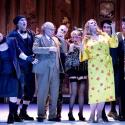
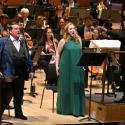
So we came to Act 3 and a new Rodolfo, Romanian Teodor Illincai, who was worse than the guy he’d just replaced. The first, Beczala (pictured left with Gerzmava), actually had a pretty fine voice in retrospect; he had it all: warmth, energy, control, a frog and a cold. What Illincai could produce was cleaner but meaner by comparison. And he couldn’t stop semaphoring and thrusting in that typically trite Eastern European way.
So it was left to Nelsons to rescue the last two acts. Colour, scenario and drama were now solely in the windmilling hands of the Latvian. The darkness of the broken relationships at the start of Act 4 was summoned up in those stilled tremolandi and misshapen flute duets. Colline’s final act aria was given life by the accompaniment: bassoons, flutes, plucked strings all pacing around in a downcast fashion. And the profound dinginess and deliriousness of the final drama came out in the pungent brass fanfares, and not in the visual whys and wherefores.
- La Boheme booking online at the Royal Opera House until 11 January