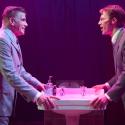
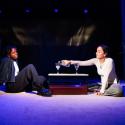
John Gay’s 1728 satirical drama was the first ballad opera. The vernacular work not only cocked a snook at the Italian operas that were so in vogue in 18th-century London, but it also lampooned Whig politician Sir Robert Walpole and the British love for scoundrels. It was an instant, huge hit; as a witticism of the time had it, The Beggar’s Opera made Rich gay, and Gay rich.
The work, which many people know through its later incarnation, Kurt Weill and Bertolt Brecht’s The Threepenny Opera, was suggested by Gay’s friend Jonathan Swift, no mean satirist himself, who envisioned “a Newgate pastoral among the thieves and whores there” and the stage is entirely populated by low-lifes - highwaymen, thieves, prostitutes and corrupt officials.
The story has nods to real-life anti-heroes such as Jack Sheppard, who escaped thrice from the notorious Newgate prison, and is rife with double-dealing. It opens with Mr Peachum (a nicely sly Jasper Britton), who is both a fence and thief-catcher, deciding which thieves (the unproductive ones, that is) he will turn in for hanging. Mrs Peachum (Janet Fullerlove, giving good bawd), who is no slouch at nefarious activities herself, tells him their daughter, Polly, has secretly married Captain Macheath (David Caves), a notorious blaggard who is the leader of a gang of robbers and pickpockets.
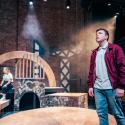
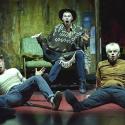
The Peachums are not, however, worried for Polly’s virtue; rather they don’t want to lose an asset to their business and so devise a plan to have Macheath arrested and then executed. Polly overhears her parents and tells Macheath that he must flee immediately, but he is betrayed by the whores he keeps company with and is taken to Newgate, run by the corrupt jailer Mr Lockit - Phil Daniels (pictured below with Jasper Britton) giving a suitably slimy performance. Lockit looks after his charges, but always at a price - Macheath is offered a choice of handcuffs and if he wants the lighter ones he’ll have to pay for the privilege.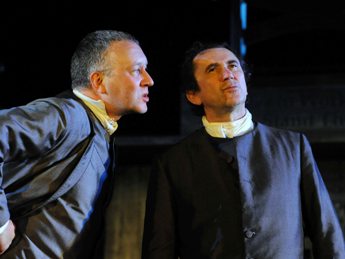 Macheath has also been dallying with, among many others, Lockit’s daughter, Lucy, who is now pregnant and believes Macheath when he denies being married to Polly. She helps him to escape but he is again captured and sentenced to be hanged, and we await to see what dastardly plan Macheath can enact this time to save himself from the noose.
Such a great story, peopled by vivid, if unlikeable, characters, using theatrically rich language - the script is littered with words such as slut, strumpet and harlot - should be a romp, but Lucy Bailey’s underpowered production fails to catch fire. The pace drags - strangely, considering that Punchdrunk’s Maxine Doyle is credited as movement director - and, while there is a lot of bawdiness on stage, the comedy mostly falls flat. The music is performed with vim but the singing is uneven.
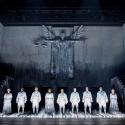
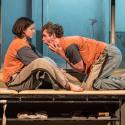
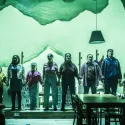
The scenes between Macheath’s vying wives Lucy (Beverly Rudd) and Polly (Flora Spencer-Longhurst) are the evening’s strongest, and their feisty exchanges bring some badly needed laughs. William Dudley’s niftily multi-purpose design, in which huge carts serve as tumbrils, beds, prison cells and a robbers’ den, is a delight, and Bailey makes lovely nods to Gay’s near contemporary William Hogarth in the set pieces. There is also a magnificent coup de théâtre at the end, but sadly what has gone before isn’t quite so witty or shocking.
 Find John Gay on Amazon