Satire, we’re solemnly instructed in Dougal Irvine’s new musical The Busker's Opera, “has to strike a fine balance of entertainment and teaching”. Well yes, but it’s also generally wise (discretion, valour, and all that) to keep the theatrical crib sheet to yourself, just in case your product doesn’t quite measure up. This latest show from the award-winning composer and lyricist of Departure Lounge and Britain’s Got Bhangra leads with its chin, and despite energy and bags of insouciant confidence, can’t quite pull off the pose.
John Gay’s The Beggar’s Opera was a nose-thumbing attack on the establishment that took London by storm in 1728. Two hundred years later, Brecht and Weill’s reimagining, The Threepenny Opera (returning to the National Theatre in a new staging later this month), did the same in Berlin. Now Irvine reworks the material for our own generation.
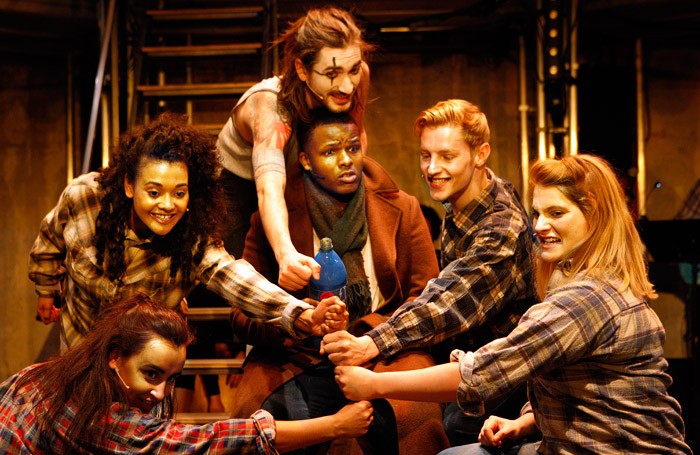 Womanising highwayman Macheath (Olivier Award-winner George Maguire) becomes a middle-class hipster anarchist (more diffident than dissident), shunning his “one-bed flat in Ealing” for a life of political protests and satirical YouTube videos. Faced with the capitalist frenzy of the 2012 Olympic Games, he must outwit Bo-Jo-esque Mayor Lockitt (Simon Kane) and unscrupulous media mogul Jeremiah Peachum (David Burt) to get his message out to the masses, all while juggling the rival affections of Peachum’s daughter Polly (Lauren Samuels) and Lockitt’s daughter Lucy (Natasha Cottriall).
For reasons best known to himself, Irvine confines the entire two-hour show into rhyming couplets, forcing his characters into verbal contortions that say more about his own skill than anything else. It’s a problem mirrored across the whole musical, which is often clever and occasionally brilliant, but is so busy trying to thrust that at its audience, that it forgets to charm, to woo. Tone swings wildly between Private Eye and sixth-form revue, unsupported by some rather thin characters.
While Brecht’s Macheath is a thoroughly amoral antihero, and Gay’s is a swaggering braggart, Irvine’s leading man is more victim than villain, carried along on currents of other’s making. But in softening the edges, Irvine also sacrifices the interest. What is it that drives this rather weak-willed young man, alternately bullied by both Peachums and Lockitts, to lead a movement? Despite Maguire’s best and most charismatic attempts to imbue Macheath with some heft, we leave the theatre still unsure of the answer.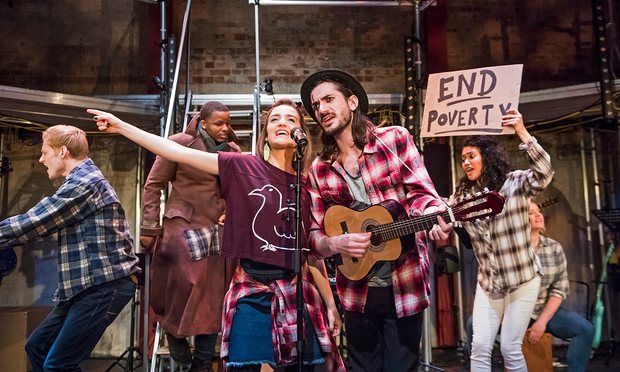
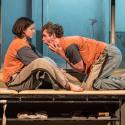
The women fare better, and while Samuels (pictured above, centre, with Maguire) shines as the dappy, pigeon-worshipping hippy Polly, it’s newcomer Cottriall who gets all the best lines, delivering an immaculate, irresistible performance as the deliciously trashy Lucy. The rest of the small cast (Maimuna Memon, Giovanna Ryan, and the outstanding John McCrea) gamely dance, sing, perform on multiple instruments as well as play multiple parts, and it’s this ensemble energy, harnessed by director Lotte Wakeham’s restless production, that carries The Busker's Opera along.
Irvine’s agitprop kitbag is stuffed with issues – human trafficking, media corruption, homelessness, economic inequality, substance abuse, corporate power – but with so few memorable tunes to peg them to, they don’t really stick. Despite a strong cast and an efficient production, this still feels like a work-in-progress. Mac may be back, but his blade’s in serious need of sharpening.
- The Busker's Opera at Park Theatre until 4 June
- Read more theatre reviews on theartsdesk