Danya Taymor’s production of “Daddy” A Melodrama has a huge exuberance: a tour de force in itself, it's also a scintillating introduction to the work of Jeremy O Harris. The young American dramatist earned considerable attention, and acclaim for the acuity of his investigation of race issues, for his 2018 Slave Play, but it's this earlier piece, written when Harris was in his mid-twenties, that reaches London first (after a two-year Covid delay).
The music, lighting, movement and sheer dramatic craft – not least the stage-front swimming pool in which a fair part of the action takes place – has an energy and style that’s a wake-up in every sense. Harris’s text seems a more multifarious thing though, excelling when it’s at its tightest, especially sharp (and funny) in its satire, but losing something in a second-half prolixity that comes to feel protracted.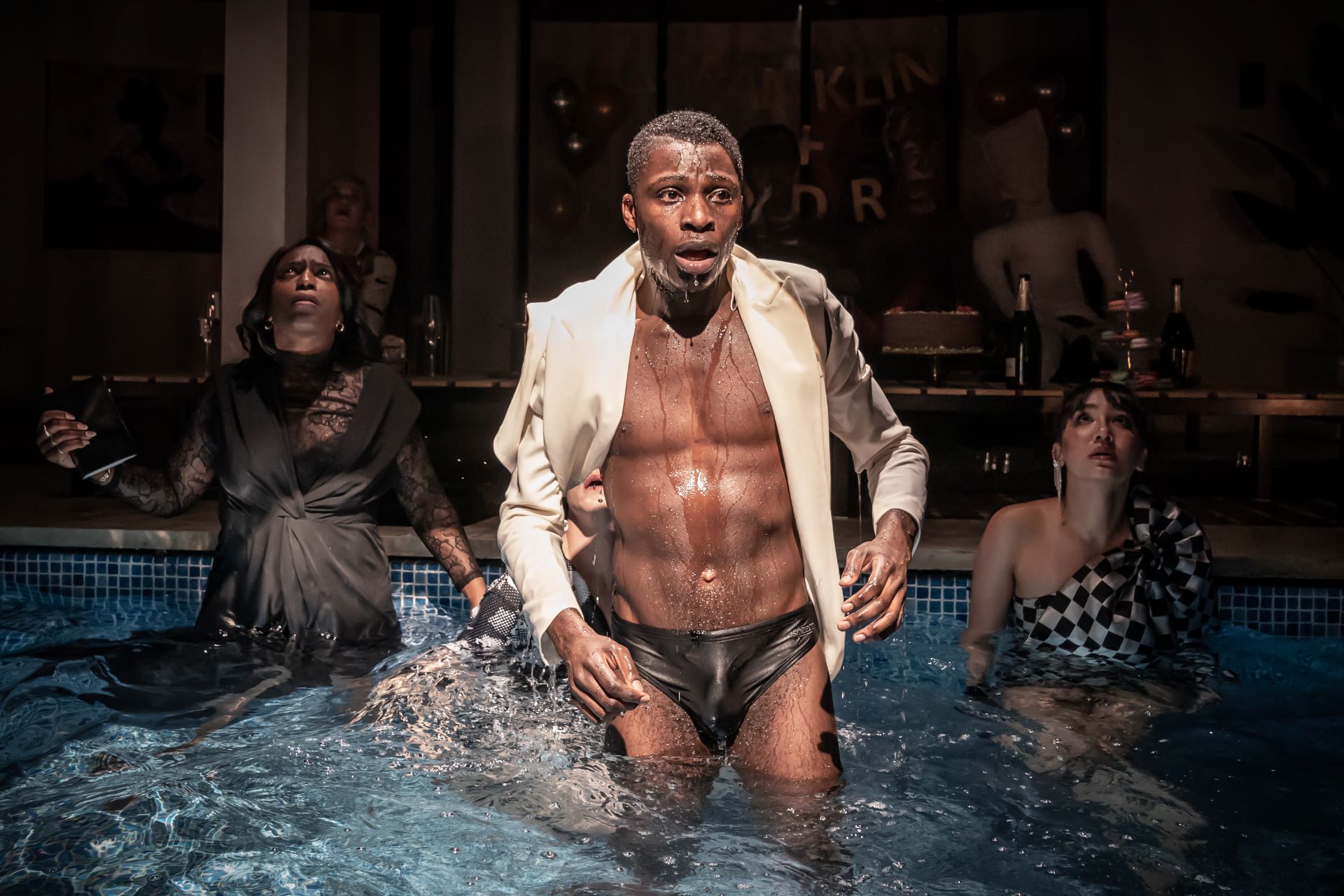 His lead characters are Franklin, a young black artist – not long in Los Angeles, preparing for his first show – and Andre, an older white man whose apparently European origins remain as unspecified as those of his wealth. The action takes place on the terrace of the latter’s luxurious Bel Air villa, a scene that’s infused with a Hockney hedonism, with a formidable collection of contemporary art adorning the living space behind. The sense of plein air California is very nicely realised in Matt Saunders’s design.
There’s an anxious frisson there from the very first touch we witness between the two men as we encounter them in a morning-after moment. As Franklin, Terique Jarrett really does look young, but he's hugely expressive in his facial expressions, catching the changing nuances of the pair's interaction as it develops. Harris is accomplished in telescoping that developing attachment through his first act, with Andre pushing a balance that swings between possession – “Be mine!” he’s soon urging his protégé, offering a support that veers between the paternalism of the title and the control of a “sugar despot” – and interdependence (Franklin learns to manage that balance too, the power working both ways). The Danish actor Claes Bang plays Andre with an assurance that may leave you pondering if the script could have offered him more.
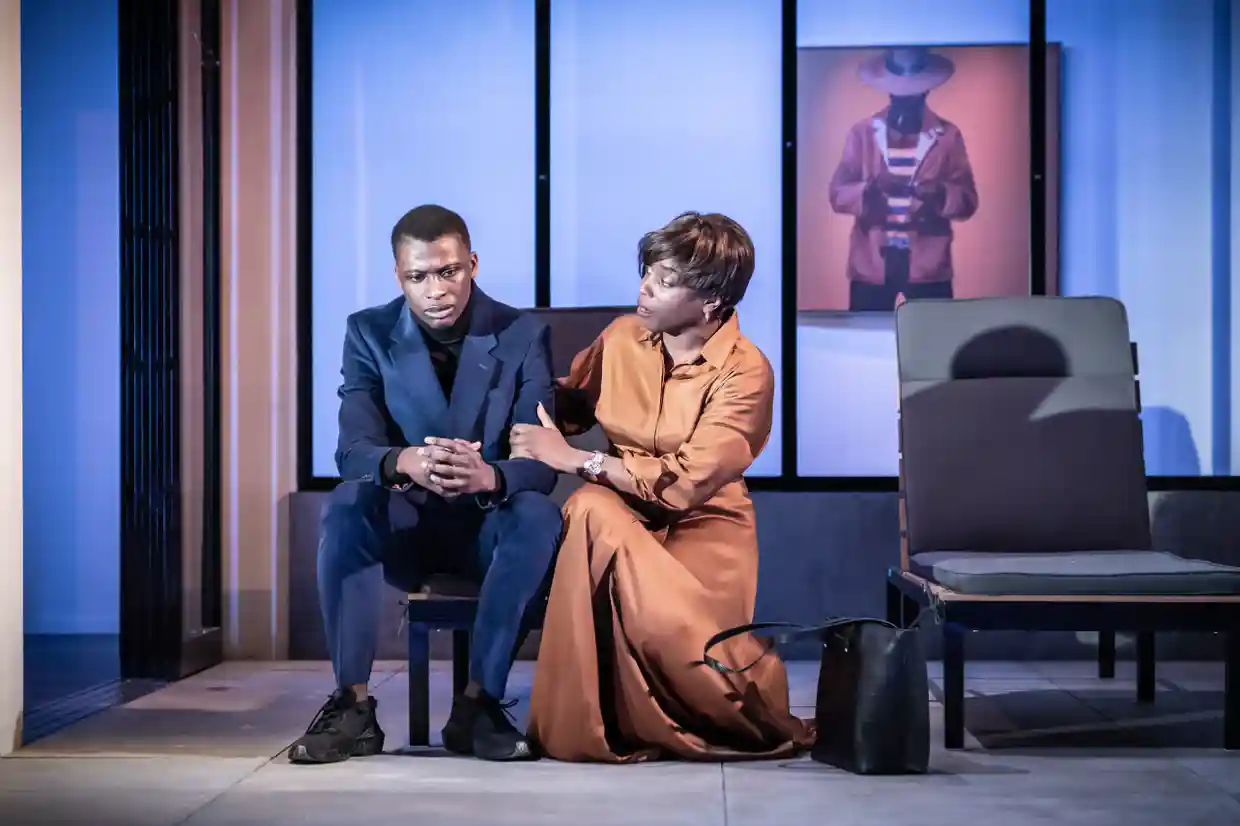 There’s a parallel for their relationship’s element of “possession”, of course, in the art world itself, and ideas about ownership, and how it can change an artwork, ripple intelligently through the play. Despite his youth Franklin shows himself the intellectual equal of his lover/partner – he has the instinct of a natural, whereas Andre’s tastes are as much cultivated by the dealers who must court him. (In a nice touch, the post-interval set shows that the pictures have been rehung, a revision of the collection that must be the younger man’s work.)
The arrival of Franklin’s gallerist (Jenny Rainsford) allows Harris to develop these themes further, as well as hone his satire to heighten the absurdities of this artistic world. It’s a wickedly funny streak that he’s shown earlier when Franklin’s best friends, Bellamy (Ioanna Kimbook) and Max (John McCrea), set up court as poolside loungers. Harris catches their vapidity with devastating acuity, though somehow it's not finally cruel.
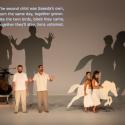
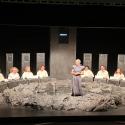
But all this LA surface shallowness needs ballast, and it duly comes in the unforgettable form of Franklin’s mother Zora, who’s first seen linked into the action by 'phone – and linked herself to a trio of gospel singers, a kind of melodic chorus that becomes increasingly involved in proceedings (their stage presence is absolutely winning). Zora’s appearance in the flesh in the second act really raises the temperature: gothically splendid in both voice and attitude, Sharlene Whyte comes close to stealing the show, but her presence fuels "Daddy" with a welcome sense of conflict. Zora and Andre may prove worthy opponents as they stake their respective claims on Franklin, but it turns out that he has much more to face.
As that maelstrom comes on, Taymor exploits the always inventive work from lighting designer Isabella Byrd, as well as Lee Kinney’s sound and composition, to surreal effect (plaudits throughout, too, for movement director Anjali Mehra). Are we caught up in this emotional climax, or does it risk becoming precious? Like the art that hangs on Andre’s walls, it’s a matter of taste. Whatever Harris’s subtitle may proclaim, I came away with a sense that less might have been more. The intensity of that “less” can be caught most of all in the face of Terique Jarrett, who’s a real discovery in this production. His youthful trepidation is indelible in a way that outlasts all the fireworks.