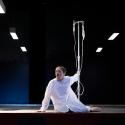
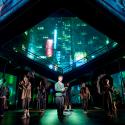
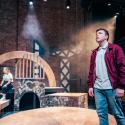
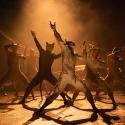
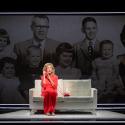
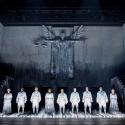
A monolithic slab, like a giant incarnation of a Biblical tablet of stone, dominates Mark Thompson’s set for Jamie Lloyd's production of the third play by Alexi Kaye Campbell. Nothing else is so solid in this big, weighty work, which wrestles with abstract notions of faith, the human soul and the myths and narratives by which we choose to live.
It’s an ambitious piece of writing, and at times Campbell trips over his own verbosity. In an evening of nearly three hours’ duration, carved up by two intervals, it’s difficult not to wish at times that he had more full-bloodedly dramatised his ideas, rather than forcing his characters to sound off about them at length, in dialogue that sometimes feels forced and scenes that are often static. But there is a questing intelligence at work here, and no little wit; and Lloyd’s production does much to hack through and irrigate the drier thickets of polemic.
The first scene takes place in New York, on the morning of September 11. With tragedy about to be perpetrated by terrorists whose faith is so strong that they are prepared to die, and kill, for it, British Sophie (Hayley Atwell) is questioning the beliefs and morality of her American lover, Tom (Kyle Soller). Once an aspiring novelist, Tom now works in advertising – and he’s heading up a major campaign for a drugs company. The snag is that their products have been tested on Ugandan children – an inconvenient fact that careerist Tom is prepared to overlook, to the disgust of the appalled Sophie. As they argue, the ghostly figure of Sophie’s dead father Edward (Ian McDiarmid, picture below), a former Anglican bishop, stands between them – and it is his prompting that drives Sophie’s furious tirade of accusation. She offers Tom an ultimatum: pull out of the campaign, or she heads home. He chooses his job.
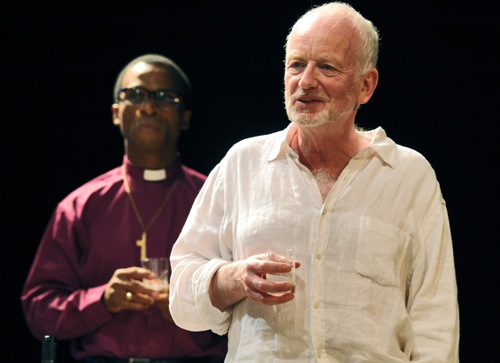 From here, the play shifts back and forth through time, testing the parameters of love and morality in a consumerist society. We see Edward, retired and living in a Greek island holiday home, and explaining in an excoriating confrontation with a Kenyan bishop who has come to attempt to coax him back to work that he cannot remain in a church that is homophobic. We see Sophie and Tom reunited at an English gay wedding: she has hooked up with Sebastian, a bearded Chilean communist; he is engaged to a skinny socialite interior decorator. In a lovely, poetic moment, Lloyd’s production sees the ex-lovers gazing at one another across a room of white and pink balloons, both sozzled on champagne and gently swaying. And we see Edward devastated by multiple strokes, still filled with passion, albeit unfocused, and despairing of being caught between the literalism of fundamentalism and what he sees as the hectoring of atheists who deny the religious the wonderment of their faith.
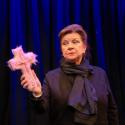
Whether the characters are groping for meaning in their personal relationships, in the political (Sophie’s activism and journalistic work in areas of conflict, Sebastian’s Marxism), in tribalism (Tom repeatedly labels himself as a New Yorker, as if it defined him), or in the pages of literature or the Bible, there is a powerful emphasis on the need to give shape and structure to existence. Lloyd’s production is engagingly acted, with Atwell giving Sophie an obstreperous quality that saves her from sanctimony, Soller brash, tactless, eager and excitable, and McDiarmid a particular pleasure as Edward, a formidable opponent capable of destroying an argument or interrogating a house guest under the guise of a social manner that appears most twinkly just when it is about to become terrifying. There’s a scene-stealing performance, too, from Bronagh Gallagher as Edward’s irascible, sharp-tongued Ukrainian housekeeper – even if her role, as a one-time prostitute who found salvation in the bishop’s home, feels like a schematic contrivance. This is ambitious, thoughtful writing; but amid all the speechifying, its themes cry out for less dogged reliance on the word, and more action.
 Book tickets for The Faith Machine at the Royal Court Theatre until 1 October
 Find Alexi Kaye Campbell on Amazon