There is indeed something of Frankenstein’s monster about the handsome young gardener, with his flat-top haircut and gym-bulked torso, who has come to mow James Whale’s lawn. The retired Hollywood director, now plagued by a series of strokes, is pathologically alert to remembrances of his earlier life, and it’s Whale’s state of mind, rather than the game-changing films he made in 1930s Hollywood (Frankenstein, Bride of Frankenstein, The Man in the Iron Mask), that forms the locus of Russell Labey’s new play.
The material comes from a speculative novel by Christopher Bram, which in turn inspired a 1998 film, with Ian McKellen Oscar-nominated as Whale – a pointed piece of casting given Whale’s sexuality: he was openly gay in an era when Hollywood barely had a name for such a thing. Labey’s play differs from the film in several respects, not least its refusal to present the developing relationship between the failing older man and the buff young groundsman as a romance. This James Whale (a convincingly tetchy and self-pitying Ian Gelder) has long since abandoned hope of consensual fumbling, let alone love.
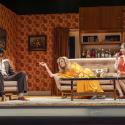
 We first meet him in 1957 as he is importuned by an over-eager film student (a standout debut from Joey Phillips, pictured right with Gelder) wanting to interview him at his home. This expository Q&A is just starting to feel clunky when Whale suddenly demands that the boy remove an item of clothing in payment for each answer. (“I do hope you’re wearing a vest today or we’ll break the bank very soon”.) The excitement of the debagging prompts in the old man what stroke doctors call an ischaemic incident: lights flash, white noise crackles, and Whale is transported to a memory of his first sexual encounter, at an evening school art class in Dudley, the West Midlands, pre-First World War. Such flashbacks, and there are many, are cleverly achieved on Southwark’s three-sided playing space, lit by Mike Robertson. We’re never in doubt what’s going on or who’s who (the accents are a reliable guide), at least not until the second half, when Labey (directing his own play) bizarrely takes it into his head to switch the casting of the younger Whale from Phillips to Will Rastall, who had previously played the friend or lover.
 Meanwhile, back in 1957 (though you sometimes doubt the dialogue’s authenticity – did folks back then say ‘I couldn’t be arsed’?), Gelder's Whale (pictured left) has persuaded the beefcake gardener, Clayton Boone (Will Austin, another newcomer), to pose for his life-drawing sessions. Boone, slow on the uptake, doesn’t clock Whale’s game, and the strip-tease of repeated sittings and Whale's wheedling for him to bare more flesh make these scenes painfully slow. The female perspective is briskly presented by the Spanish housekeeper, Maria (Lachele Carl), whose genuine kindness to the old man is clear, despite her purse-lipped disapproval of his lifestyle.
You emerge from Gods and Monsters with a fair biographical knowledge of James Whale – learning that he was responsible for the long-delayed staging of that First World War gem, Journey’s End, at once endeared him to me – but not much about a gay director’s life during Hollywood’s Golden Era, nor the depressing after-effects of stroke. Jason Denvir’s set design, of walls and floors painted pale and veiny like the surface of a brain, suggest a textual intention that petered out somewhere along the line. At one point, Whale describes the moment he created the iconic look of Frankenstein’s monster in 1933: “a flat-topped head, like a tin of beef”. The idea that we might open the lid, as it were, and peer into the tangle of memories, desires and sensitivities contained within, is appealing. It’s what this play half-achieves.