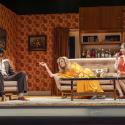
Midway through Hamlet a troupe of actors arrives at Elsinore. Coaching them for his own ends, the prince turns director, delivering an impassioned critique: “O! it offends me to the soul to hear a robustious, periwig-pated fellow tear a passion to tatters…it out-herods Herod: I pray you avoid it.” It’s a philosophy director Robert Icke takes as his own watchword. Out goes declaiming, along with anything demonstrative or self-consciously dramatic, and in its place we get a conversational Hamlet that allows its audience to eavesdrop, forces us to turn voyeur in a contemporary palace of CCTV cameras and hidden microphones.
The effect is brilliantly, dislocatingly fresh. There was a risk that, once freed from the Almeida’s claustrophobic interior into the West End, Icke’s production might lose its uncomfortable intimacy, but instead it merely gains scope in the new contrast between Hildegard Bechtler’s sleek fishbowl of a palace (all sliding doors, hotel lobby-style sofas and chrome accessories) and the wider world that constantly breaks in on television screens that cover the walls. The rot at the heart of the Danish state stinks all the riper for being framed so tastefully – muted visual understatement only broken up by primary coloured flashes of the national flag.
Andrew Scott’s Hamlet who carves such clarity of thought through his soliloquies
But Icke’s updating only starts with design. It’s Shakespeare’s text that gets the biggest makeover in a feat that, whatever your views on the production as a whole, is remarkable for its unerring instincts. This is Shakespeare at length – largely uncut, supplementing the Folio with the Quartos where needed. This isn’t about updating detail or reference (the Emma Rice trick over at the Globe – cut-and-paste contemporary Shakespeare), it’s about finding new inflection in old words, revealing truths that were always there, guiding eye and ear to find new routes through a familiar landscape.
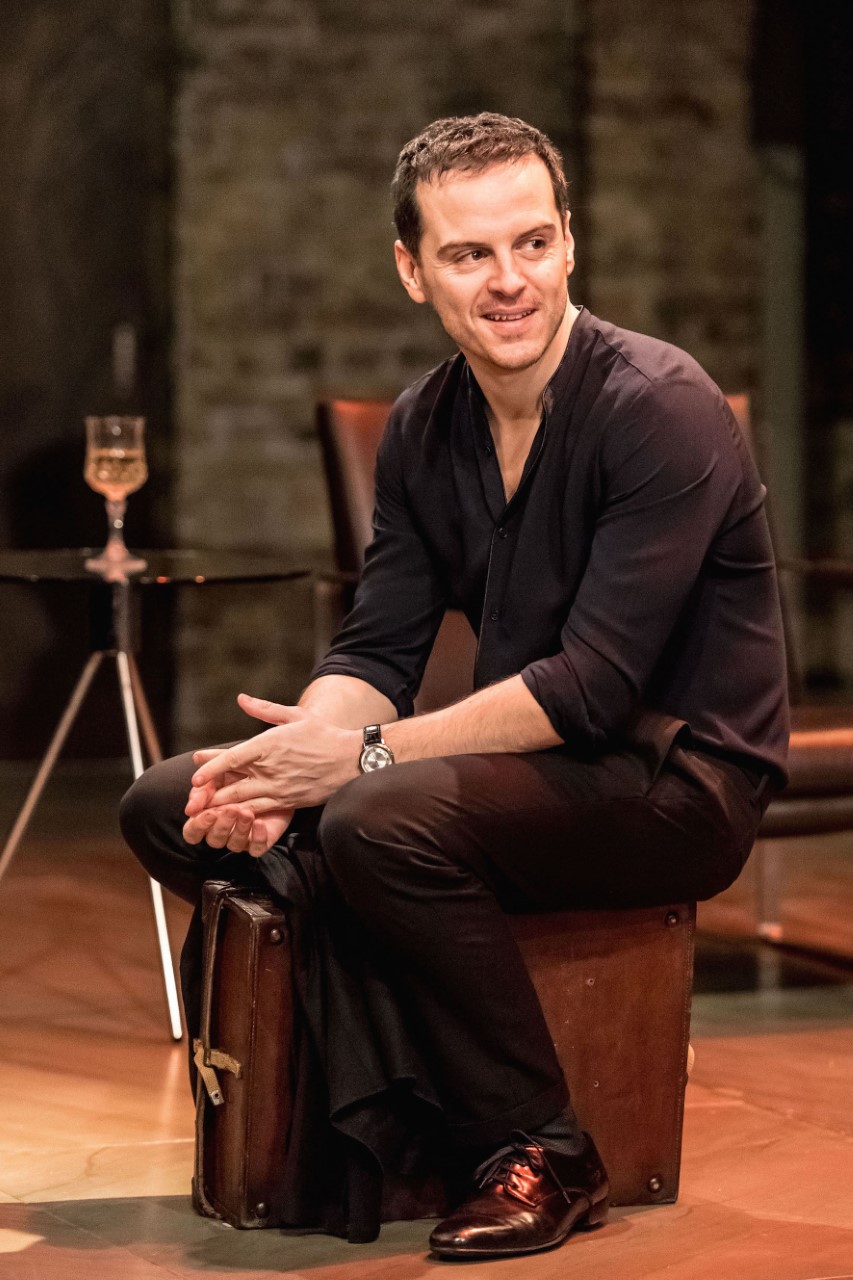 Icke is helped by Andrew Scott’s Hamlet (pictured right) who carves such clarity of thought through his soliloquies, invites us so completely into his play of logic and morality. This Hamlet is no vacillating bore, but a live-wire wit – dry and wryly, self-mockingly funny, puncturing the balloon of his own inflated passions ("Why, what an ass am I?”) long before anyone else can do it. His nervous energy drives the production forwards in erratic bursts of intention, ricocheting off encounters with David Rintoul’s charismatic Ghost/Player King, Peter Wight’s Polonius (a heart-tugging portrait of mental decay) and a tellingly gender-bent Guildenstern (Madeline Appiah).
There are moments of magic: the live-streamed performance of The Mousetrap, video screens projecting the reactions of a court who take their seats in the front row of the theatre itself; the initial encounter with the Ghost – genuinely terrifying; the sexual charge between Angus Wright’s Claudius and Juliet Stevenson’s Gertrude. But there are also some issues.
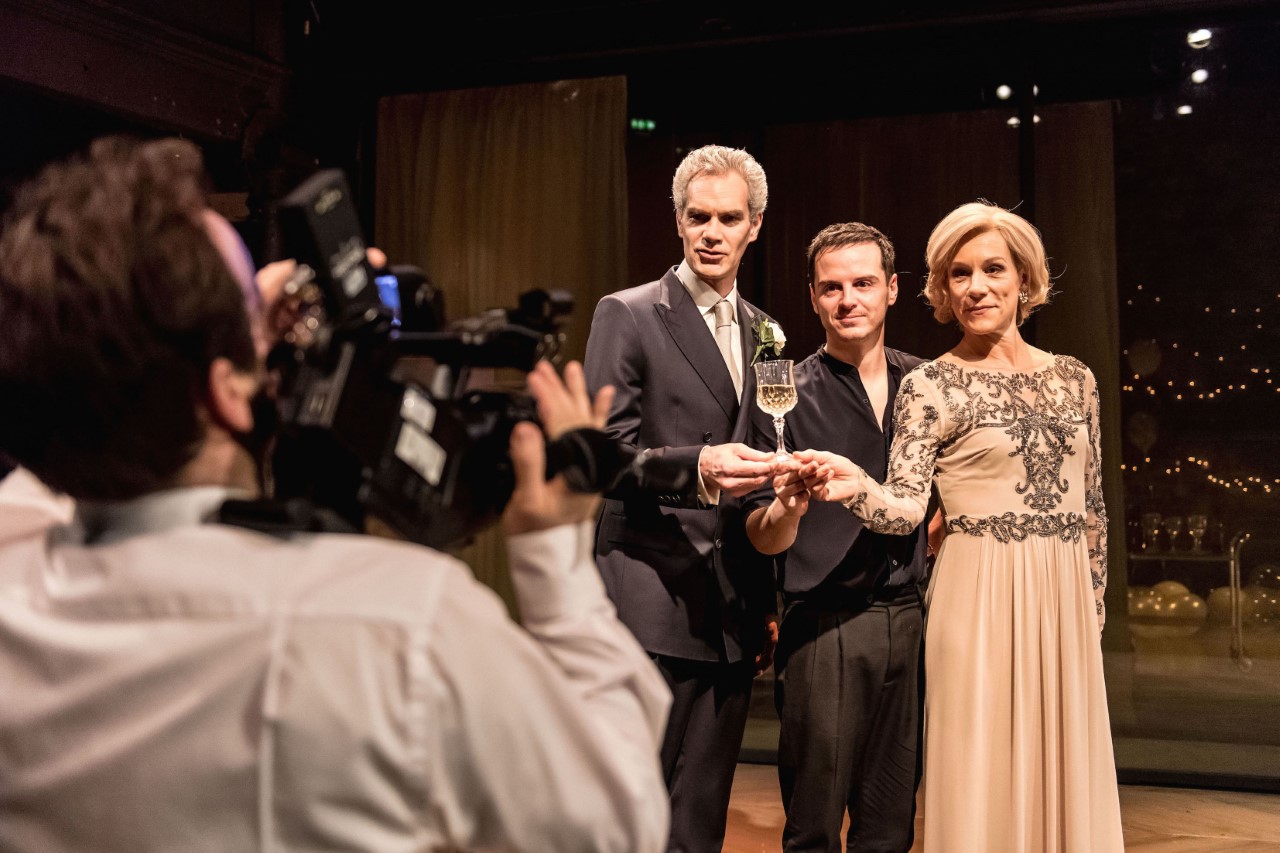
The dumbshow (scored to a Bob Dylan soundtrack) looks like nothing so much as a Building Society advertisement. Would Claudius really confess his sins to Hamlet (and would he, hearing them, really not shoot him on the spot?); would a modern-day Ophelia really accept so much, so quietly from her lover as Jessica Brown Findlay uncomplainingly does? Both she and Stevenson struggle to find their place in this updating, and Icke’s insertion of a dubious Quarto scene between Gertrude (Juliet Stevenson, pictured below with Wight and Scott) and Horatio suggests a recognition (if not a satisfactory solution) of the problem.
 Running at nearly four hours (with an unnecessary second interval breaking the play’s stride just as it should be speeding up), this Hamlet earns every minute of its stage time. Far from a foregone conclusion, the ending reads newly charged as Laertes, softened by Hamlet’s sincerity, has a last-minute change of heart. For one wonderful moment we believe everything could yet be alright, that this will be the bout that ends in a handshake and not a body-count. Those bodies, when they finally come, weigh heavy indeed.
- Hamlet is at the Harold Pinter theatre until 2 September, 2017
- Read more theatre reviews on theartsdesk
Andrius Mamontovas, Globe to Globe. Lithuanian take on the Danish play puts on a frantic disposition
Benedict Cumberbatch, Barbican. Visuals threaten to swamp Shakespeare – and, yes, Sherlock
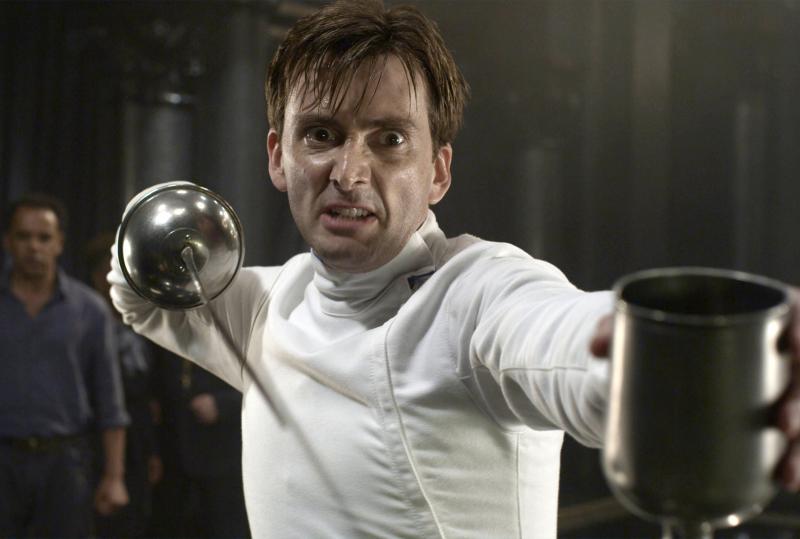 David Tennant, RSC/BBC. Star looks for life in an infinite space beyond the Tardis
Lars Eidinger, Schaubühne Berlin. Acrobatic Hamlet, outshone by the earth and the rain
Maxine Peake, Royal Exchange, Manchester. An underwhelming production, but Peake is gripping as the young Prince
Michael Sheen, Young Vic. Sheen is riveting as the crazed Danish Prince in Ian Rickson's terrifying psychiatric-hospital staging
Rory Kinnear, National Theatre. Kinnear isn’t a romantic Prince, but an unsettled, battling one in Nicholas Hytner's staging which is modern, militaristic and unfussy
Overleaf: Robert Icke's dazzling career so far
 ROBERT ICKE: HIS CAREER SO FAR
Boys. Ella Hickson’s new play is fuelled by testosterone but floats on nuance
Mr Burns. A startling vision of a post-apocalyptic world dominated by The Simpsons
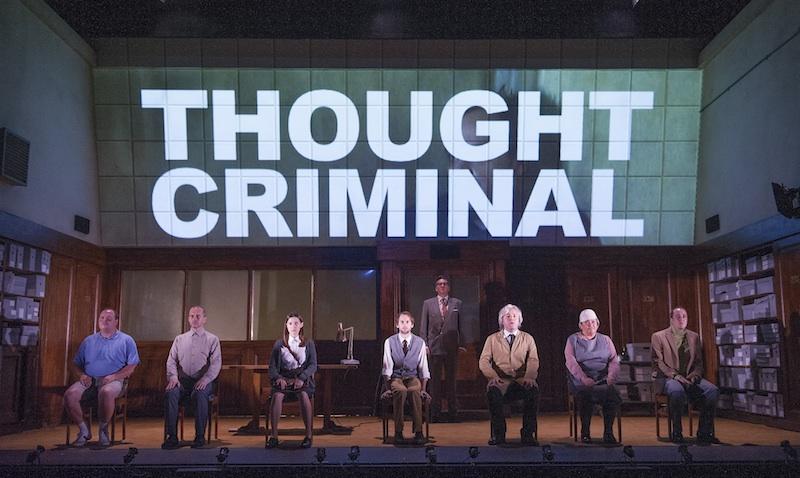
1984 (pictured by Tristram Kenton) Headlong's adaptation of George Orwell's novel is a theatrical coup
Uncle Vanya Icke's lengthy revival/reappraisal is largely a knockout
Oresteia. Lia Williams stands firm on the bones of Aeschylus in uncertain makeover
The Red Barn. David Hare’s latest is a superb adaptation of a Simenon thriller
Mary Stuart. Juliet Stevenson and Lia Williams electrify as four Schiller queens