Harold Brighouse's time-honoured English comedy from a century ago survives, its virtues mostly intact especially once attention shifts away from the snarling patriarch of the title, Henry Horatio Hobson (a padded Martin Shaw), to the generation of women beneath him – his peppery, politically and socially progressive eldest daughter, Maggie (Naomi Frederick), chief among them.
Director Jonathan Church, the former Chichester Festival Theatre chief here doubling as co-producer, does well to release the Lear-like underpinnings of a play, set in 1880 Lancashire, that charts its own portrait of an ailing Salford termagant and his three variably loving daughters. But for all the text's embrace of a liberal worldview some way ahead of its time, the production would be better served by less bluff and bluster from Shaw as the dyspeptic widower of the title, who sows ill will in his foul-tempered, drink-sodden wake.
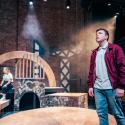
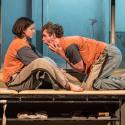
 Hobson is in truth a relatively late arrival to the play that bears his name. The emphasis rests on the crisply no-nonsense Maggie, an "old maid" (not her self-appraisal, 'natch) whom the agreeable Frederick (pictured right with Shaw) plays as a more likeable mixture of Mrs Thatcher and Lady Macbeth in her determination to snag a husband alongside better conditions that might allow his inner entrepreneur to flourish.
And playing the "business idea in the shape of a man" – aka Willie Mossop – who eventually blooms under his wife's prodding, Bryan Dick embodies a new breed of self-made businessman capable of arguing billing in the play's closing passages like a would-be Hollywood agent. (Announced for the summer revival at Chichester of Half A Sixpence, Dick will instead stay with this production through its run.) His fretfulness giving way to newfound assurance, Dick suggests an unformed personage waiting to be made whole – or, as Maggie says in the run-up to their improbable-seeming nuptials: "it's church we're going to, not the dentist's".
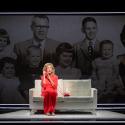
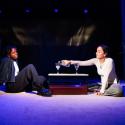
Church catches the social striations both within the family and beyond. Joanna McCallum (pictured below) makes hay of her first-act scene as the customer-grandee who stops by Hobson's boot emporium to sing the praises of the quasi-literate Willie, who has been consigned to working below stairs. Once Willie emerges into the light, so to speak, he faces the disapproval of his own in-laws, younger Hobson sister Alice (Florence Hall) speaking dismissively of Willie's work as a cobbler as compared to the professional classes into which she has married.
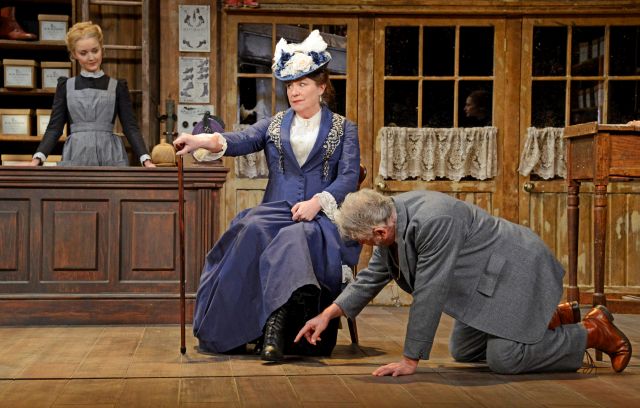 All of which leaves papa Hobson to look on agog at the multiple reversals of fortune in his midst, his stubbornness unwavering in the face of a Scottish doctor (a firm-voiced Ken Drury) who wastes no time telling this "dunderheaded lump of obstinacy" what's what even as he rails against abandonment at the hands of his newly "uppish" daughters.
Tottering about in high dudgeon, Shaw plays the second act in particular with rather too calculating an eye on the exit applause that duly arrives: the performance is pitched to the gallery when we want more of a sense of Hobson's own reckoning with himself and the brave new world in embryo around him. There's a deconstructionist staging of this play lying in wait that would blow its well-made contours apart, until which time audiences can feast on the ever-comforting smell of bacon frying and the appeal of Frederick and Dick as an odd couple whose match turns out to have been made in mercantile heaven.