Science on stage is quite the thing at the moment with a revival of Michael Frayn’s Copenhagen opening at Hampstead Theatre next week and Lifeline, a British musical, injected into Southwark Playhouse for a six-week residency.
It’ll be interesting to track the difference between the reactions of audiences and the critics as too many journalists dismiss anything beyond a bunsen burner or a percentage calculation as a matter reserved for boffins. Being proudly ignorant of such subjects appears to be on the person spec for a job at the BBC, but the explosion of science-based podcasts and YouTube channels shows that such condescension is misplaced. The public at large will engage with proper science, as we’ve pretty much recovered from our Jonathan Van-Tam overload in Covid Times, and we're ready for more.
This new show, if you don’t count Edinburgh, off-off Broadway and even a gig at the United Nations (remember them?) and you really shouldn’t, given the fact that the gestation period for a musical is about the same as four elephants, concerns Sir Alexander Fleming. A taciturn professor in a lab coat may seem an unlikely subject around whom to construct a two hours plus evening of songs, science and sentimentality, but a singing Scotsman called Alexander is still packing out houses around the world, so why not? Perhaps the Nobel Prize winner would smile, as his own discovery of penicillin was as much alchemy as science, and what is theatre making if not a series of experiments in the hope of spinning gold from base metal?
We open in a stadium gig where, guitar in hand, a Scottish folky singer-songwriter is playing “Rose Of No Man’s Land”, a hundred-year-old tune that chokes him up as he dedicates it to his ex. He collapses suddenly, and he’s soon back in London where his cancer is subjected to the full artillery of medical interventions.
That sets off the first of the two plotlines that intertwine through the show. The second starts with a different kind of artillery, as Professor Fleming, 30-odd years on, is still suffering from PTSD and survivor’s guilt from his time in a Boulogne hospital during World War I. He has just lost his wife to boot, so grief only adds to his troubles. He’s closed off, but he’s a decent man, as well as a bona fide genius, and his colleagues rally round as we discover how he has lived up to his promise to save his friends across a glittering fifty 50-year career.
If that sounds as busy a schedule as a resident doctor’s on a Friday night A&E shift at Newcastle General Hospital, it is, but Becky Hope-Palmer’s book and, especially, Robin Hiley’s songs, just about keep all the plates spinning before a sensational coda flooded the house with authenticity and for which I really should have been on my feet. That Hiley had the cojones to write a song called “The Man Behind The Mold” goes to the confidence so critical in overcoming the dread evoked by the fatality rate associated with homegrown musical theatre and its reception on opening night was fully deserved.
The creatives are helped by some of the best singing outside the West End right now (or, I’d venture, even in the West End). Nathan Salstone has a Lewis Capaldi vibe about him and a voice that squeezes plenty of Scottish brogue on top of melodies augmented by pipes and a hint of Proclaimers/Big Country tartan rather than Kenneth McKellar in a kilt. Maz McGinlay plays Doctor Jess Irvine, the childhood sweetheart from whom he drifted as his career took off with a brisk efficiency that crumbles under the emotional strain. She is a superb vocalist, with the kind of feeling in her voice that musical theatre requires and, like many in the cast, she really has no need of the body mics.
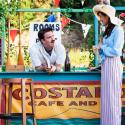
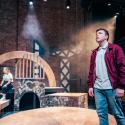
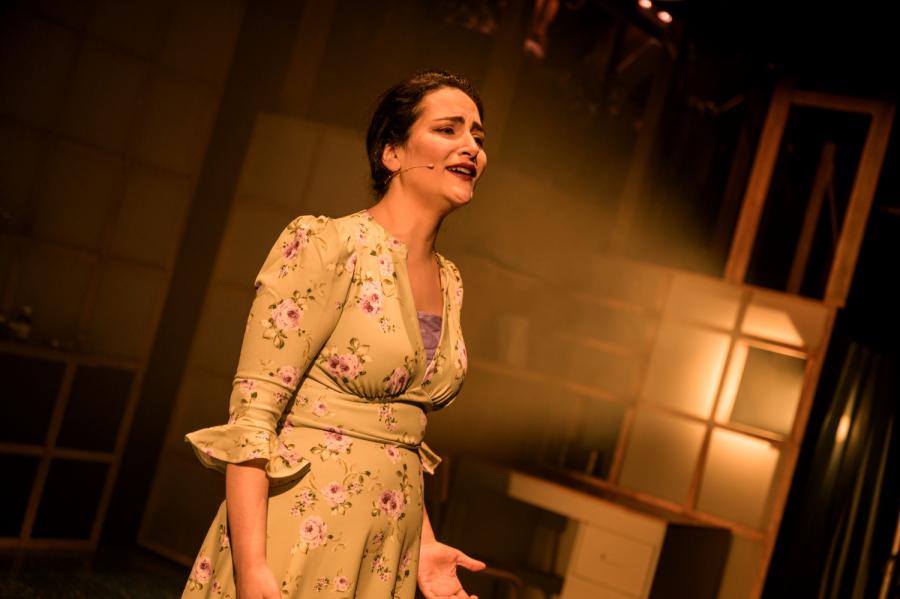
Alan Vicary brings a plaintive dignity to our hero and, if the will he/won’t he romance with fellow scientist, ex-Greek Resistance fighter and high-flying bacteriologist, Amalia Voureka, goes on a bit too long, that’s just more opportunities for Kelly Glyptis (pictured above) to sing. She slightly holds back her soaring operatic soprano as it's big enough for a house ten times larger, but what a voice to hear at such close quarters!
The hardest edge in a show that has a very strong message indeed about the complexities of global medicine’s R&D and its subsequent roll out, is delivered by the underused Robbie Scott with “I’ve Done All That I Can”. It is, in some ways, the counterpoint to Act One’s “Climb On”, a rebuttal of the complacency that allows us (and Big Pharma) to use antibiotics to ease discomfort and increase milk and beef yield for profit rather than reserve them for treating life-threatening diseases. The spectre of bacteria building resistance against Fleming’s silver bullets is a clear and present danger for a world complacently sleepwalking towards potential disaster.
This unusual, thoughtful and deeply committed musical is a welcome (pun unintended) addition to the London stage and, if it hasn’t cured all the health problems of infancy, it’s standing on its own two feet and is healthy enough to run far beyond Elephant and Castle.