There are any number of ways, it's increasingly clear, to approach A Number. Caryl Churchill's astonishingly prismatic and beautiful play about genetic cloning, nature versus nurture and the ineffable mystery of existence as amplified by Shakespeare in a certain well-known tragedy gets its latest London airing this week. To be (happy) or not to be (happy)? That's among the various questions raised in a two-hander (albeit with four characters) that runs less than an hour; any longer than that and your brain just might explode.
Jonathan Munby first directed this play four years ago at the Crucible Studio, Sheffield, and one can imagine that living with it in the intervening years has only multiplied the unexpected resonances of writing that is exhilarating even to encounter on the page. What's clear, too, is that Churchill's text, while undoubtedly exacting to perform, can reverberate to wildly different degrees. Upon first viewing, at a 2002 Royal Court premiere pairing Michael Gambon and an indefinably electrifying Daniel Craig, the play had a scalding power (Stephen Daldry directed that one), while its New York debut several years after, with James Macdonald directing Sam Shepard and Dallas Roberts, was more overtly weird and eccentric, if scarcely less arresting.
This time round marks the tenderest take on a play that is both mournful and ruthless about relations between fathers and sons, as you might expect from a production featuring a real-life father and son. Reprising parts that they played up in Yorkshire, Timothy West is Salter, the paterfamilias of an exponentially ever-expanding clan, with son Samuel on hand as three of his offspring: Bernards 1 and 2 (referred to in the text as B2 and B1 and introduced in that order) and, in the final of the five scenes, Michael Black, a chap who in his agreeable yet also chilling cluelessness comes to embody the unexamined life - and, as the closing exchange illustrates, an utter lack of comprehension of the fact of loss.
Churchill puts parenting on trial, up to a point, a quality to the text that is reinforced by searchlights that sweep the stage during all but one of the scene changes; Oliver Fenwick is the crucial lighting designer here. B2, the first of the sons to appear, reacts balefully to his father's use of the word "things" to describe a cloning process that has apparently gone AWOL and from which Salter is quick to ponder the prospect of financial gain: "We're looking at five million for a start."
Come the second scene and the emergence of B1, five years B2's senior, and we begin to glimpse the secrets and lies by which Salter has lived, which in turn feed a series of childhood reminiscences that themselves exist to be revised as the play goes on. Can these two brothers share the same planet, much less father? That's not to be revealed here beyond a gathering anger and grief that eventually consume all concerned, next to which the apparent easefulness of the final encounter casts its own disquieting chill: surely there's more to life than merely liking blue socks and banana ice cream. (Churchill may be indulging in a bit of the self-referential here, having written a 1989 play entitled - all one word, in her styling of it - Icecream.)
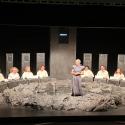
Staged in the round on a set by Paul Wills topped by a forest of test tubes, the play acquires the feeling of a police procedural into scientific malfeasance toppling into familial woe, and it's difficult not to be moved simply by the quiet insistence with which Timothy West's Salter tells one of several anguished sons, "Just wait, because I'm your father" - especially when the person to whom he is speaking is his own flesh and blood. That's a bond that no drama college could ever buy.
West fils isn't able to communicate entirely from within the various selves that Craig managed wearing only jeans and a white T-shirt, but he moves impressively from doubt and rage through to the maddening acceptance of the way we are that Michael, the married maths teacher, introduces into the equation, only to find his equanimity beaten down by dad. A Number may never quite communicate the singular electric force field that it did first time out, but one could nonetheless watch it time and again and be startled by its deceptively unshowy breadth and force anew. It's as if the entire piece were following on from that great Stephen Sondheim number, "Children Will Listen", only to pose the unexpected rebuttal: what then happens if those children in turn have nothing to say?