Ever wondered if there was one moment when in-yer-face theatre started? Well, yes there was; there was one play that kicked off that whole 1990s sensibility, a drama that had a direct influence on Sarah Kane, Mark Ravenhill and Jez Butterworth, and an ongoing inspiration for countless others. That moment was January 1991, and the play was Philip Ridley’s The Pitchfork Disney.
Now revived in the suitably claustrophobic subterranean space of the King’s Head Theatre, the legendary 90-minute real-time story is set in an East End flat where Presley and Haley Stray, 28-year-old “shut in” twins, are confined indoors because of the trauma they suffered over the sudden death of both their parents 10 years previously. Paralysed by agoraphobia, they subsist on a diet of chocolate, tablets and medicine, performing rituals and telling stories to keep their fears at bay and trying to make sense of the world.
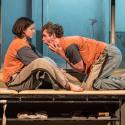
Very strange, but somehow okay. Until, until, until one day Presley spots a beautiful young man vomiting in the street outside. He invites him in. Enter Cosmo Disney, an 18-year-old pub entertainer who eats insects for money and who has a sinister associate called Pitchfork Cavalier. When Cosmo comes into their flat he dazzles Presley with his stories and his verbal finesse. The weird visitor is proud of his beauty, but doesn’t like being touched. Although he expresses disgust with the lifestyle of the twins, Presley is attracted by his personality, even munching a cockroach when Cosmo stages a demonstration. But when Cosmo is attracted to Haley, the trouble begins.
The Pitchfork Disney, whose title refers to Presley’s long monologue in answer to Cosmo’s questions about what happened to their parents, has the hallmarks of what became in-yer-face theatre – intense exploration of extreme mental states through explicit sex and violence – but it’s also a poetic phantasmagoria. Ridley’s writing explodes with a vivid lightshow that embraces pop culture (the names of the characters) and gothic imaginings and apocalyptic dread (the descriptions of the world outside the flat). At the same time, he has plenty to say about everyday nostalgia for childhood, animal agonies and the human need to know about horror. Likewise, the play has a queer sensibility – long before this was common.
Ridley’s vision of the world of the Strays, with its repetitions and rituals, explores a godless universe where sudden catastrophic loss cannot be explained by mainstream religion, but can only be soothed by drugs and incantations. There are images of extreme visceral disgust, such as raisins in chocolate compared to “bits of skin” or a snake being fried alive, or mad love defined as the result of an atomic blast, its victims experiencing a savage fate: “their skin falls off”. Stomach pains are likened to “razor blades in my gut” in a story whose psychological mood is stark fear. The playtext sports an epigraph from Mauritian polymath Malcolm de Chazal: “Extreme terror gives us back the gestures of our childhood.”
With his strikingly visual style of storytelling, Ridley evokes situations, such as the use of insect eating as a seduction, that speak directly to our deepest emotions of attraction, repugnance and unease. The uncanny relationship of Presley and Haley, who spends a large part of the play in a druggy sleep, and the intrusion of Cosmo, whose monstrous associate Pitchfork wears a bondage mask, make this drama a beautifully peculiar outing, suffused with images of sexual longing as well as moments of tension – always balanced by a dark humour. Here a serial killer can make you smile. Like a fairground ride, once it starts, it’s impossible to jump off.
In its quieter moments, when naturalistic exchanges take over from the more sparkling image arias beloved by the characters, you can count and recite the litany of fears that streak through the play: of nuclear annihilation, of invasive strangers, of uncontrollable emotions, of being lost, of toxic waste, of bodily decay, of physical assault, of foreigners, of mob violence and of cruelty to animals. Given that both the twins are virgins, there is also the fear of sex, of being thought gay, even of falling in love. Given that Pitchfork was the surname of the notorious 1980s serial killer Colin Pitchfork, there’s also fear of torture and murder.
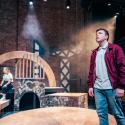
This revival, directed by Max Harrison and designed by Kit Hinchcliffe of Lidless Theatre, who have also staged Ridley’s Moonfleece and Tender Napalm, is a terrific ride, blazing with energy and emotional conviction – one of the very best I’ve ever seen. They create a atmosphere of disturbed normality and passionate perversion, which highlight aspects of the show, such as the Catholic upbringing of the Strays, which I hadn’t noticed before. Much of this is down to a brilliant young cast, who throw themselves into the story with enormous vigour and commitment.
Ned Costello’s Presley and Elizabeth Connick’s Haley are completely convincing as siblings who bicker but are bound together for ever by past trauma. Their exchanges flash across the stage. Her performance of the maddened dogs monologue is thrilling in its energy as she dashes around the stage, filling it with the playwright’s imaginative storytelling, while Presley’s long Pitchfork Disney monologue is perfectly compelling. William Robinson lends Cosmo a kind of Aryan imperiousness, with glimpses of vulnerability occasionally peeking out. His emphatic interactions with Presley feel gloriously alive and build the tension that prepares us for the disturbing entrance of Matt Yulish’s terrifying Pitchfork. By the end, brutality rubs up against beauty in a production that is hot, hot, hot. Long live Ridley’s dark magic.