Mark Haddon is rather making a habit of writing about mental-health issues. His novel The Curious Incident of the Dog in the Night-time was about a boy with Asperger’s and his TV drama Coming Down the Mountain had a character with Down’s syndrome. He charts similar territory with Polar Bears, which also features a character with a mental-health disorder.
The play begins with philosophy teacher John (Richard Coyle) telling Sandy (Paul Hilton) that he has killed Kay (Jodhi May), his wife and Sandy’s sister, who is an emerging artist. John has found living with someone with mental health problems just too much to bear, even though he once said to Kay, “And I promise. I will carry on loving you when the lights go out. I will.”
Haddon then describes events leading up to Kay’s death with several time jumps and much dark humour. Kay, we are told, regularly spends time in hospital and during one spell she befriends “Jesus”. Did he ever get depression? she asks. “Well, the crucifixion thing wasn’t good,” he deadpans. We learn that Kay’s father hanged himself and her grandfather spent his last years in an asylum. We learn, too, that Sandy, now a smooth-talking businessman, cruelly made Kay re-enact their father’s death - complete with noose - when they were children and that her mother, Margaret (understandably, you may think), wanted to keep Kay close to her. Is she, in Alcoholics Anonymous-speak, an enabler to her daughter's illness, or is she her only protector until John comes along and woos her with tales of his hero Nietzsche and encouragement of her artistic talents? Is Kay doomed to suicide, and what was that throwaway line early on about John’s college job?
Thus the questions - and there are many - begin in Haddon’s devilishly clever thriller-cum-psychological drama; it’s only 90 minutes long but I guarantee you will be discussing it even longer after. Because about three-quarters of the way through the play suddenly lurches into another gear and one’s perceptions of what is going on onstage are completely thrown.
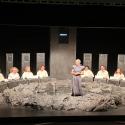
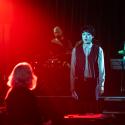
The performances are superb, and May and Coyle’s are beautifully measured, while Hilton expertly treads a fine line between suavity and coldness. Celia Imrie as Margaret does well in a perhaps too opaque role and she’s given the odd duff line, at one point delivered from a high gantry on Soutra Gilmour’s strikingly stark set. Ben and Max Ringham’s soundscape adds to the tension admirably in Jamie Lloyd’s astute production.
Some may find Haddon’s stage debut too tricksy by half, or even incomprehensible but, from what he has said in recent interviews, I suspect he would positively welcome the latter response. But I think he makes a subtle case for treating people as individuals, not named disorders, and his riveting play shows that mental-health problems are rarely straightforward.
Haddon then describes events leading up to Kay’s death with several time jumps and much dark humour. Kay, we are told, regularly spends time in hospital and during one spell she befriends “Jesus”. Did he ever get depression? she asks. “Well, the crucifixion thing wasn’t good,” he deadpans. We learn that Kay’s father hanged himself and her grandfather spent his last years in an asylum. We learn, too, that Sandy, now a smooth-talking businessman, cruelly made Kay re-enact their father’s death - complete with noose - when they were children and that her mother, Margaret (understandably, you may think), wanted to keep Kay close to her. Is she, in Alcoholics Anonymous-speak, an enabler to her daughter's illness, or is she her only protector until John comes along and woos her with tales of his hero Nietzsche and encouragement of her artistic talents? Is Kay doomed to suicide, and what was that throwaway line early on about John’s college job?
Thus the questions - and there are many - begin in Haddon’s devilishly clever thriller-cum-psychological drama; it’s only 90 minutes long but I guarantee you will be discussing it even longer after. Because about three-quarters of the way through the play suddenly lurches into another gear and one’s perceptions of what is going on onstage are completely thrown.
The performances are superb, and May and Coyle’s are beautifully measured, while Hilton expertly treads a fine line between suavity and coldness. Celia Imrie as Margaret does well in a perhaps too opaque role and she’s given the odd duff line, at one point delivered from a high gantry on Soutra Gilmour’s strikingly stark set. Ben and Max Ringham’s soundscape adds to the tension admirably in Jamie Lloyd’s astute production.
Some may find Haddon’s stage debut too tricksy by half, or even incomprehensible but, from what he has said in recent interviews, I suspect he would positively welcome the latter response. But I think he makes a subtle case for treating people as individuals, not named disorders, and his riveting play shows that mental-health problems are rarely straightforward.
- Polar Bears is at Donmar Warehouse, London WC2 until 22 May
- Check out what's on at the Donmar Warehouse
- Find Mark Haddon on Amazon