Why is it so hard to write a decent play about Bach? Maybe, in part, because there are no words that can express anything as eloquently as his music did – about life and death, pain and transcendence, wretchedness or rapture at the simplest aspects of existence. So much of what he represented was distilled into that music – and what we are left with biographically is the workaholism, the curmudgeonliness, the rows with figures of authority.
Nina Raine wrestled with this only semi-successfully in her 2021 play, Bach & Sons, and now Oliver Cotton has taken on the challenge by focusing on Bach’s ultimate showdown with authority when he met the bombastic Prussian King Frederick II.
Trevor Nunn’s production arrives in the West End following a successful run at the Theatre Royal Bath, not least due to the cantankerous charisma of Brian Cox – known to millions as Succession’s Logan Roy. Some would argue that Succession owed at least part of its success to the theme tune’s flagrant adoption of a theme from Beethoven’s Pathétique Sonata, so it’s a nice connection that Cox here plays Beethoven’s hero Bach. Where, as Roy, he embodied ruthless omnipotence, here as Bach, he finds himself speaking truth to power. Frederick is the employer of his son, Carl Philip Emanuel, but he has also invaded Leipzig as part of the Austrian War of Succession and Bach is consumed by rage at the accompanying atrocities.
The Score is a curious beast of a play – part comedy of manners, part Blackadder-style history, part impassioned rhetoric against the abuse of power. The higher the emotional stakes, the more compelling Cox is in his disgruntled disdain for Frederick’s gilded tyranny, but the rest of the play just doesn’t hold together. In the opening scene we see him with his second wife Anna (played with grit and charm by his real-life wife Nicole Ansari-Cox), as they deal with the disruption caused to their daily routine by boorish Prussian soldiers. We feel the different pressures piling up – not least since one of their children is seriously ill – yet suddenly the action moves from this moving domestic scene to deposit us in the foppish milieu of Frederick’s court at Potsdam.
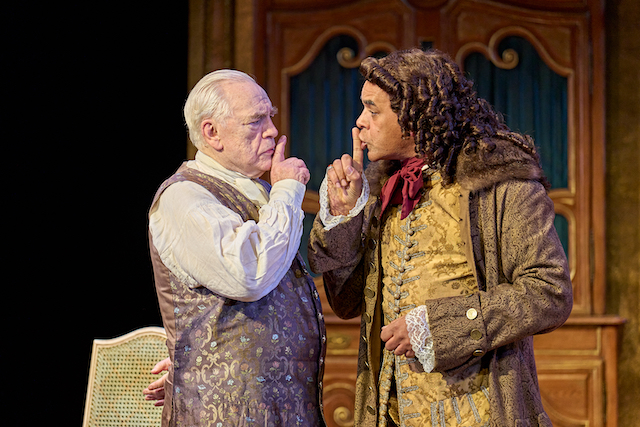 Quickly we realise we have gone from nuance and understatement to a world of scabrous humour and ridiculous breeches. It’s not an impossible shift to manage, but the three competitive composers we encounter – Quantz, Benda and Graun – are as two dimensional as a piece of manuscript paper. Bach, we realise, faces a double challenge: to refrain from denouncing Frederick about his war, and to improvise a three-part fugue based on the ludicrous chromaticised theme that Frederick has composed. Jamie Wilkes puts in an empathetic performance as Bach’s son, yet while the stakes are high the outcomes are also predictable, and the depiction of the court’s artifice doesn’t have enough sinister undercurrents to make us feel the risks Bach is negotiating.
It’s frustrating because the real-life encounter resulted in Bach’s anthology The Musical Offering. So it represents a fascinating moment in musical history, and it’s not hard to see why Cotton chose to dramatise it. The politics of Bach’s conscientious objection to Frederick’s war also resonates strongly today. Towards the end Frederick (played with steel and frivolity by Stephen Hagan) delivers a speech that evokes the rhetoric of contemporary populist tyrants; both this and Bach’s thunderous response (brilliantly delivered by Cox) had the audience riveted.
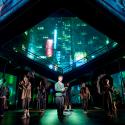
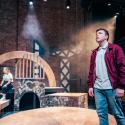
Yet it’s too little too late. Peter de Jersey’s woefully underdrawn Voltaire (pictured above) – reduced from philosophical complexity to vapid witticisms – exemplifies the missed opportunity to create a rich drama from this intriguing scenario. The musical interludes by Bach – including the Italian Concerto and the first movement of the Double Violin Concerto – remind us why we’re all there. But though The Score occasionally flares enjoyably to life, as we enter Lent season you’d be better off seeking out one of the many Bach Passion performances to get a sense of the man it depicts.