One of the Finborough Theatre’s Artistic Director, Neil McPherson’s, gifts is an uncanny ability to find long-forgotten plays that work, right here, right now. He’s struck gold again with The Silver Cord, presenting its first London production for over 95 years.
Carla Joy Evans’ beautifully observed costumes set the tone. The styling is just so for upper middle class New England in the 1920s, a touch of Paris (Paul Poiret gets a namecheck), a cloche hat and shoes to die for darling. Once I stopped ogling the cloth (the weight of which reflects the personalities wearing it) and the cuts, Alex Marker’s set oozes into your consciousness: the paintings of mother and child, tacky but pricey; the claustrophobic lack of windows, all shut; the drawing room as prison cell. We’re in it too, director Joe Harmton staging the play in the round, our backs to the wall in more senses than one. For some mums and dads (maybe some sons and daughters too) it can be an uncomfortable watch. If you haven’t felt yourself edging towards helicopter-parenting, you’ve definitely seen it in others. A low-level anxiety can oscillate between worrying about doing too little for our kids and worrying about doing too much. Understandable over-investment can bleed into neurosis but, in Sidney Howard’s black comedy, it’s spiralled all the way to psychosis.
The play succeeds or fails on the performance of its protagonist, the appalling Mrs Phelps, widow, matriarch and narcissist. Sophie Ward (pictured below) walks a tightrope for over two hours during which one false step would bring the whole thing down. Too self-pitying and we lose the crucial sympathy that comes from the knowledge that this is a damaged woman; too arch and pantomime dames would intrude on our thoughts; too self-aware and the humour would lose its Chekhovian bite. It really is a masterpiece of up-close acting marrying the stage’s demand to command a physical space with the screen’s requirement to convey meaning with a mere narrowing of the eyes or twitch of the cheek.
The support cast do well to keep up as you really can’t keep your eyes off Ms Ward. George Watkins (David, pictured above with Alix Dunmore) and Dario Coates (Robert) convince as the double act of the adored, controlled sons, one tall and initially full of bravado, the other shorter, weaker, even more pitiful if it were possible.
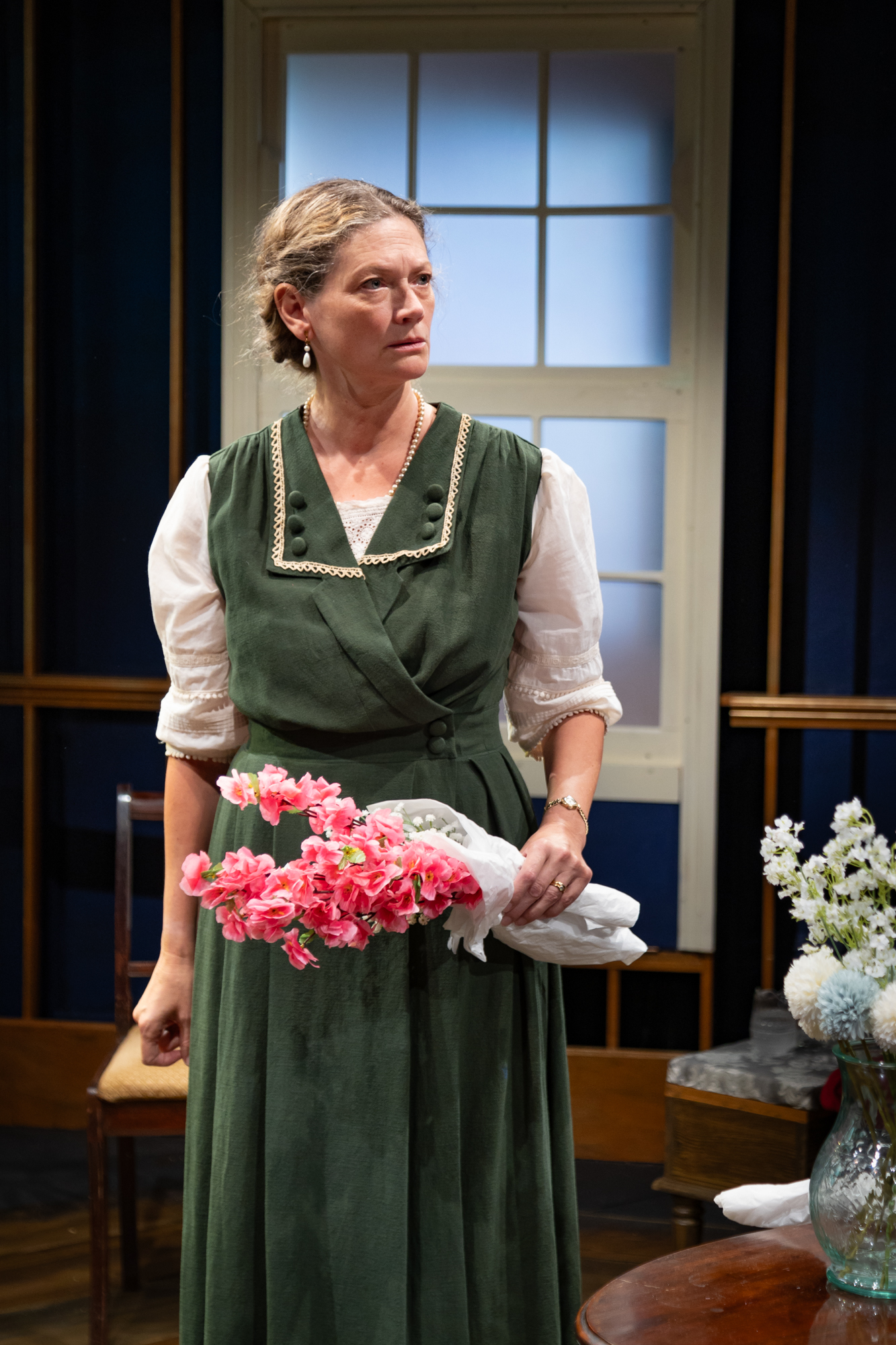 Their women travel much further than the men, not being hamstrung by the imposition of arrested development. Jemma Carlton, all pixieish energy and Noo Yawk accent is winning as Hester, the kid who is engaged to Robert and who is crushed by Mrs Phelps’ cruel manipulation of her fiance.
Alix Dunmore carries the moral of the play as David’s wife, Christina, a research scientist who is the antithesis of everything Mrs Phelps’ holds dear. She is a woman of the 2020s, never mind the 1920s, polite, worldly and resilient. She gets the big set-piece speech at the end when she stakes her life on a confrontation - though she would equally be staking her life on not having a confrontation too.
There is a hole in the play, at least for a 21st century audience. How could these women ever have fallen for these men? Hester may have been attracted by the money, but the 1920s were an eligible girl’s market even in the USA. But Christina? We hear that she turned David down three times, but she can’t have been short of suitors, even in her late 20s. I mean, she could have had me…
The other flaw in the play is its pacing and elements of repetition, possibly betraying the fact that Mrs Phelps would have been a much more shocking and surprising figure a century or so in the past. There’s certainly room to knock out some of her lines which will ease a slightly over-extended runtime too.
So Narcissistic Personality Disorder right in our faces? Not a pretty sight, but the last ten years or so has seen this mental state move out the the history books and showbiz stereotyping and occupy places at the heart of public life, in the highest offices of some of the world’s great democracies, unhidden, unabashed and, for many, uncondemned.
Who you really see when you see Mrs Phelps will depend on your own experiences, your own politics, your own values, but you will see someone. Which is why this play is no museum piece, but an essential lesson in a world in which we (and our own children) cannot be Davids and Roberts rendered sterile, cowed, unhappy. Be more Christina...