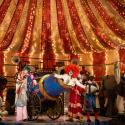
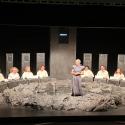
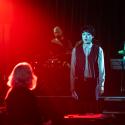
How many times can a director re-work the same show and still come up with something fresh, gripping and memorable? This is James Brining’s third version of Sondheim’s killer thriller musical Sweeney Todd. He produced an award-winning version in 2010 at Dundee Rep. He turned to it again last month for his first production since becoming artistic director at West Yorkshire Playhouse. Now, he has re-worked it for the in-the-round confines of the Royal Exchange, initiating a trans-Pennine collaboration between the two theatres. And he is scheduled to deliver a fourth version in 2015 in a co-production with Welsh National Opera.
If you’re onto a winner, why not work on a successful formula? One can understand the challenge of fitting essentially the same show into a different space, especially like this one, where the absence of space below stage immediately takes out a barber’s chair which tips victims into the meat cellar. That problem is solved with ingenuity – the chair (actually, they use three) runs on a track and delivers the victims directly to the bakehouse.
Birrell captures the suppressed vengefulness of the demon barber and his progression to routine killing
Brining has also taken the risk of shifting the setting from the original mid-19th century underbelly of Dickensian society to the Thatcher era. The idea is that in our own time we have witnessed the powerless poor being put upon by the powerful rich. So he has moved it on half a century from Jonathan Kent’s greatly acclaimed Chichester version. But, really, why bother? After all, Sondheim pitched his tent, as the poet says, in the place of excrement – and produced a musical and dramatic masterpiece. The time shift throws up some anachronisms, such as Todd having been deported to Australia for 15 years before his vengeful return. And you lose something of the Victorian Gothic. But this is such a powerful and compelling production, with a sure narrative drive, that none of that seems to matter.
We still get the bloodletting story, the self-justified psychopathic murders, the juicy meat pies for unwitting cannibals and, of course, the score and lyrics full of invention and wit, heartbreak and dark humour. Also, set in our own times, the everyday throat-slitting seems extra-chilling. This was the time when Peter Sutcliffe, the Yorkshire Ripper, was gruesomely active not far from this very theatre.
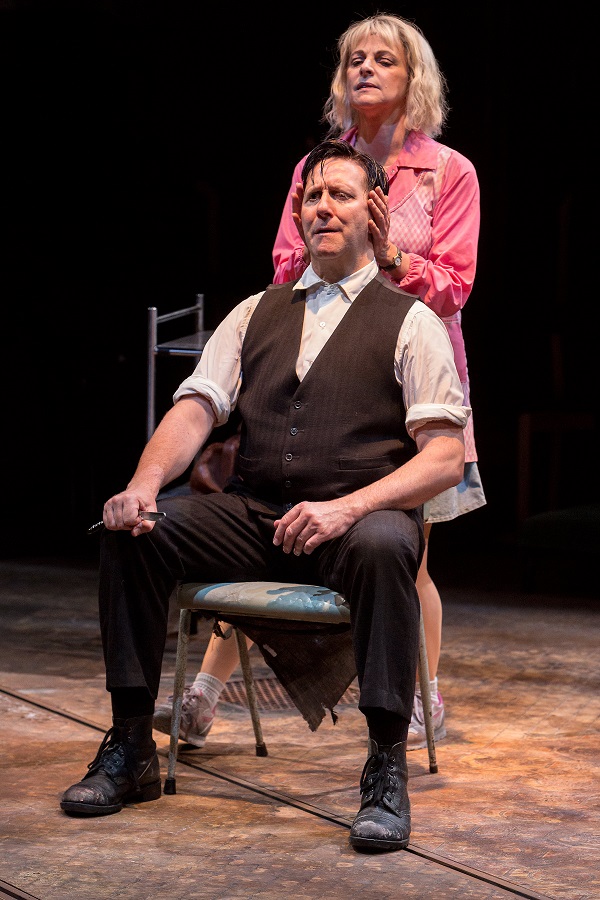 It starts bleakly in a sparsely furnished institution for the mentally deranged, peopled by distracted inmates. One almost expects to see Jack Nicholson emerging from One Flew Over the Cuckoo’s Nest to play a leering Sweeney. David Birrell has the appearance of an ordinary rather than demonic barber. And Mrs Lovett (Gillian Bevan, pictured right with Birrell), appropriately entrepreneurial, even sports an electric fly-catcher in her greasy spoon. Well, you don’t want your pies contaminated, do you? Production line in place, he smartens up and her caff gets a neon sign and coloured lights.
The 15-strong cast, backed by a lively seven-piece band brilliantly directed by George Dyer from the keyboard, turn in exhilarating and characterful performances. At the centre of it all are Birrell and Bevan. He captures the suppressed vengefulness of the demon barber and his progression to routine killing. She urges him on like Lady Macbeth in an apron. And they can both sing. Their song of the pies, darkly funny and saucy, is one of the highlights. The ensemble acting and singing are outstanding. Impressive individual performances come from Don Gallagher as Judge Turpin, who tries to assuage his desire for his ward, Joanna, through prayer and painful-looking self-flagellation. Niamh Perry makes a fetching Joanna, splendidly partnered by Michael Peavoy’s Anthony. Sebastian Torkia as Pirelli, entering in an illuminated Del Boy three-wheeler, provides a comic highpoint in his shaving and tooth-extracting competition with Todd. But this is a spellbinding ensemble achievement.
- Sweeney Todd at the Royal Exchange until 30 November