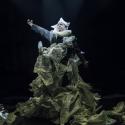
Playwright David Hare is on a West End roll. Not only is his new play, Grace Pervades, about super thespians Henry Irving and Ellen Terry, making its way from Bath’s Theatre Royal to the Theatre Royal Haymarket next month, but his 1976 play with songs, Teeth ’N’ Smiles, now arrives at the Duke of York’s. Both are star-laden accounts of performance, with Ralph Fiennes and Miranda Raison as the Victorians, and Rebecca Lucy Taylor as Maggie the 1970s rocker. Also known as Self Esteem, she’s an Ivor-Novello Award winner last seen as Sally Bowles in Cabaret a couple of years ago. She also contributes some of the show’s music.
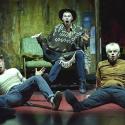
First staged at the Royal Court, where it starred Helen Mirren, the action takes place at the May Ball, Jesus College Cambridge, in 1969. Booked to play all night, The Skins are fronted by their singer Maggie Frisby (Taylor), a feisty Northerner who’s permanently drunk, while the musicians Inch, Wilson, Smegs, Nash and Peyote, are all more or less stoned. As they get ready, and then thrash out some banging rock, the story explores Maggie’s relationship with songwriter Arthur, her former lover who is now tangled up with Laura, Maggie’s childhood friend. Of course, the gig goes wrong, with Maggie behaving like a cut-price Janis Joplin or – since such things rarely change – Amy Winehouse. But can the arrival of cockney band manager Saraffian save the day?
If you think it won’t, you’re probably right, but before we get to the end of the night, which not only features the band playing live, but also some literally incendiary moments. With everyone off their heads on various drugs and drinks, there are some amusing games – such as find the most boring fact – as well as interactions with the college porter Snead and medical student Anson, who wants to interview Maggie and frets about the band being late on stage. When Saraffian arrives, he’s accompanied by Randolph, his latest protégé. In keeping with the spirit of the mid-1970s, most of the characters get a chance to articulate their ideas about the meaning of life. Yes, it is definitely Monty Pythonish.
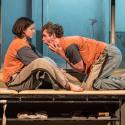
Maggie’s tale is the most vividly represented. A former junkie who now only drinks whisky, her traumatised life is expressed through both substance abuse and compulsive sex. But when Saraffian says that addiction is “something to blame”, Maggie refuses to admit she needs “an excuse”, instead arguing that “there’s something in me that won’t lie down”. This deep emotional pulse, born of pain and in pain expressed, makes her a great singer, but also a very vulnerable person. As a defence, she treats everyone badly, even her bestie Laura, and rejects Arthur, who clearly can’t live with her, can’t live without her. Hare’s Maggie is both luridly singular and a metaphor for all women attracted to, and then caught in, the music biz. Sad, sad case.
In this production, Taylor’s Maggie simply smashes it, often literally. As a singer she is compelling, and her acting perfectly conveys the singer’s troubled, but irrepressible character. Her passionate downs as well as her ups. Thrown around by the patriarchy, she gets up with a snarl every time. And the songs, originally written by Nick and Tony Bicât, with a new one by Taylor, who also adds some lyrics to another number, are exciting enough for Theatreland foot-tapping and head-nodding. My favourites are “Don’t Let the Bastards Come Near You” and the titanic “Last Orders”, but the most deeply heartfelt is Taylor’s “Maggie’s Song”. Clearly, she is living the part, using it to express her own negative experiences in today’s music industry. Her stage presence is so forceful because the role is, in her words, “autobiographical, almost”.
If it’s Maggie that dominates the play, both sartorially as well as emotionally, it is also worth looking at the character of Arthur, although by comparison he is less well fleshed out. As the rather sincere song writer, and spokesman of the subculture the youngsters represent, he is quite symbolic, a metaphor for the radicalism of the 1968 generation, a man whose fiery revolt is already beginning to wane. As he says, they’re all “rolling down the highway into middle age. Complacency.” Writing in the mid-1970s Hare realised that the utopian hopes of political revolution following the Paris May Days, and of hippie alternative lifestyles, was already on the way out: as Maggie says, “The acid dream is over – lezzava good time.”
In this play, rock music both expresses the anger of youth and diverts it away from politics into hedonism. As with most plays about rock, the purpose of popular music is questioned: are the American blues the authentic expression of rebellion under oppression, and is white rock music just a rip off? A way of making money from addled audiences? Or does it articulate the new revolt of 1960s youth? Sadly, these ideas are mentioned, only to be dropped – they remain unexplored. We are left with Saraffian, a rather sleezy manipulator who always has an eye on profit, and offers a good contrast to the idealism of some of the kids.
As you’d expect from a state-of-the nation playwright, Teeth ’N’ Smiles is also a drama about England, with themes of class antagonism as the proto-punk band members cast satirical glances at the privileged students they are entertaining. Like so many plays from this era, such as Hare’s Plenty and Trevor Griffiths’s Comedians, the shadow of the second world war is never far away. As Saraffian tells an anecdote about class hatred during the Blitz, the metaphor of Britain as an island sinking into nostalgia and despair is clear, and further emphasised by the words of the band’s last song: “Last orders on the Titanic.” The ship is sinking, time is running out. Some things, some sensations, remain relevant, even after 50 years.
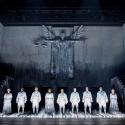
It has to be said that, in many respects, this is not a very good play. The plotting is weak: the love triangle of Maggie, Arthur and Laura blazes at one point, but is never really central, and overall the action is messy, even when laughs are plentiful. The plot point about Maggie’s bag of drugs feels quite random, even if it supports the criticism of the way men treat women in the wonderful world of rock ’n’ roll. But despite the anarchic energy, and the flashes of metaphorical resonance, there is no sense of emotional grip or deep thinking. Still, director Daniel Raggett and designer Chloe Lamford present this piece of period gig theatre with enormous vigour, with the songs coming over as thrilling, touching and funny, some stomping through your whole body, others tickling your thoughts and feelings. Ben and Max Ringham’s sound is superb.
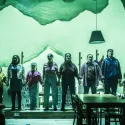
As well as Taylor, whose performance is the main draw, the cast includes Phil Daniels as Saraffian, more cockney charmer than sinister spider, Michael Fox’s sensitive Arthur, Roman Asde’s gawky Anson and Jojo Macari’s spectacularly druggy Peyote. The rest of the band, namely Noah Weatherby (Inch), Michael Abubakar (Wilson), Bill Caple (Nash) and Samuel Jordan (Smegs), have too few lines to create distinctive individuals, but they banter and play well as a group. Similarly, Aysha Kala struggles to make the underwritten Laura memorable. Yet whatever the imperfections of the writing, this hippie history play is a super vehicle for Taylor – she’s its shining heart.