There is nothing quite so exciting as witnessing the debut of a fresh new voice. But young writers can be rather frail creatures, and their exposure in the high-profile Royal Court Young Writers Festival might sometimes highlight their failings as much as their virtues. In actor Hayley Squires’s first play, which opened last night, there is plenty of evidence of a fiery new talent coming into the world, but also some doubt about the writer’s ability to mould her insights into a compelling story.
The situation is distressingly common. Bobby, a young soldier from Kent, has been killed in Afghanistan. This disaster pushes his mother into a despairing seclusion, while Bobby's other siblings – Emily and Danny – quarrel over how heroic, or not, he really was. But while the tabloids idealise “our boys”, his brother and sister know the bitter truth about him. Likewise, his cousin Charlie, a feisty 16-year-old girl, has reacted to his death by falling silent.
The opening scene is a minor miracle of beautiful writing
But now, a couple of months later, as Charlie hangs out with her schoolmate Sammy, a rough boy who wants to be a boxer, she begins to find the words to express not only her grief but also her pent-up violence. This mirrors the abrasive relationship between Danny and Emily, although Squires introduces another level of deceit by bringing in Lee, one of Bobby’s best mates, and showing us that Lee and Emily have been having a secret sexual relationship for a number of months.
The opening scene is a minor miracle of beautiful writing, as Sammy and Charlie prepare for a fight that the former insists on having with an abusive classmate. There’s a brilliant passage when Charlie despairs of doing her Romeo and Juliet homework only to find that bad boy Sammy can explain the bard’s plot to her, while we appreciate the fact that the tale of sexual attraction and violent confrontation in Renaissance Verona will find an echo in the play we are watching. At the end of the scene, the offer to share a Penguin is a tender moment of teen eroticism.
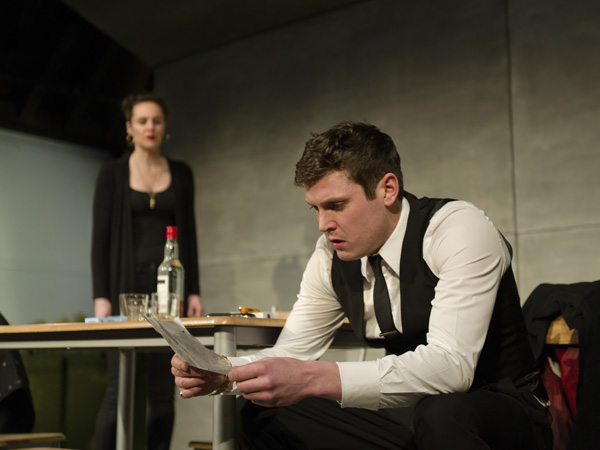 In a different key, the scenes involving Emily, Lee and especially Danny buzz and blaze with violent antagonism, furious truth telling and emotional bitterness. It’s as if the playtext has, like the characters, had a couple of very good shots of vodka and is left tingling with accumulated frustrations and roaring the vulgar songs of bully boys and vicious girls. Contrariwise, in the scene changes we hear songs sung by Vera Lynn, their sweet romance a sharp contrast to the guts being spilled on stage.
Bobby’s death in Helmand provokes the outpouring not only of grief but also of sheer hatred. For this, Squires’s writing is full of vitality and violence and her voice sounds thrillingly fresh. The moment when Emily realises that “we aren’t good people Lee, we’re shit” is as heartbreaking as her argument that her brother didn’t die for his country “because we are his country”. But since Squires’s characters are so thrillingly alive, it’s a real pity that her 60-minute play is a sliver, a shard, rather than a full-size mirror. Yet, although only in a fragmented way, it still manages to vividly reflect a green and unpleasant land.
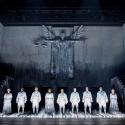
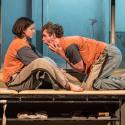
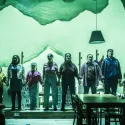
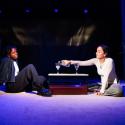
Punchy direction by Jo McInnes, on Tom Piper’s versatile set, gives the play’s emotional fuel plenty of room to thrash about. There are excellent performances from a young, energetic and convincing cast. Ted Riley and Abby Rakic-Platt are superb as the young teens Sammy and Charlie, while their older relatives are played with enormous commitment by Danielle Flett as the pent-up Emily, Tommy McDonnell as the bruising Danny and Daniel Kendrick as the secretive Lee (Flett and McDonnell pictured above right). This is a fine, ferocious little play that suggests we will hear much more, and even much better, from this writer.