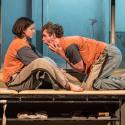
Clothes are shed, sensibilities skewered and political correctness defiantly ignored in this latest London revival of Joe Orton's wonderful play (the fourth, for what it's worth, in the capital during my time). But what most distinguishes Sean Foley's take on Orton's posthumously produced, gallopingly rude farce is the noise level of a show that is here played at a near frenzy throughout. The laughs remain, don't get me wrong, but they sometimes get lost in the mounting decibel level that, at this rate, may find one or two of the performers sidelined by laryngitis before too long.
What's the problem with that, I hear you ask? After all, a text that in any case is in no way reined-in or polite finds everyone ending up in the loony bin, starting with Tim McInnerny's visibly frazzled, sweaty, red-faced psychiatrist, Dr Prentice. Lunacy is the natural landscape traversed by a slamming-door scenario that finds room in its anarchic fold for jokes about rape, pederasty and Winston Churchill's genitalia. But one still wants to savour the verbal felicity with which Orton eviscerates all available pieties while drawing on the wit and structure of Oscar Wilde, among others, to help him do so: "I am a heterosexual," one authority figure announces determinedly to another. Comes the reply: "I wish you wouldn't use these Chaucerian words."
 It's possible that the natural architecture of the piece will come into its own more fully once the cast settle into their run and (perhaps?) soften their performances. And Orton's maverick engagement with a society that he railed against but understood down to its last institutionally beholden and class-conscious toe adds to an unparalleled opportunity at the moment to survey stage comedy across the ages in one fell swoop, from One Man, Two Guvnors to Noises Off, The Sunshine Boys to this.
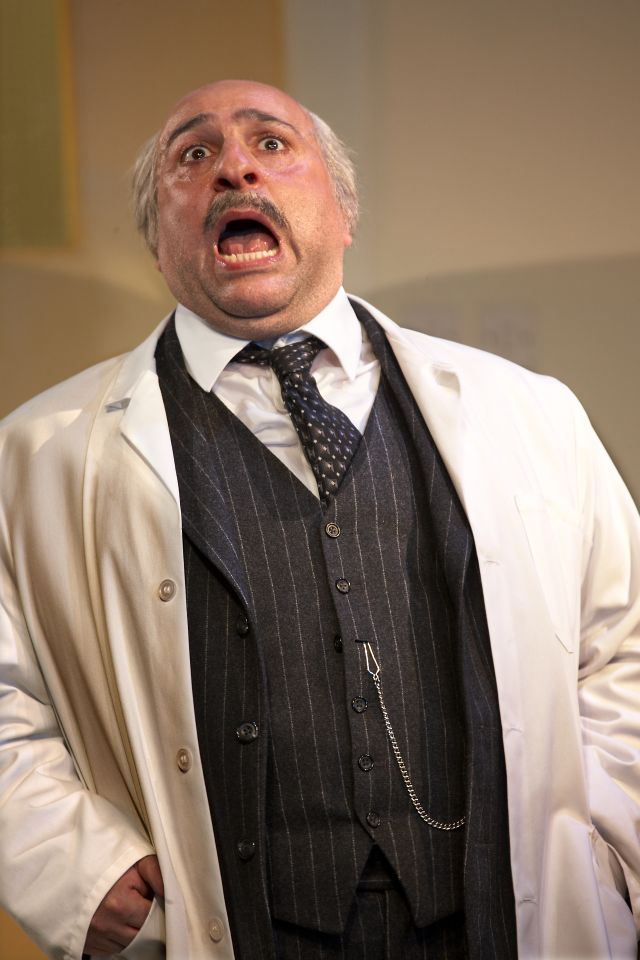
In casting terms, Foley's wild card lies in plucking Omid Djalili (pictured above) to play Dr Rance, the officious government representative who has come to examine the private clinic run by Dr Prentice at which private parts intrude into the action with increasing abandon. Djalili could temper the funny laughs of his own that Orton of all writers doesn't need, as well as the strange habit of every so often barking a random word or line as if to test whether the audience is still paying attention. (We are, don't worry.)
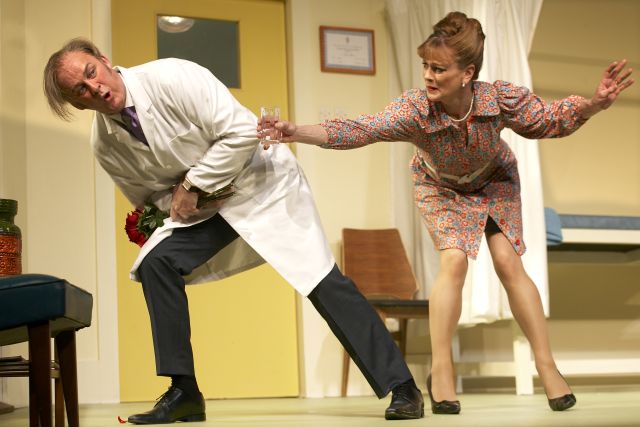 On the other hand, Djalili's own comic impulses are sufficiently honed that he can raise a genuine laugh from some physical by-play with a pair of guns, and he's very funny acknowledging the truth that if you're going to go insane, it's useful already to find yourself in a mental institution. As the warring husband and wife who push each other towards the limits of propriety and well beyond, McInnerny and Bond (pictured above) certainly give it their all, sputtering and shrieking their disbelief as the absurdities mount. Bond, especially, looks magnificent as a nymphomaniac whose fate is to espy naked men at every turn, and one only wishes that excessive drink wasn't added in this go-round to the mix: Orton's language is intoxicating enough not to need further, um, lubrication.
In some ways, the most rewarding performances come from the lesser-known players, starting with Jason Thorpe, an addled marvel as the policeman who is reduced to a gibbering wreck as he is shorn of his clothes. Georgia Moffett is sweetly sympathetic as the shorthand typist whose arrival at Dr Prentice's office sets events on their ever-escalating course (it no doubt hasn't hurt that her husband, David Tennant, was in the Phyllida Lloyd-directed revival of this play at the National in 1995). Playing the part of the randy bellhop taken by Tennant all those years ago, recent RADA graduate Nick Hendrix makes a fetching West End debut as a lad striving to find both sense and sex amid an environment spiralling into chaos. And when his character reports early on that he had a "hard boyhood", well, in the world of Joe Orton, you know just what he means.
- What the Butler Saw is at the Vaudeville Theatre until 25 August