Sensing economic opportunity, the Dutch artist Peter Lely (1618-1680) emigrated in his early twenties to London, and was thus the right man in the right place. After the early death of Sir Anthony van Dyck, followed by the Englishman William Dobson, Lely cleverly and charmingly utilised disarming ambition to open up a career for himself and become in due course the most successful painter of his time.
Lely’s establishment in Covent Garden became a factory for the production of portraits of grandees, aristocrats, royals and their wives and mistresses. He was the pre-eminent portraitist in England first for the unfortunate and hubristic Charles I, and then, deploying a genius for treading on eggshells, enjoyed the patronage of the interregnum of the Commonwealth, famously painting Oliver Cromwell at his command, warts and all, and his son Richard. Lely then went on to be the artist most closely identified with the Restoration as Principal Painter to Charles II for nearly 20 years. It is said that he died at his easel.
 But his early ambitions were other, looking to the imagination first and foremost, and it is examples of these Arcadian visions that form one of those succinct and revelatory exhibitions in which the Courtauld specialises. The young Lely’s chosen subject matter included legends, mythologies, biblical scenes and fantasies of musical parties and sleeping nymphs in idealised wooded landscapes. Rosy bottoms, rosy nipples, carmine lips are the colour accents in a procession of well-fleshed, marshmallow soft-porn featuring languorous beauties made respectable as fictional characters and prototypes. The Finding of Moses shows us an array of bare-breasted ladies focusing on the baby, with one wholly naked woman still bathing in the river; another version of the subject by Lely, now lost, appears in the background of Vermeer’s Woman Writing a Letter, attesting to Lely’s fame.
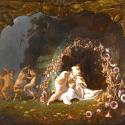
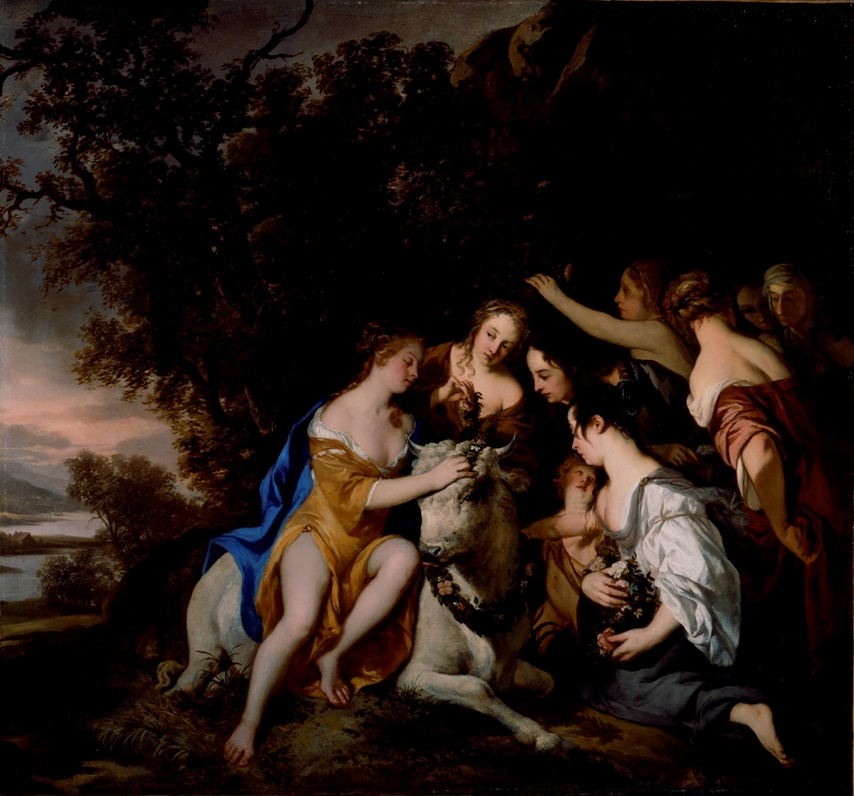
The infant Bacchus and fellow baby imbibers are gathered round a wine fountain. Artfully clustered females dote on a surprisingly docile bull garlanded with flowers, which, naturally, is titled The Rape of Europa (early 1650s) (pictured above right, courtesy of Devonshire Collection, Chatsworth). Music figures large: a beautiful boy shepherd holds in one hand his crook, in the other a recorder. The grandest work is A Concert (main image), with perhaps the artist himself depicted playing a bass viol. This painting of music played for the delectation of a female audience reflects not only Lely’s personal interest in music, but his intelligent and sensuous appreciation of Venetian painting. Nymphs by a Fountain (c. 1654) (pictured below left, courtesy of Dulwich Picture Gallery) is rather more explicit, an array of barely draped women all in a state of perhaps post-coital drowsiness: shockingly there is even a hint of pubic hair. Byron, no mean womaniser himself, suggested in Don Juan how Lely’s skill with drapery means we can admire his beauties freely. The Arcadian fantasy legitimises all.
 Alexander Pope phrased it thus: “Lely on animated canvas stole/The sleepy eye, that spoke the melting soul.” The 18th century commended Lely’s ability to portray a look of sweetness, languor, tenderness: whatever the goings on, by the time Lely paints it, his nymphs are just exhausted. His whole world is on the verge of taking a nap.
An astringent contrast to Lely’s idealised beauties - those fantasies for the (very) upper classes - is on display in the next door gallery. Frank Auerbach’s gift to the Courtauld consists of a series of ferocious and forensic etchings of male and female nudes of the 1980s and 1990s by his close friend and artistic colleague, Lucian Freud. Under Freud’s gaze flesh is all too rampant, exposed to the devouring gaze of the artist: no sugar coating here.
- Peter Lely: A Lyrical Vision at the Courtauld Gallery until 13 January 2013