I'd love to see the stats on the last time a Prom was this packed for an afternoon organ recital. Were it not for the fact that organist Cameron Carpenter was sporting spandex trousers encrusted in silver glitter, a wife beater and Mohawk, you could have been mistaken for thinking we were back in the organ glory days of the early 19th century. Even the programme harked backward, offering as it did big, bloated Romantic transcriptions, arrangements and improvisations (pretty much everything in fact except the urtext).
Scratch that. We did get two pieces of unadulterated Bach, the Toccata and Fugue in F major, BWV 540, and the Prelude and Fugue in A major, BWV 536. Not even these however could completely escape the Carpenter treatment, the garish stops chosen for both reflecting better the organist's outfit than the sober wishes of the composer. The tradition for arranging Bach works is long and eminent. Several works in yesterday's programme were transcriptions of transcriptions. I have no objection per se to any of this. Not even to the slash-and-burn type of arrangements that the young showman clearly seems to like most. But the result must be musical. And very little of what I heard was.
When left to his own devices, Carpenter revealed a musical tastelessness
His arrangements of the Partita No 3 in E major for solo violin, BWV 1006, Chorale Prelude "Nun freut euch, lieben Christen", BWV 734, and the Evolutionary Toccata in D minor, BWV 565, was full of mess and confusion. Bach's melodies and musical arguments were endlessly being swallowed up by Carpenter's incontinent fiddling. Again, no problem with that if there had been some sense to it. But there wasn't.
The wonders of Carpenter's technique (his foot pedalling is beyond compare) could only sustain interest up to the end of the first piece. Beyond the opening Toccata and Fugue in F major, the excitements of his technical virtuosity became overshadowed by irritations over his fidgety musical excess. And when left completely to his own devices in his Improvisation on B–A–C–H, Carpenter revealed a musical tastelessness that suggested this virtuoso wasn't going to return the organ back to the glory days of the 1800s but to the naff indulgences of the middle part of the 1900s.
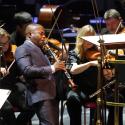
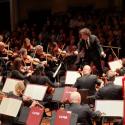
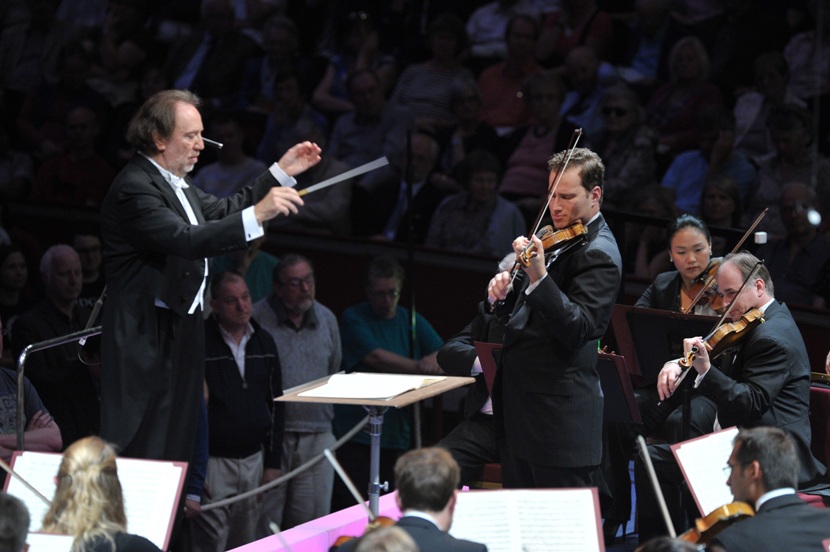 The 19th-century theme carried through into the Leipzig Gewandhaus Orchestra's Prom, with a programme that wasn't just all Mendelssohn but was all newly restored early editions of Mendelssohn. The only piece that wasn't making a Proms premiere in a new version was the ever popular Violin Concerto. Danish violinist Nikolaj Znaider (pictured above with Riccardo Chailly) was the soloist. It would have been churlish not, at some level, to enjoy his accomplished performance. There was an elegance and aristocracy to his sound and a Nathan Milstein-esque cleanness and directness to his playing. But dissatisfaction did creep in. A warhorse like this needs to be invested with a new energy when being wheeled out for a millionth time. And despite a few tiny idiosyncrasies in phrasing here and there - which seemed almost accidental - there was no new vision for the work.
This was strange considering how almost dangerously adventurous Chailly's approach to music-making normally is - and how fresh Znaider's Bach encore sounded. You will never hear a run-of-the-mill performance from Riccardo Chailly. You might hear him going too far, pushing things too fast, revelling in too much detail, but he'll never be boring. So it proved again in last night's evening Prom. The original editions of the Ruy Blas and Fair Melusine overtures and the Fifth Symphony that Chailly brought to London were all less immediately ingratiating than the more familiar versions but also more clever.
Hearing the Leipzig Gewandhaus straight after the Berlin Philharmonic was a little cruel
The Fair Melusine especially becomes a more richly complex web of sound in the 1838 edition, foreshadowing Wagner's musical densities. The connection to Wagner (especially Parsifal, which has a direct quote from the Fifth) and Bruckner is ever clearer in the Reformation Symphony. Its formal oddities were more pronounced too, especially in the small recitative passage for flute and orchestra that creeps in before the finale as an inventive little bridge.
Hearing the Leipzig Gewandhaus Orchestra straight after the Berlin Philharmonic, however, was a little cruel. Few ochestral sections compare that favourably to the Berliners. The Leipzigers' strings, for example, sounded quite thin after the luxuriantly plush Berliners. In fact, was there anything that special about the way the Leipzigers do their Mendelssohn? Their heritage suggests that there should be. Mendelssohn was after all the orchestra's chief conductor. But their greatest asset still seems to be Chailly.
Where individual and sectional contributions failed to blow one away, broader musical ideas, tempi and rhythmic details often did, Chailly hustling the orchestra from the podium with an athletic restlessness. Few could have invested the Fifth with such billowy freshness and still retain the work's majesty. In this vein, the last movement became a thing of glory. Our ovations and stomping were rewarded with a loving rendition of the Wedding March from A Midsummer Night's Dream.