After perdition, salvation – with the Royal Albert Hall in the unlikely role of redeemer. Last winter, the much-garlanded French period ensemble Les Siècles performed a semi-staged production of Berlioz’s 1846 “concert opera” La Damnation de Faust at their Parisian home, the Théâtre des Champs-Élysées. Director Silvia Costa’s whimsical conceits – with Faust as a sort of dreaming hipster in a toy-filled bedroom – were thoroughly panned. Worse: reviews suggested that she had taken the (generally excellent) musicians and singers down with her.
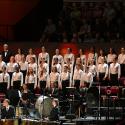
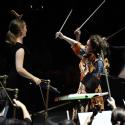
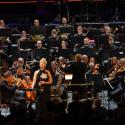
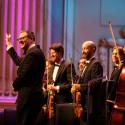
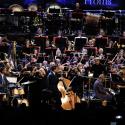
In that case, I’m happy to report that Les Siècles and conductor Jakob Lehmann (pictured below) have earned their redemption at the Proms. They dumped the directorial stunts and furnished us with an old-fashioned – almost Victorian – massed-choir spectacle, with stalwart soloists fairly immobile but vocally agile at the front and the well-drilled armies of the Choeur de Radio France and its youth section, the Maîtrise de Radio France, stacked behind.

A few offstage fanfares aside, they dropped all pretence of framing Berlioz’s “dramatic legend” as full opera. This scholar’s quest for love, pact with Méphistophélès, and final doom plays out firmly in the theatre of the mind. In other words, we enjoyed a traditional Albert Hall choir-led blockbuster: not quite as musically remarkable (to my ears) as Edward Gardner’s Damnation with the LPO a couple of years ago, but full of well-shaped, characterful passages to relish as we galloped to hell, and to heaven.
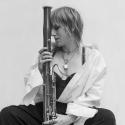
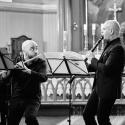
What struck – and charmed – from first to last was the distinctive period colouring of the Les Siècles players as they negotiated all of Berlioz’s weird and wonderful orchestral shades, from chirping piccolos, gracefully untamed natural horns (pictured below) and a magical quartet of historically-informed harps down to the growling sub-tuba ophicleide (take a bow, Sylvain Mino, if you can move at all when lumbered with that beast). Reedy, breathy, woody, closer to the human voice and to the earth Faust invokes, somehow pre-industrial: this transparency, almost nakedness, of sound fitted a work that, in Faust’s doomed search for meaning and fulfilment, presents a Romantic ideal of authentic feeling that the anomic intellectual can never quite attain.

True, there were moments when the huge expanses all around the players might have responded better to the penetrative force of modern orchestral firepower. Perhaps the musical pandemonium of the finale lost some of its hellish roar, for instance. Yet the quieter passages – such as a mesmeric dance of the will-o’-the-wisps – compelled even in this unforgiving space. Besides, the savoury flavours of so many sections – from Rémi Gormand and the horns to those hard-working flutes and piccolos (Marion Ralincourt, Anne Parisot, Anne-Cécile Cuniot) – lent a distinctive style to the performance that never palled.
Lehmann’s unabashed embrace of old-school concert conventions meant that La Damnation by and large returned to the status of a pageant of luminous vocal, choral and orchestral set-pieces: from Faust’s opening ennui among nature’s beauties, through to the assumption of Marguérite into a heaven thronged with seraphic young voices. Though musically delightful, this approach did make for a disjunctive, stop-start evening. We had a break after the Hungarian March (played with delicious bustling swagger) and a leisurely re-tune before the fourth and final part. That said, Lehmann’s pacing within the scenes seldom dawdled. He supplied dramatic edge and tension when – as in the ride into the abyss – the action demanded it.

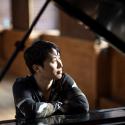
As Faust, John Osborn (pictured above) sustained a fine-grained, cultivated tenor tone throughout a taxing role but maybe lacked a little emotional contrast. His world-weariness in the opening pastoral episodes (beautifully executed by Les Siècles) and the tavern scenes suggested dyspepsia rather than despair. However, his “Nature immense” hymn managed a proper amplitude and authority, gorgeously offset against the slowly tumbling low brass behind him. And refinement ascended into rhapsodic ardour when he fell for Marguérite. Despite the lack of much stage interaction, he glowed sensuously through his part in the great duet, “Ange adoré”.
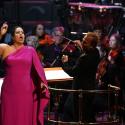
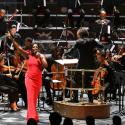
As Marguérite, soprano Veronique Gens (pictured below) was luxury casting. The dramatic commitment she brought to the role for a while made me regret the absence of any operatic ambitions in this version. The uncanny beauty of her “Roi de Thule” song displayed not just control, nuance and understated power but – thanks in part to the viola solo – showed how voice and period instruments could combine to watermark this Faust. She more than matched Osborn for warmth in their duet and, in “D’amour l’ardente flamme”, moved from legato serenity through to a flummoxed urgency. Maybe she had no need of opera direction: all the drama resided in the voice.

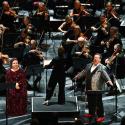
Méphistophélès often steals the show, in any iteration of the Faust legend. Here, the irresistibly suave baritone of Gerald Finley might have done so if choirs and orchestra had not chipped in with their own star turns. Phrasing, emphasis and delivery pulsed with character. More sophisticated than sulphurous, his powers of temptation rested more on confiding irony than brazen lures. If that meant Finley (pictured below) never quite gave us the emetic whiff of hellfire, then his vocal alertness and urbanity – never more so than in his wickedly clever patter number, “Devant la maison de celui qui t’adore” – proved infernally attractive. As Brander, Thomas Dolié’s bass chewed through his tavern song about the roasted rat with lip-smacking delight.

That nasty ditty closed with a magnificently droll mock-pious “Amen” fugue from the Radio France choir. At the outset, I wondered if the singers had quite come to grips with the weird acoustic in this temple of Albertopolis. But their later set-pieces sparkled, soothed or smouldered, just as Berlioz required. As cackling demons or blessed spirits, they both projected effectively and made the divisions of their forces audibly count. When the young singers of the Maîtrise joined them to serenade the saved Marguérite’s entry into paradise, a celestial stardust floated through the hall.
In this Damnation, her redemption became no sentimental comedown after Faust’s pyrotechnic perdition, but a genuinely affecting catharsis. It capped an evening that always pleased, and sometimes inspired, precisely because it avoided that road to hell paved with new-fangled good intentions. Period instruments, period presentation, and (mostly) heavenly results.