Given the number of audience members playing air-piano along with parts of Pictures at an Exhibition, Behzod Abduraimov should perhaps be described as a pianist’s pianist. He is nevertheless a great deal more than that. Ten years ago this young musician from Uzbekistan, via Kansas City, emerged victorious from the last-ever London International Piano Competition; he was 18 then and if his artistic growth thus far is anything to go by, we are dealing here with a rare and enchanting musician.
Having chosen what appeared to be a programme of miniatures, he made each set of pieces a cohesive and convincing whole. While some pianists become bogged down in detail and miss the wood for the trees, Abduraimov worked within the grand sweep of the big picture; at the same time his absorption in the music’s atmospheres lived rivetingly in the moment. Often he built his impressively expansive sound upon a strong bass, with a vivid awareness of harmonic direction, while layering textures so that instrumental figurations created a flickering background to the important lines.
This had many pros, if a few brief cons too, in Chopin’s 24 Preludes Op. 28. Here we never forgot that Chopin was an opera buff: the preludes that resemble songs without words (the E minor, the A flat and the C sharp minor, for instance) emerged with the elegant phrasing and rich depth of tone of an old-school bel canto singer. Though played more or less without a break, each prelude had an ambience all its own. The only caveat was that there was a slight tendency to overpedal and blur the harmonies in those preludes for which the filigree patterns are part of the musical point (I was sitting quite near the front, though, and it’s possible these sounded with more clarity further back in the hall). 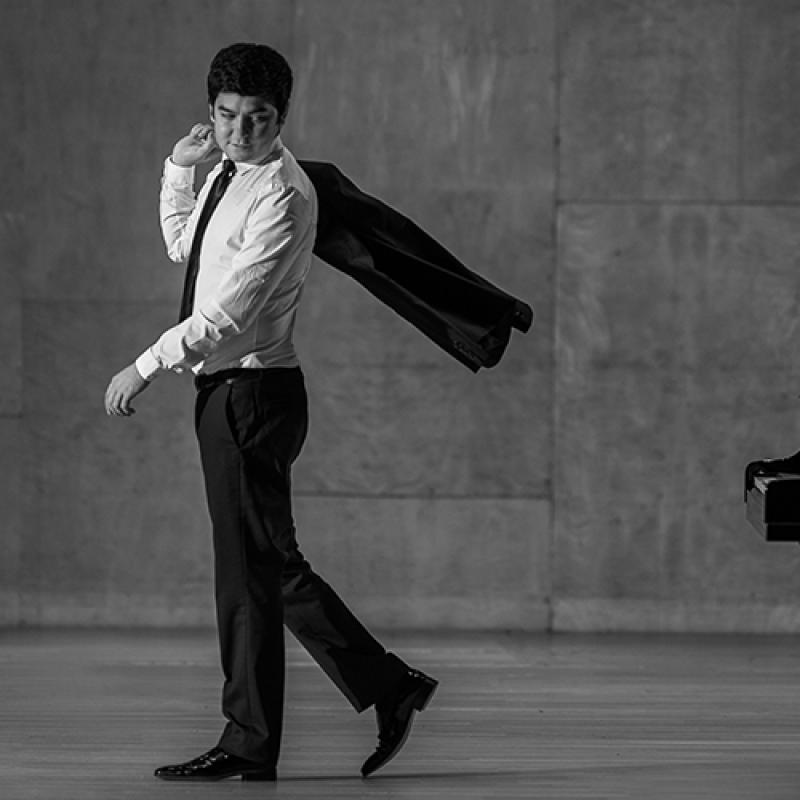 Debussy’s Children’s Corner emerged as if from a different world; here it was the delicacy and subtlety of sound that counted most, together with Abduraimov's engaging absorption in the musical storytelling. ‘The Snow is Dancing’ was a particular joy: clear, soft and sugar-free; ‘The Little Shepherd’ thought aloud, simple and unfussed; and the concluding cake-walk was deliciously louche.
It’s impressive that Abduraimov created a distinctive soundworld for each of the three composers in the programme - but he had been keeping some gunpowder in reserve for Mussogsky’s Pictures at an Exhibition. This is an oddity among favourite virtuoso war-horses because it’s the one piece in which pianists have traditionally felt able to take liberties and “pianostrate” the rather bare, rugged original, soemtimes milking it for additional effects. Abduraimov proved no exception, but one could hardly object to, for example, his choice of eerie, horror-score tremolandi at the tense climax of ‘Gnomus’. And during the course of the work he let off the full complement of no-holds-barred fingering techniques (clusters, side-of-hand, you name it) and astonishingly quick-fire wrist action that can set pianophiles ablaze.
All this breathtaking virtuosity, though, was in the service of the music’s character. The unhatched chicks danced on pointe, the troubadour sang hynotically in the castle ruins, the Limoges market was busy enough for a Black Friday sale, and there was some real pathos to Schmuyle, rather than cruel caricature. Bydlo, the Polish ox-cart, suffered a little in terms of pacing, but that’s a tiny caveat beside Baba Yaga’s utterly hair-raising witch’s ride and the glorious pealing of Kiev’s cathedral bells in the Great Gate finale.
Topped off with two encores - Tchaikovsky’s Lullaby in Rachmaninov's multigarlanded piano transcription, then Mercutio’s dance from Prokofiev’s Romeo and Juliet(a Queen Mab scherzo in all but name) - this was an evening to remember. As a mildly jaded middle-aged critic, it’s always wonderful to encounter a performer who reminds you exactly why you fell in love with the piano in the first place.