Every ten years or so Thomas Adès writes a piano concerto and the latest had its UK premiere last night at the Royal Festival Hall, played by Kirill Gerstein and conducted by Adès himself. Following on from the youthful, skittish Concerto Conciso of 1998, and the lush, layered In Seven Days of 2008, the new piece, baldly called just Concerto for Piano and Orchestra, sees Adès engaging with the giants of 20th century piano concerto, fashioning something that simultaneously looks backwards and forwards.
The concerto has lots of Adès trademarks: rhythmic complexity in the form of polyrhythms and irregular meters, technical virtuosity required of the whole ensemble, not just the soloist and a quicksilver variety of changing textures. Here he also adds a richness of scoring, a melodic charm and solid foundation of a very traditional structure.
The big beasts that hide in the background, occasionally peeping above the parapet include Rachmaninov, in rippling piano textures, Prokofiev, in the bold final bars of the first movement, and an intriguing mixture of Gershwin and Ligeti in the beguiling slow movement. The piece, commissioned by the Boston Symphony Orchestra uses large forces (unlike the earlier chamber scorings) and it is possible to detect an American brashness, both in the instrumental writing, which is perhaps more primary-coloured than usual, and in the material, which is unapologetically big-boned. Gerstein (pictured above by Winslow Townson) gave a terrific performance, not just in the meaty business of the outer movements, but in the alternately tender and stern second. He captured the kaleidoscopic sounds and textures, projecting over the orchestra but also happy to be part of the orchestra. He deserved his warm reception in the hall.
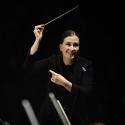
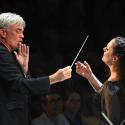
For a composer, Adès is a good conductor, but good rather than great: better than, say, John Adams but no Esa-Pekka Salonen. His beat is clear – important in the blizzard of meter and tempo changes in his piece – but he has a tendency to micromanage. It’s pretty certain he wouldn’t be conducting the LPO if his music wasn’t on the programme, but with that acknowledged he did a perfectly good job, not just in the concerto but in Holst’s The Planets, that were the second half.
This piece is so familiar that we can forget how extraordinary it is – what else is like it? – and Adès and the LPO threw themselves into it with the necessary determination and vim. The first movement – “Mars, The Bringer of War” – is, for all that follows, surely the best bit. The LPO were sufficiently violent and destructive, with some fine timpani playing and spot-on ensemble in the big chords at the end.
There was lots to like in the playing throughout. “Venus, The Bringer of Peace” saw a change of tone exemplified by John Ryan’s fragile horn solo. Adès took the central section of “Jupiter” – aka “I vow to thee, my country” – at a refreshingly fast pace, banishing any sentimentality or solemnity. The brass here were gleaming and fabulous, and in “Uranus”, where the whole orchestra captured beautiful the jolting change from frenzied dance to frozen stasis. The grim tread of the basses in “Saturn” had a wonderful inevitability about it before the celesta, harp and upper voices brought “Neptune” to its icy end.