At this time of year the musical world – and particularly the choral world – is full of festive concerts, and the challenge can be to find programmes venturing off the well-worn path of traditional favourites. But at Kings Place on Saturday I found one: the choirs of St Catharine’s College, Cambridge presenting, as part of the "Venus Unwrapped" season, a fresh take on the “lessons and carols” format, focusing largely on women composers.
St Catharine’s staked its claim to this territory by being the college that, in 2008, broke centuries of practice among Oxbridge chapels by starting a girls’ choir. This school-age choir sang alongside the chapel choir of mostly undergraduates, under the benevolent leadership of Edward Wickham, and acquitted themselves well in some challenging repertoire.
This ranged from third-century chant to the world premiere of Diana Burrell’s Green Growth the Holly. The chant was sung by the girls’ choir from the gallery and, in that and a two-part 14th century discant, the singing was assured and pin-sharp in tuning. The Burrell, for both choirs together, was spry and piquant, the singers making light of the tricky chromatic lines before coming together for a unison finish. Wickham’s conducting was unfussy and he did an excellent job marshalling the disparate forces. He is clearly an inspirational, if understated, leader.
The highlight for me was Stevie Wishart’s Lullaby for Freya, with its mesmeric, melismatic lines circling round a striking solo by Isabella Savage. The choir’s clean, focused sound was perfect for this “new-old” music, Wishart conjuring something of today from the materials of many centuries ago. I loved it.
 Among some more straightforward – and beautiful – pieces by Sally Beamish and Nicola LeFanu, the other stand-out piece was Hannah Kendall’s Nativity. This pitched the girls in the balcony singing a Donne sonnet against the women of the college choir creating a luminescent halo with only the word “light”. I would like to hear it with more voices, where perhaps the “halo” would have more depth, but in this piece in particular the spatial separation of the groups was absolutely at one with the music.
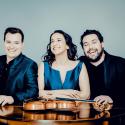
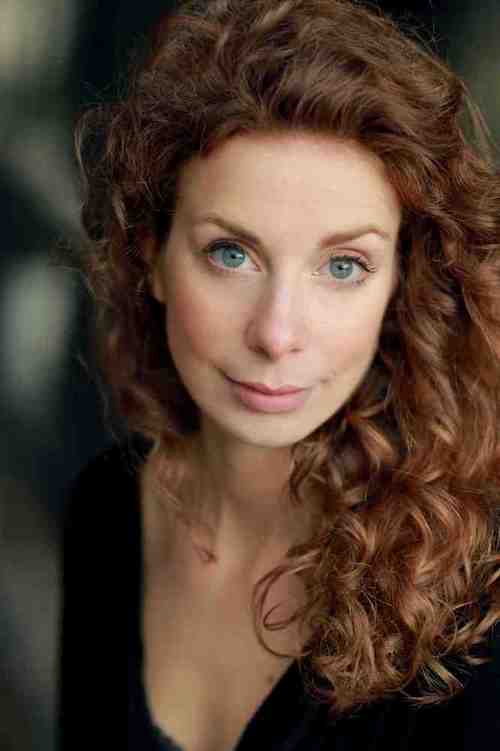
The “lessons” were not the conventional Bible extracts but works by female writers, read by the comedian, writer and St Catharine’s alumna Helen Duff (pictured left). She had an arch delivery that worked best in the UA Fanthorpe sequence and least well in reading Rossetti’s "In the bleak midwinter", where she seemed to be working too hard to find a rhythm different from the familiar Holst setting, and managed to mangle the line “Yet what I can I give him”, significantly altering the sense. Although I am on the whole a fan of conductors speaking to the audience, on this occasion Edward Wickham’s additional spoken links somewhat broke the thread of this carefully worked out sequence – as did the audience ignoring the request to clap only at the indicated breaks.
The most ambitious combination of words and music was in the penultimate item, where Arvo Pärt’s Magnificat was interspersed with lines from Kathleen Raine’s no-nonsense Northumbrian Sequence. The severity of the music was matched by Raine’s stark imagery, but the “Pärtitioning” of the musical lines did interrupt their flow. On the other hand, I would applaud the innovative approach, even if it wasn’t entirely successful. And most of the evening was.
But was it more or less interesting for being women-centred? No. The music was what it was – conventional Christian carol settings – with no feminist “message” or loaded agenda. But I hope that before long this kind of programme will not need to be part of a special season, and that the sex of the composers will not merit a mention.