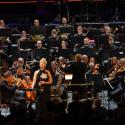
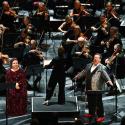
For the first night of its 114th season, the dear old Wiggy welcomed back its regulars after the summer break. A starry occasion like this recital by Joyce DiDonato and Sir Antonio Pappano gets booked out virtually exclusively by those patrons and members, so it was an evening with a lot of air-kissing and greeting across the familiar rows of red seats.
The hall does have a special vibe when it's completely full, as does the knowledge that the audience is seeing an artist who can - and will - sell out venues several times its size. The two nights of this programme (the second is on Monday, returns only) are being recorded for a commercial release by Warner Classics, and DiDonato sang the whole recital with a microphone stand between her and the public.
DiDonato's Rossini songs had her completely in home territory
Whatever she sings, however, DiDonato is one of the great musical communicators of our time, and the microphones didn't prevent her from receiving rapturous applause, particularly during and at the end of the second half. Anyone in need of evidence of DiDonato's passion as performer should watch her delivering this summer's graduation address at the Juilliard School (link here). It is a tour de force, a spirited and spectacular defence of all that is best about working in the performing arts.
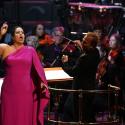
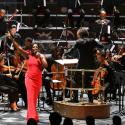
Her programme had a first half of songs in Italian (for which she wore a Vivienne Westwood dress, pictured below right), and a second half of songs from 19th- and 20th-century American classical repertoire, and from the American songbook. I liked where we ended up a lot more than where we'd begun. DiDonato talks a lot about centring herself, finding neutral gear, home base. For her final encore, therefore, she took us to Kansas, her home state, a place to escape in "Somewhere Over the Rainbow" by the masterly songwriting team of Harold Arlen and Yip Harburg. DiDonato was singing with impeccable control and legato, but the revelation was what was going on underneath.
In that song, as in the Jerome Kern numbers earlier, such as "All the Things You Are" and "My Funny Valentine", Pappano was finding the clever voicings, the chromatic root movements, the colourful descriptive "out" playing of a fine jazz pianist. So how did that happen? Somehow, somewhere, in a maximum path career in the world's opera houses, Pappano has not only taken on board huge helpings of Brubeck and Erroll Garner, he also has a remarkably mischievous impatience and a facility to give the predictable chords the slip. It could be predicted that, as a conductor, he has an utterly serene way of shaping and communicating time, but, to me at least, this was the sound of surprise.
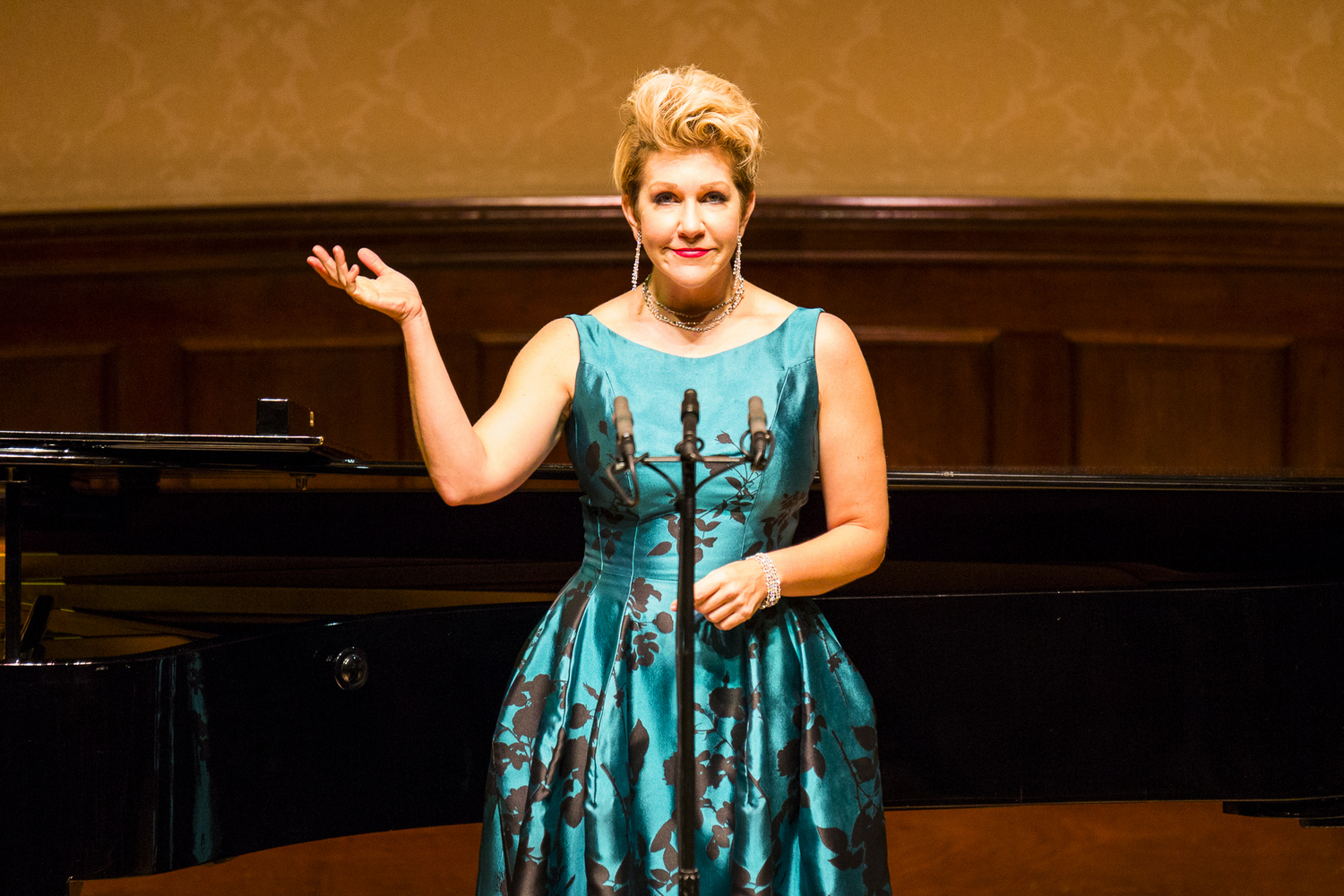 There were other highlights in this programme too. DiDonato was dedicating her concert to her late father Donald Flaherty, on what would have been his birthday. Her Irish heritage was all there in a delightful song, "Lovely Jimmie", by the Irish composer Havelock Nelson (1917-1996). It was the perfect emotional centrepiece of the second half, a beautifully melodic number delivered sincerely and beautifully. Jerome Moross's "Lazy Afternoon" is another pearl of a song, beautifully conveyed. She also managed the comic numbers very well, and there was some entertaining on-stage banter with Pappano, such as an urgent and immediate disclaimer of the lines "If some gentleman would talk with reason/I would cancel all next season".
DiDonato's Rossini songs had her completely in home territory, with flawless phrasing and rubato, and the first half closer, the Neapolitan song "Non ti Scordar di Me", was highly effective. I thought her set of Evening Songs by Francesco Santoliquido outstayed its welcome, with a few too many trembling hands and predictable cadences. Haydn's Arianna a Naxos always seems like a more attractive destination than it is when you get there, and maybe you have to grow up with Stephen Foster's songs to really appreciate them.
Nevertheless, the high points of this recital were remarkable. It was a joyous evening and an auspicious start to the new Wigmore season.