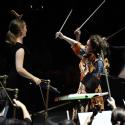
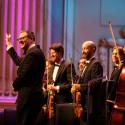
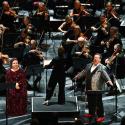
"Finally,” said Sir Simon Rattle, “I get a chance to say thank you. We have had forty years working together without an argument." The Royal Philharmonic Society was awarding an Honorary Membership to Martin Campbell-White, Rattle's agent. Campbell-White, who has been a guiding influence on the conductor's career since the 1970's made a rare appearance on stage, as he became the first artist manager ever to win this award in the RPS's 201-year history.
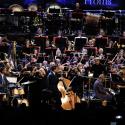
There was a sense of occasion about this concert, which was also Rattle's first appearance with the LSO since the Olympics opening ceremony in 2012. The London audience is always keen to show its appreciation of Rattle, and to express an evident desire to win him back from Berlin when his Berlin Philharmonic contract expires in 2018. Who knows...
Eberle and the LSO brought the light-footedness of chamber music and of dance
If there was a common thread in the programme - apart from Martin Campbell-White's proud statement that there were no fewer than three Askonas Holt artists on-stage - it was this: that all three German composers whose works were played had deeply complex characters which rapidly outgrew the narrowness of the provincial towns in which they were raised. Beethoven escaped from an alcoholic father in Bonn at the age of 17; Schumann was obliged by the terms of his late father's will to get out of the mining town of Zwickau to study law in Leipzig; Henze's father's proud identification with Nazi values very soon made life in the quiet Westphalian town of Gütersloh unbearable.
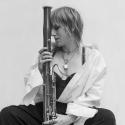
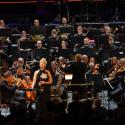
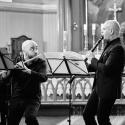
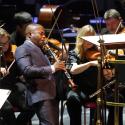
Rattle's way with the ebb and flow of the 25-minute first movement of Beethoven's Violin Concerto is to give it plenty of ebb. The word dolce appears so many times in the score - and in the solo violin part in particular - it is an invitation to enjoy the sweetness to the point of lingering over those calories. I thought that the Swabian violinist Veronika Eberle (pictured below) appeared hesitant at the start, but grew in authority. The Larghetto was spacious in the extreme, with several of those trademark Rattle pianissimi, but the breadth of gesture gave the opportunity for Daniel Jemison's glorious bassoon tone to resonate, and the Egmont-like chords at the end of the slow movement were given real passion. Eberle and the LSO brought the light-footedness of chamber music and of dance to the closing rondo movement.
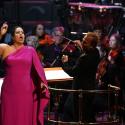
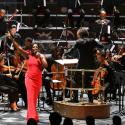
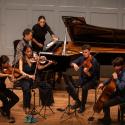
 Henze's Being Beauteous from 1963, a setting of Rimbaud, is an unusual, fascinating piece in several respects. Settings of French-language texts are very rare in Henze's oeuvre. To set a symbolist poet for a coloratura soprano who has to hit high notes effortlessly is to enter the world of Boulez whose setting of Mallarmé's Pli Selon Pli from the previous year must have influenced the soaring vocal part. But Henze was very different. As Rattle himself has said: “at the very core of his being Henze is emotional, a romantic. He was never going to be at home in the aesthetic of a Boulez or a Stockhausen.” The four cellos and harp have far more regular parts, and in the sequence of instrumental variations which link the vocal episodes in particular, there is a deliberate re-imagining of the Adagietto of Mahler's Fifth Symphony. The harp of Bryn Lewis and the cello of that LSO stalwart Jennifer Brown provided a strong, assertive, grounding musical presence, which gave the gloriously clean-toned coloratura soprano of Anna Prohaska her freedom.
A highlight of Schumann's Second Symphony was the Scherzo. Rattle gave special attention to David Alderman and to his cohort of second violins, and they responded with exactly what was required. Their part is petulant, stroppy. Forget "smooth classics" (please). Here we are in the presence of an unreasonable, borderline psychotic voice, which they characterised magnificently.
- Simon Rattle will be giving give four concerts in the LSO's 2014/15 season starting with Schumann's Das Paradies und die Peri in January