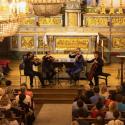
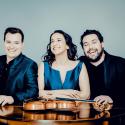
Could you get a more American string quartet than the Emersons? They dress like Yanks. They play like Yanks. They're even shaped like Yanks. There's Steve Martin on viola, Steve Buscemi on cello, Laurel and Hardy on violins. The night started in true Stateside fashion, an announcer indicating the Emersons would be conducting a Q&A session from the stage after the concert. I can't imagine anyone took them up on the offer. Because, for all the trials and tribulations of their recital last night at the Queen Elizabeth Hall (some good, some bad), this wasn't a performance that needed explaining.
The playing was as bold, brusque and, at times, astonishingly brilliant as only New Yorkers know how to be. There were casualties. Refinement, subtlety and elegance went out the window in the Mendelssohn String Quartet No 5 in E flat. Even accurate intonation was swept away by their broad Romantic brush. I wasn't complaining. Anything that swells and darkens Mendelssohn's passing clouds is fine by me. The Scherzo tumbled disturbingly along like a companion to Schubert's Gretchen. A lovely pungency seized the Adagio. And for those for whom there was too much Romantic sauce with these Classicist trimmings, terrific bite was to be had in the finale. The foursome chomped and chewed at the strings happily to the end.
The emotionally direct mood was well suited for the Thomas Adès quartet, The Four Quarters, receiving its UK premiere last night. Despite innocuous subheadings - Nightfalls, Morning Dew, Days and The Twenty-fifth Hour - this is a troubled work. The technical simplicities of the music, confined to repetition, rhythmic regularity and various series and scales, act as emotional straitjackets, which are broken out of by bouts of hysteria. Even the freer second movement, Morning Dew, imagines the microscopic process of condensation as something quite crazed. A relief of sorts is to be had only in the imagination, in The Twenty-Fifth Hour, the quartet first taking on the form of tolling bells and then ending in sleepy consonance. An accomplished but ultimately troubling piece.
The Beethoven String Quartet in C sharp minor, Op 131, had the most to gain and lose from the Emerson's shoot-from-the-hip approach. Without the secure legs that just intonation and rhythmic tightness provides, you can't have a sturdy musical table on which to lay all the things that makes it an interesting experience. Having said that, choppiness and instability from pros like these in what a friend rightly described as an Emerson party piece has its visceral thrills.
That's not to excuse the ugly moments: ragged solos, unnecessary glissandos, a fugue completely adrift. The problem with party pieces is that you think they don't need practice. Op 131 does. But the freestyling came into its own in the faster, angrier final movements that demand dynamism rather than thought. The final Allegro was extraordinary. Eschewing any niceties, first violinist, Philip Setzer, souped up every accent and ritardando, every possible change of pace or dynamic, in almost Mengelbergian fashion, stretching and squeezing the music for every last drop of emotional juice that the music would allow. It wasn't pretty but it was devastating.