

Kahchun Wong’s second Bridgewater Hall concert of the new season was partly an introduction to the Hallé’s artist-in-residence for 2025-26, Anna Lapwood. The star organist brought a new piece by Max Richter for organ, choir and orchestra and a recent one by Olivia Belli for organ solo – both on the theme of space travel.
It sounds a bit bald to say it, but they both evoke the vastness of space and the awe it creates in the human mind in similar ways. Richter’s Cosmology – a Hallé co-commission with the Sydney Symphony Orchestra which has still to receive its Australian premiere – was written for Lapwood and was first heard at the recent BBC Proms in the Royal Albert Hall with the Philharmonia. Much of its four-movement, 30-minute span is based on increasing textural complexity and power over repeated patterns of melody, chords and rhythms: the first (“Voyagers”) beginning in the orchestra, with a pair of harps prominent and the chorus singing high, sustained notes. It builds via a gradual crescendo to a huge noise and then stops suddenly.
The second (“Orion Nebula”) is more of a there-and-back-again, beginning with a cushion of sound from six horns and three flutes, with organ pedal mainly audible, then introducing a cello melody, followed by the remaining strings, as a descending bass line repeats, passacaglia-style. Wind and brass add their contribution before the texture thins again, the bass becoming a sustained single note and the organ singing through a solo flute stop. The third (“The Pleiades”) begins with Fauré-esque figurations for organ and percussion against sustained string and harp sounds, after which rhythmic patterns emerge, building via a very gradual animato, thickening and finally adding the chorus in a burst of sound – its ending brought a whoop and applause from the audience.
And the fourth (“Earthrise”) is a slow-tempo treatment of the first two lines of the “Wachet Auf” chorale for chorus and orchestra, again using a descending bass line, rising to a full-organ and orchestra peak of intensity, and then decreasing the decibels to make a gentle end.
Kahchun Wong was master of the sustained spans of slow change, whether of dynamic level or pace, and the Hallé, led by Roberto Ruisi, played like stars themselves.
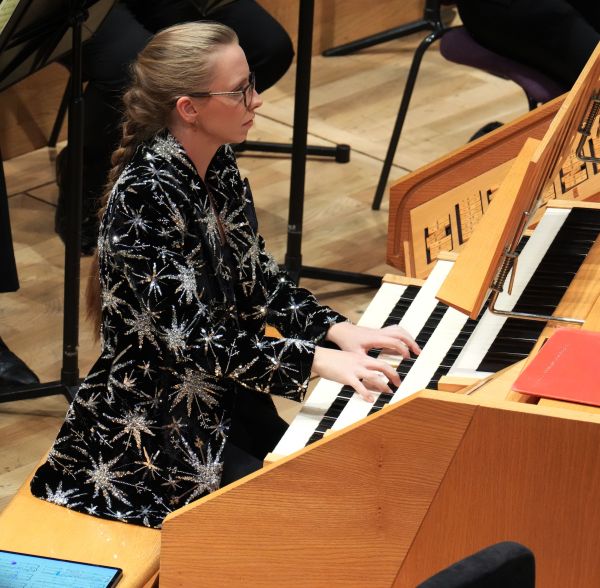 Anna Lapwood (pictured left) likes to make an impression, dancing to the console on her entrance, and later to the platform front to explain that the Belli piece, Limina Luminis, which she premiered at the Proms in 2023, feels to her like the journey of an astronaut into space – excitement and nervousness to begin with, confidence and pride growing, in the middle a very audible moment of take-off full of noise and power, and then a sudden change to restfulness … in orbit. It’s done by beginning with soft undulating figures hovering around a melody in tenor register, which becomes, through registration changes, much more like a powerful solo and reaches a much wider compass, then building to that climax of power. It cuts to a single ethereal flute-with-tremulant pipe over a low pedal, and then some Holstian chording, with staccato pin-pricks of high-pitch organ sound, glittering like the stars in the firmament.
It was beautiful, approachable music – you might say atmospheric, if that wasn’t an inappropriate term – certainly descriptive, and much enjoyed for the sonic experience afforded.
Down to earth, not with a bump but rather a warm dose of human feeling, as the concert ended with Elgar’s “Enigma” Variations. Kahchun Wong’s interpretation is in some ways a laid-back one, catching the affection for Elgar’s friends “pictured within” by his music. Variation 1 was expansive, and the allegretto of RBT was a sort of stately dance, which contrasted vividly with the bluff energy – still in relaxed tempo – of its successor.
Contrast works well in this piece, and the alternations of “Ysobel”, a dignified young lady, with the energetic, timpani-dominated “Troyte”, and of the gentle “W.N.” with the succeeding, passionate “Nimrod”, were well made. “B.G.N.” brought a warm cello solo from principal Rachel Helleur-Simcock and a rich string tutti, and in the finale the brass were let resonantly off the leash to splendid effect.


