This penultimate night of the London (formally Lufthansa) Festival of Baroque Music brought beautiful, intelligent, superbly musical singing from two sopranos Julia Doyle and Grace Davidson, who sang early 18th century works by François Couperin: two exultatory motets, a Magnificat and the Leçons de Ténèbres.
Their voices were ideally suited to these works, and particularly to the Leçons which filled the second half as an uninterrupted sequence. The three “Lessons” which have survived and were published – and only three out of what should be a complete sequence for Holy Week, of nine – are a masterpiece. As Richard Langham Smith wrote in his excellent programe essay: “There is nothing in French baroque music to match the vocal lines of the three Leçons de Ténèbres and the extreme demands they make on the performers.” They are settings in Latin of the Lamentations, which portray the city of Jerusalem as a grieving widow. Couperin was an organist and harpsichordist, and the vocal writing is instrumental in character, Italianate, affectingly chromatic, long-phrased, florid and gorgeous.
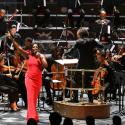
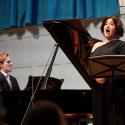
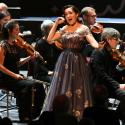
 The two singers were well-matched. Doyle (pictured right) tended to point the way, sometimes sculpting phrases in the air with her left hand, narrating, surprising, consciously giving weight to each phrase. Davidson is far more instinctive: she inhabits the phrase and lets the listener enjoy the sheer radiance of her sound. Both sopranos brought out the word-painting and the aching chromaticism in the work. When a word such as “gementes” or “afflictionem” crops up, Couperin sees no reason to hold back on the melisma. From the points of view of intonation and ensemble, these two were well-nigh faultless all evening.
The programme had been devised by Stephen Devine, who played a small chamber organ in the Couperin, and switched to harpsichord for two short works by Rameau, and also to accompany viola da gamba player Jonathan Manson in works by Marin Marais. These contributions were dutifully shoe-horned into the Festival's theme for this year “Women in Baroque Music – Composing Women – Performing Women – Inspiring Women”.
In the Couperin, the two highly experienced players did a fine job to keep the basso continuo going all evening, but it was a very tall ask. There were times when the sense of landing in the harmonic rhythm seemed to be asking for a more resonant and stronger bass line than the two unaided were able to provide. In the Marin Marais pieces, Manson was poetic, but these pieces needed a greater sense of fantasy, rhythmic freedom and a bit of bad-boy extraversion.
In the end, however, it's all about that singing, and it is to be hoped that an enterprising record label will record these two captivating singers and their deep empathy with this unique work.
- There will be another performance of the Leçons by La Nuova Musica as part of the Spitalfields Festival at Village Underground. It will have the benefit of the extinguishing of candles which was part of the Holy Week ritual
- The final night of the London Festival of Baroque Music presents Monteverdi's Vespers of 1610 in Westminster Abbey