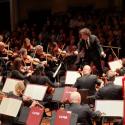
There was a change of conductor from the one advertised for this BBC Philharmonic performance at the Bridgewater Hall – but the one who we heard from was an interpreter of extraordinary vision and intensity. Yoel Gamzou is also a composer in his own right, and a Mahler specialist, it would seem: he’s made his own completion of the Tenth Symphony, so he’s no doubt as aware of the language and creative imagination of that other composer-conductor as anyone.
Here it was the Ninth he brought to life, the only item on the programme in the event, as Britten’s Sinfonia da Requiem was simply dropped (there could have been interesting inter-work reflections between them, but that was not to be). At an hour and 35 minutes, in his reading, it was a concert in its own right, and you would be right to conclude that he does not rush it.
What he does do is to emphasise the expressionist and proto-modernist aspects of the writing, and to bring its emotional charge to the full in every aspect. If there’s one word that’s often been deployed to convey the essential quality of the symphony, it’s “valedictory” – but that applies most obviously to the first and last movements, which are (startlingly) both slow, often elegiac and long-drawn-out. Mahler himself would have said that the symphony should encompass a whole world in its discourse, and the other lands this experience visited were varied indeed.
The opening of the first movement – bare and seemingly almost atonal in its stark laying out of its fundamental motifs in the first bars – contrasted with a surge of feeling as the strings took up the tale, particularly in a palpable hesitation on the two up-beat staccato quavers when the first violins finally make their entry. This was to be flexible and passionate playing (Zoë Beyers leading), and though I wondered at first whether Gamzou’s extravagant gestures were going to hinder the orchestra’s reading of his exact beat, there were only occasional hints of any lack of unanimity.
The movement had drama in it, despite the measured pace of much of its progress, and when its acceleration came, the effect was all the more incisive. A sense of grotesquerie as the music reached the recall of its opening was becoming apparent, but gave way to its extended, nostalgic final pages with lovely solo playing from Beyers, Victoria Daniel (as principal flute), Javier Molina Parra (guest principal horn) … and Clifford Llantaff, making a welcome return to the ranks as guest principal harp.
Mahler asks for the playing in his second movement, which begins in his much-loved rustic waltz idiom of the Ländler, to be clumsy and rough. Well, it was never less than beautifully precise in the playing of the overlapping rhythmic figures involved, and Gamzou took its middle part at a good lick, before the introduction of what is really the whole work’s “motto” – the two-note sigh of a falling major second, which was touching, before an exciting finish to the reprised introduction. The third movement of the symphony was confident and achieved its purpose by more economic means as far as the conductor’s movements were concerned. Tempo changes were neat and smooth: the interruptions of the timpani to its more restful moments very pronounced (they’re certainly meant to stand out – maybe this time they did so a bit too obviously). Sub-principal viola Sarah Greene made her soulful presence felt in the solo viola’s melody, and the acceleration of the stretto and warp-speed concluding presto were thrilling.
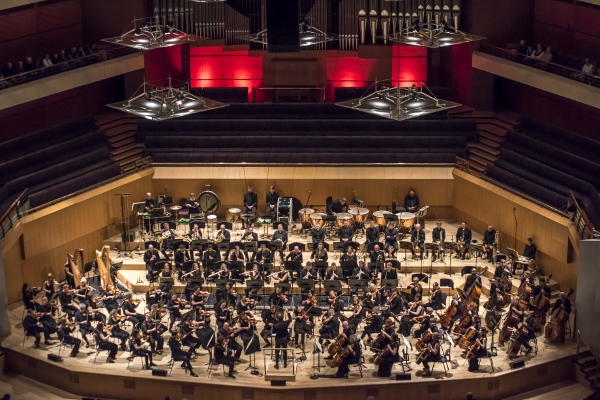 The last movement – “very slow and even holding back”, as Mahler marked it – was poised and heartfelt, the strings’ playing of the two main themes both focused and intense, and solo contributions from the wind as eloquent as before (and guest principal cello Karen Stephenson’s particularly memorable amid the delicacy of the full grouping). By the end it’s all about sustaining the sense of a calm so precious you hardly dare breathe – a tension unlike that of almost any other symphonic work – which Gamzou and the orchestra achieved amazingly. The sound of this pianissimo was tinier than any I’ve ever heard: you could have heard a pin drop, as they say, but no pin did, and it was a full 40 seconds after the last note died, when Gamzou finally closed the score, that the audience’s response erupted.
- To be broadcast on Radio 3 on 8th July
- More classical reviews on theartsdesk