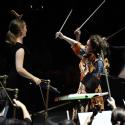
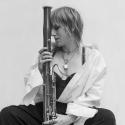
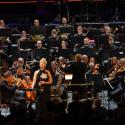
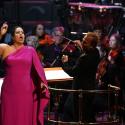
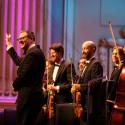
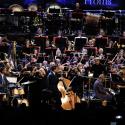
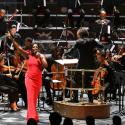
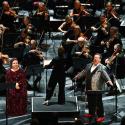
My abiding memory of the Berlin Philharmonic’s second Prom under Sir Simon Rattle on Saturday will be of 6,000 people listening with rapt, or at any rate silent, concentration to Schoenberg, Webern and Berg. Has it ever happened before? Perhaps in Boulez’s day, though I’m not sure even he ever filled this hall for these particular composers. And what does it signify? That we were the stragglers who failed to get tickets for the previous evening’s Beethoven and Mahler? That we would put up with anything to hear Karita Mattila sing Strauss’s Four Last Songs?
None of these, I think. The day that Schoenberg’s, Webern’s or Berg’s orchestral pieces cease to assault our ears will be the day they stop mattering. As for the stragglers for Strauss theory, I wouldn’t insult a Prom audience (or myself) in any such way. This was quite simply a fantastic, thrilling piece of programming, and it packed the house (almost) because people respond to exceptional artistic events that chime with their sense of what is fitting. The Berlin Phil is one of the great orchestras. Probably, at the moment, the greatest in the tradition that culminated precisely in these amazing scores. And of all current orchestras they are surely the best constituted to play this music with the richness of colour and precision of detail without which it can easily slide into incoherence. People grasp this kind of thing intuitively; and the concert proved it conclusively.
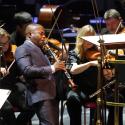
This is a virtuoso orchestra in all its parts, but not a flashy, chromium-plated one. The quality of the sound is as rich and varied as the colour in a Kandinsky landscape, with seemingly endless shades of light and dark, tones that blend or contrast, that stand out or fade into one another, that move effortlessly from solo delicacy to the massive force of a sonic avalanche. And this is exactly how Schoenberg especially, but also his two great pupils, were writing for orchestra around 1910. Typically, Schoenberg starts his Five Pieces with a soft figure for a pair of clarinets and muted cellos; Webern launches his Six Pieces with a solo flute; Berg’s Three Pieces start with a soft gong-stroke. Yet the audience is confronted in all three works with an army of players who do sometimes set off violent explosions of sound, but who just as often vie with each other in the refinement and articulacy of their individual voices, as if this were nothing but chamber music on a vast scale.
Simon Rattle has said that he designed these programmes around Mahler as a kind of hub: music that influenced him – hence the beautiful performance of Wagner’s Parsifal prelude that opened this concert – and that he influenced – hence, I suppose, the Strauss songs, but above all Schoenberg and co, with their nervy flickers of sound and ear-splitting shrieks of anguish. Rattle controlled the intensity magnificently throughout, having not made it any easier for himself or his players by presenting the three orchestral sets as a continuum: no applause, no breaks – as if the nightmare of the dying Germano-Austrian empires were a collective horror which we still share: a grim but perversely pleasing conclusion.
An unforgettable concert, then. But in the dear old Albert Hall there are always problems. From my seat in K stalls (facing the platform but far away) Mattila’s Strauss sometimes had to be imagined in its finer points, though the beauty of her long melismatic lines was almost as visible as it was audible. And this was despite Rattle’s hyper-discreet accompaniment, carefully graded to avoid overwhelming the voice, as Mattila says happened when she first sang these songs in Turku almost 20 years ago. As for the Wagner, there can be few harder starts for a concert or an opera: rhythms that float across barlines, exposed unaccompanied melodies, chorales of brass and woodwind where the slightest deviation in ensemble creates an untidiness that needs trimming off like a stray wisp of hair. Maybe there were one or two of these at the very beginning, but all soon forgotten in the total beauty of the sound – so brilliantly summed up by Debussy as “lit from behind” - and the marvellous sostenuto of those endless phrases, held back to perfection by the masterly Sir Simon.