To coincide with the National Library of Scotland’s first bi-lingual exhibition Sguel/Story, an exhibition in English and Scottish Gaelic which celebrates stories and storytelling, the library presented a performance of newly reinterpreted Gaelic ballads with string quartet arrangements from composer Ned Bigham.
These ballads – known as laoidhean – are heroic folk tales telling the stories of mythical beasts, brave warriors and ancient kings and queens, and have been an important part of Celtic folklore since Medieval times. One of the most notable collections of these songs was compiled by the 19th century folklorist and polymath John Francis Campbell, who drew on manuscripts, printed material, and his own fieldwork in the Highlands and Islands. His work is housed in the library, and forms the basis for the exhibition, as well as the inspiration for these brand new interpretations.
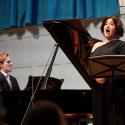
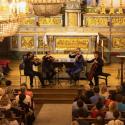
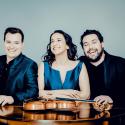
Bigham’s arrangements are sensitive to the original Gaelic melodies, with fragments of the tune intricately developed and woven throughout each instrument’s line. The quartet performed with a rich romanticism, which worked well for the rounded, pizzicato passages but for the most part was overly heavy for the spritely melodies. That, mingled with an unforgiving acoustic and some slight intonation issues left most of the instrumental music somewhat sluggish sounding. Gaelic singer Màiri MacMillan, who hails from South Uist, sang with the buoyancy needed to carry the stories, as well as a pleasant, light tone and engaging sense of drama, particularly in "Laoidh a’Choin Duibh" (Lay of the Black Dog). The strong rhythms in the opening "Là Bha Ridire ag Òl" (Waulking Song) felt awkwardly out of sync though, and MacMillan was barely audible against the quartet, a balance issue which inexplicably was not fixed throughout the hour-long recital.
This is an interesting and important project; it’s vital this Gaelic tradition is kept alive, and juxtaposing these ancient melodies and folk-singing style with contemporary string quartet arrangements is an innovative yet sympathetic way of doing this. It’s also commendable that the NLS is exploring its collections in a way that’s artistically holistic, but the room the concert was held in wasn’t the most suitable; perhaps it could consider holding events after general opening hours in one of their large spaces where there’s a more lively acoustic.
Sadly, despite many positives on paper, this was a concert that just didn’t spark. Whether a longer soundcheck, more rehearsal time or just a greater care was needed I am not sure, but the end result was a performance which fell flat.