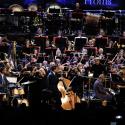
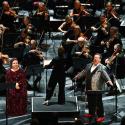
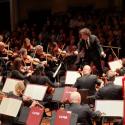
Clown trousers, comedy tie, half a head of candy floss hair and a circus-performer's grin received us last night from the podium. Was that Krusty the Clown conducting Mahler's Resurrection Symphony? No, it was Eliahu Inbal, one of the funniest-looking men in a pretty funny-looking profession. During one of those big preganant caesuras in the Allegro maestoso, I was half-expecting balloons to shoot out of his baggy trousers or, at the end, the singers' flowers to be ta-dahed from his even baggier sleeves. He even came on stage with two batons. Why? Who knows. Perhaps I missed a juggled encore.
The cheapskates among you (come on: hands up) will be well acquainted with Inbal. He has recorded virtually every Romantic symphonic cycle there is. And each CD goes for around two pounds a pop, if I remember rightly. As a result of this seemingly low-grade fecundity and his tenure with second-tier European orchestras, he unfairly slips under the radar. His recordings are, in fact, very highly-rated and always worth a punt. The performance at the Royal Festival Hall last night showed us why.
Neither funny, nor cheap was Inbal's vision. If he was a clown, he was a Stephen King sort of clown. The sort of clown to seriously bedevil your sleep. As a result, this was a Resurrection without much of a Christian payoff but with a hell of a dark and ferocious journey to redemption.
The pungency was there from the off. With one flick of the finger he plunged the orchestra into darkness, the brass terrorising the eardrums with a sound of chemical dissonance. Waves of lightlessness caught other waves. The soaring strings were forced into uncomfortably high positions on G string and A to adumbrate this extremity of texture and mood. A Boschian chaos was envelopping us.
And then from out of this extremity, an extreme softness to match. The entry of the first major-key theme on high strings was a heavenly thing. There was an almost Boulezian differentiation of colour, where the sweetness seemed so from another world that one wondered whether the same metre, the same dynamic laws were governing these two forces.
Inbal seemed less interested in refining the simple space of the second movement, the Andante moderato. The result was a tiny bit heavy-footed, perhaps because there were too many strings in on the game? Still, there was a lovely nostalgia and pathos to the phrasing. And it soon began to yearn like a 1950s film score. One could imagine a best supporting actress waltzing out to these sentimental strains quite easily.
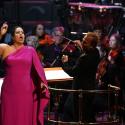
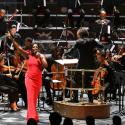
The third movement scherzo was not as vivid a portrait as that which preceded it. Inbal's focus was on the orchestral explosions and great towering crashes, rather than the patches of tenderness. And why not. There was at least one idyllic moment, the elderly choristers sun-bathing smilingly in the warm and natural tones of contralto Ekaterina Semenchuk.
Then came some more dark digging. Particuarly good were the violas with their enthusiastic sforzando attacks at the heel behaving like a pack of ferocious moles. Some of the orchestral plunges were almost visible as they swung into a tumultuous and terrible action. The fanfares became near-uncontrollable calls of the wild. The clarinets careened. The view was topped off, quite literally, with a Doris Day-like blonde bombshell at the tubular bells, who came out menacingly at moments of greatest tension, like some Aryan dominatrix.
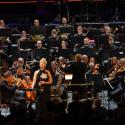
As so often with British choirs, and in particular with the Philharmonia Chorus and Voices, the highlight came with their fine-particled entry. Their first notes were less sung, then emitted, like some gas, some sonic cloud or spray, talc-like. They were accompanied by the fabulous stand-in soprano, Caroline Stein. And then we were hurled into the Resurrection itself.
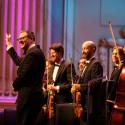
I have to say that this is very much how I imagine any hypothetical Resurrection to pan out. Not so much joyous and peaceful as blinding and frenzied. For the curtain call, the clown-cum-conductor turned clown again as he tried oh so sweetly to get every orchestral section the audience applause they deserved. The Marx brothers couldn't have timed it better as section leaders were pulled up and down, up and down, as if playing musical chairs. Eliahu Inbal: first-rate comedian, first-rate Mahlerian.
- The Philharmonia's season continues with Kurt Masur's Bruckner 4 on 18 February
- Check out what's on in the South Bank Centre season
- Find more about Eliahu Inbal at this website.
- Buy his CDs atamazon.co.uk