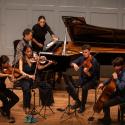
She is habitually called “the violin star” but this was Nicola Benedetti in the role of dedicated chamber music player, thoroughly prepared and hard at work. Any expectations that she might play in a flamboyant or limelight-seeking way proved completely misguided.
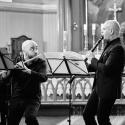
Benedetti was at Cadogan Hall for the last of the eight Proms Chamber Music concerts, in her established trio with Frankfurt-born cellist Leonard Elschenbroich and Ukrainian pianist Alexei Grynyuk. In this context she is just one of the team, doing complete justice to a major work, in the full knowledge that the whole will be bigger and weightier than the sum of its parts.
The poise and elegance of the hushed ending was remarkable
That main work was Brahms' Op 8 Trio, and everything that the trio did helped to reveal the complexities and demands of the work as a convincing whole. It presents tricky performance issues, and these had clearly been thoroughly addressed. Some groups are daunted by the length of the first movement, and miss out the exposition repeat. Here there was no shying away, and it worked superbly. The reprise of the opening theme was played even more beautifully and plangently second time round, with Eischenbroch in particular showing his gift for beautifully melodic and shaped phrasing.
Brahms' slow third movement presents perhaps the toughest challenge. Its sheer scale and stately pace almost defy the players – and the audience – to work out if they are really up for it. There were a few rustlings in the audience right at the beginning, but thereafter the intense concentration of the playing and the quality of the silence from the audience were stunning; the full hall's attention was clearly held by the performance. The poise and elegance of the hushed ending was remarkable. Grynyuk placed the slow successions of chords with poetic assurance. Another highlight was the scherzo and trio, the only part of the work Brahms left largely unchanged in his later revision. The differentiation between the elfin Mendelssohnian scherzo (in the minor) and the heart-on-sleeve lyricism of the trio (in the major) was beautifully brought out.
 The second of the two works in the concert was Butterflies Remember a Mountain. This work for the trio had been commissioned from the London-based composer Arlene Sierra (pictured right by Ian Phillips McLaren) by Leonard Elschenbroich in his role as Artist-in-Residence with the Philharmonic Society in Bremen. The title and the story of this programmatic work are based on a popular (and highly dubious) myth that has taken root: it is believed that the indirect migration path of the monarch butterfly around the Great Lakes can be explained by the existence several millennia in the past of a mountain which they needed to circumnavigate. The composer introduced the work and its story and content.
At a first hearing, Butterflies... presented and captured moods well, but used what sounded like motoric repetition of the materials and motifs rather than organic development, even if the third of its three movements did contain a major build of intensity. The context didn't help: anything was going to sound slight after the monumental scale and sheer quality of the trio's performance of the Brahms.
Read theartsdesks reviews of other BBC Proms