

The Southbank Centre’s second Multitudes festival – which commissions artists ranging from filmmakers to acrobats to shine new light onto the orchestral repertoire – began last night in triumph with the Aurora Orchestra’s celebrated performance of Stravinsky’s Rite of Spring from memory. As a musical feat alone this seemed the equivalent to building a human pyramid on a tightrope above the Thames, but the Aurora Orchestra heightened the challenge by sweeping us back to 1913 for a dramatised account of the Rite’s origin.
Experiments fusing classical music and theatre are, perhaps inevitably, hit and miss – productions I’ve seen in recent years have ranged from the thrillingly inspired to the pretentiously leaden. Happily Jane Mitchell’s astringently witty script – first presented to critical acclaim at the Proms in 2023 – delivered insights into Stravinsky’s eccentric creative process that were as convincing as they were compelling.
At certain points the audience was divided into different sections to clap some of the work’s fiendish cross rhythms. At another we were asked to sing the bi-tonal chord from The Augurs of Spring in which Stravinsky juxtaposed a bass chord of F flat major with a treble chord of the dominant seventh of E flat major. Strikingly we also heard some of the players sing the traditional Lithuanian folk song that Stravinsky transformed so memorably into the opening by writing it for solo bassoon, transposing it into a higher register to give it its wonderfully ethereal, other-worldly quality.
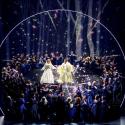
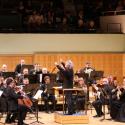
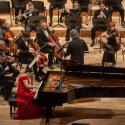
Alongside this illuminating musical deconstruction – led by conductor Nicholas Collon – we watched actors Karl Queensborough (above upright piano, below) and Sarah Twomey (on stand in red shirt, below) act out roles ranging from Stravinsky himself to the archaeologist and folklorist Nikolai Roerich, the choreographer Vaslav Nijinsky, and the impresario Sergei Diaghilev. Moments of light comedy peppered the intricate action, whether it was Nijinsky declaring “What an idiot the public is,” or the sight of Stravinsky manically playing the same chord more than 200 times on the piano to Diaghilev.
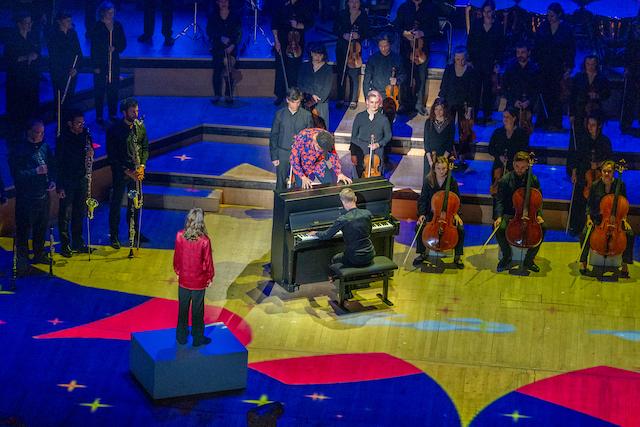
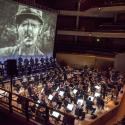
Throughout the narrative, the orchestral players, circulating the stage, gave us tantalising snatches of the finished piece, in a performance heightened by Lil Warden’s often rhythmically deployed lighting design and Anouar Brissel’s swirling shadowy projections. By the time we reached the interval, there was a real sense of electric excitement in the hall as the audience readied itself for the second half in which the work would be played in its entirety.
By now we all knew that the first half of the evening at which The Rite was premiered had been devoted to Les Sylphides, a romantic reverie set to music by Chopin. In that interval, some have argued, lay the chasm between the old era of music and dance and the modern era. More than a century later there was a pin drop silence as Jonathan Davies performed the immortal bassoon solo, allowing it to weave its way sinuously across the auditorium. Then, following the dissonant horn accompaniment, other woodwind players joined the bassoon, with the conflicting tempi bringing a sense of an anarchic dawn chorus.
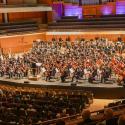
The Aurora Orchestra has been performing works from memory since 2014, but to play The Rite by heart feels particularly appropriate. It allows the musicians to be fully saturated in the music, performing as if they are possessed by its pulsating rhythms and wildly shifting moods. Following the giddy cross-rhythms of the opening, The Augurs of Spring introduced its repeated bitonal chords played with brutal relish by the strings, the violinists and violists tilting forward menacingly with each accented note. Towards the end of the movement, a hurricane of chromaticised sound was underpinned by thunderous timpani.
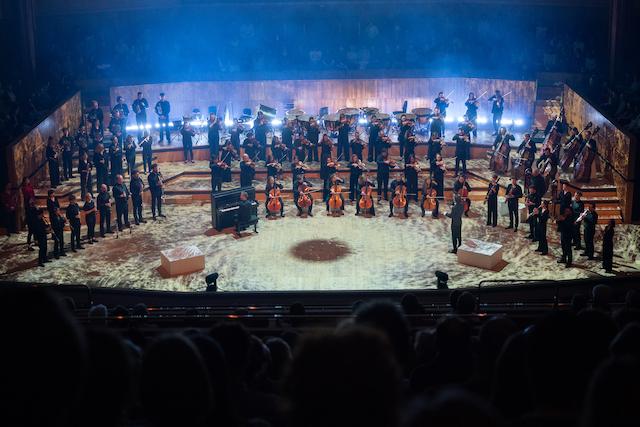
As the work progressed there was no let-up in the raw intensity. At points the sinister rumble of the drums sounded like a dragon awakening at others the cynical cackle of the fantastic brass section heightened the sense of horror and bloodlust at the central sacrifice of a young woman. As the conductor, Collon became a high priest of sound, conjuring new rhythmic motifs out of the air with a gesture of the hand, or shifting the mood from surreal reflectiveness to full blown tempest. Antoine Siguré’s superb, muscular performance on the kettledrums was just one highlight of an interpretation which truly allowed rhythm to become a dominant Nietzschean force, fusing a sense of vivid chaotic life with the turmoil of destruction.
Once the main performance was over, the players then came into the audience, so we could experience parts of the piece as if we were within the orchestra. Witnessing the sheer physical effort of the musicians was thrilling and conjured up entirely different images from the primal rite that inspired the work. In the angry energy of Stravinsky’s 1913 masterpiece it was suddenly possible to sense the turbulence of a century on the brink of war and revolution. No wonder that first audience rioted – and what a testimony it was to the Aurora Orchestra’s performance that the fire and rage of Stravinsky’s vision continues to exert its force in our own age of transformation and destruction.

Add comment