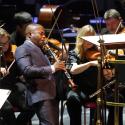
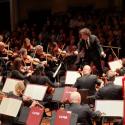
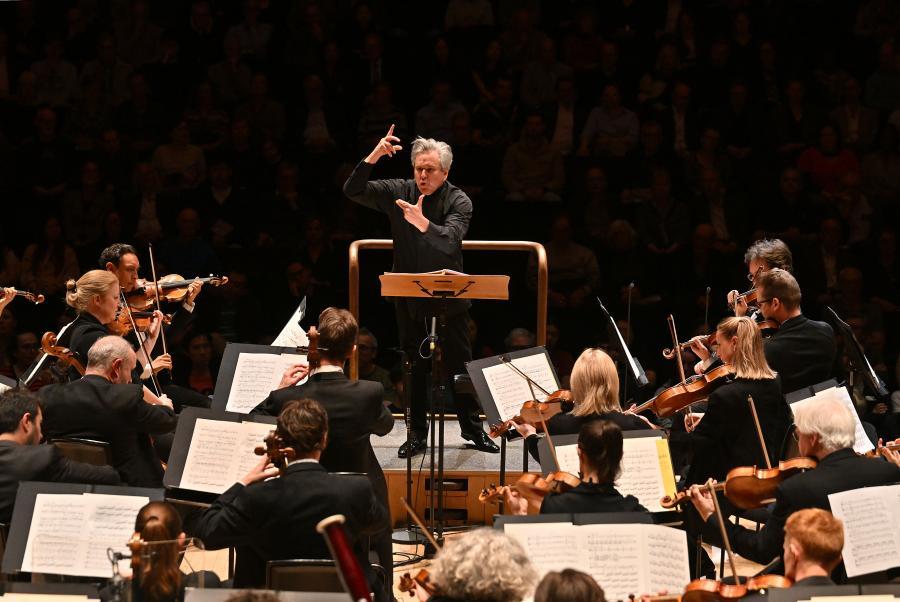
Antonio Pappano’s pairing for last night’s Barbican concert intrigued – and, initially, baffled – me. Shostakovich’s Fifth: a clear choice, given the London Symphony Orchestra’s recent stellar accounts of the Russian’s major symphonies. Its preface, however, came in the unpredictable form of Korngold’s violin concerto, under the bow of the supremely elegant and tasteful Vilde Frang.
Between Hollywood and Leningrad, however, Pappano and his high-achieving band struck up a truly engrossing dialogue. Questions of kitsch and sentiment, of freedom and compulsion, of authenticity and artifice, played out across utterly convincing performances of works that each bear the stamp of 20th-century traumas. If we might say that Hitler (and then Warner Bros) authored the first piece, then Stalin – or at least the tyrant’s omnipresent shadow – fashioned the second. One is the fruit of enforced exile; the other of domestic intimidation.
Before we reached this juxtaposition of two works forged out of terror and upheaval, the LSO gave a rare outing to the controlled, elegiac rapture of Imogen Holst’s tone poem Persephone. This youthful essay in musical myth (1929) reveals a composer already sure of her skills – the orchestration, especially in the LSO’s deft hands, has satisfying confidence and versatility – but still seeking a personal language to carry them. Beginning and end, lush and rippling, sound like a rhapsodic Daphnis and Chloe tribute act, while the central section – Persephone’s descent to the underworld – breaks out of the Ravel-like mould and into a more original seam of sinister sadness. Unsettling low strings and brass, effectively deployed, illuminate the Plutonic gloom. Pappano did generous justice to a score imbued with sensitive and varied colouring, and drew from the LSO an orchestral palette as rich and dense as in the later works.
In the Korngold concerto, Frang thrillingly invested in every element of schmaltz and swagger, while making its shameless virtuosic passage work race, skip and leap. We heard why, in 1947, this high-fat blend of Vienna and Los Angeles became a custom-made vehicle for Jascha Heifetz, as Korngold inaugurated his postwar return to the concert hall after upgrading the musical level of the Hollywood soundtrack in ways that endure to this day.
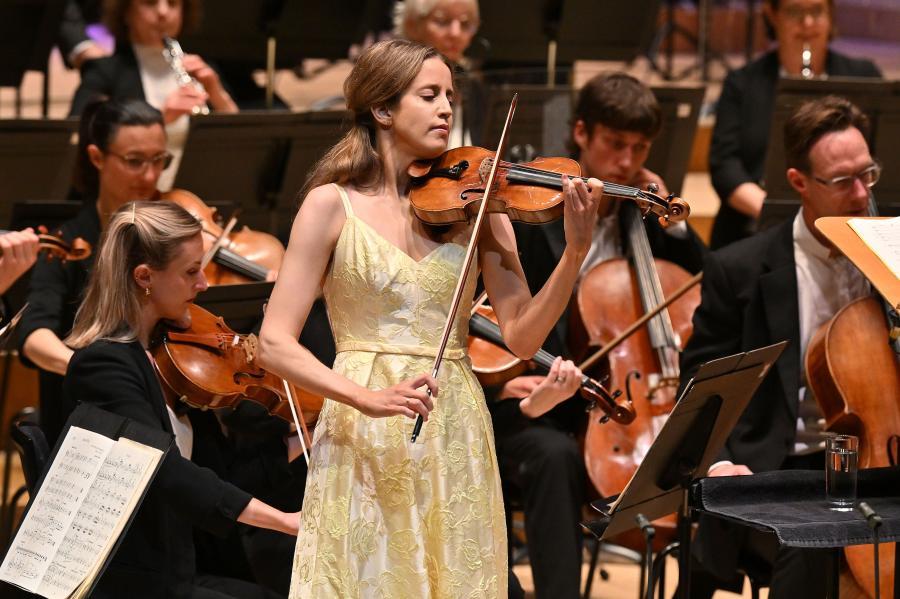
The Norwegian star never held back. Singing but skittish, unafraid of sheer lusciousness of tone but capable too of a silvery piano delicacy, she responded to the work’s weird kind of integrity with a wholehearted commitment of her own. She shuns sentimental excesses but never sounds too (Nordically?) dry or cool. Those recycled Hollywood tunes from swashbuckling crowd-pleasers joined with echoes of the Viennese wunderkind adored by Mahler and Strauss into a contradictory but seamless whole.
Frang, with an equally heartfelt Pappano in support, let us appreciate the exile’s journey through and beyond the apparent “vulgarity” of the movie score. The first-movement cadenza had a surprising prickly urgency; a rasping edge. And in the eerie lyricism of the Romance, conveyed up to the top of the violin’s range with exquisite filigree refinement, she and the orchestra hit a glittering vein of uncanny beauty. It felt closer to (say) the numinous nocturnes of early Schoenberg than to the sound-stages of Burbank. At first I had imagined that, if you sought to yoke Shostakovich to an avant-garde émigré composer pitched into US showbiz, Kurt Weill would be the natural choice. Frang proved me wrong.
I don’t think it was a complete illusion to feel that Korngold’s knife-edge dance between candour and kitsch seemed to reverberate through the Shostakovich too. I have heard harsher, starker, more abrasive readings of the Fifth, but few that brought out – as Pappano so persuasively did – the yearning for harmonic wholeness (even sweetness) that courses through the endless disruptions and collisions of the piece. Painting with a broad, sometimes leisurely, brush, but always alert to fine instrumental details, Pappano made Shostakovich sound distinctly Mahlerian – and not just in the manifest homage of the scherzo’s bittersweet ländler. That quality alone gave the Korngold a secret handshake.
Full-toned, spacious, often unexpectedly warm, the LSO’s playing seemed to bypass the question of whether Shostakovich – harassed for “formalism” by Party apparatchiki in 1936 – meant the audience-friendly affirmations of the Fifth as genuine populist gestures or subversive mockery. Korngold, after all, had already indicated that irony and sincerity can coexist. So they seemed to here. Deep, dark strings (led by Benjamin Marquise Gilmore) and Elizabeth Burley’s keyboards built up the threat that pumps through the “Moderato” opening – measured, yes, but never sluggish. The LSO woods, throughout, contributed their broad and intense palette of feeling, from lyrical relief to shrill panic: Gareth Davies and the ever-impressive LSO flutes, Sérgio Pires and the clarinets, the poignantly expressive oboes (Juliana Koch, Rosie Jenkins) – and Patricia Moynihan’s crucial piping piccolo.
Did Pappano make the string-led Largo almost too serenely lovely and expansive? For sure, the lower strings (notably, Timothy Walden’s gorgeous cellos) added tremendous body and soul to its hymn-like lament. But, from the piercing mock-militarism of the first-movement march to the over-the-top repetitive jubilation of the crashing finale, Pappano does a fine line in sardonic pastiche as well.
If his interpretation of this so-called “Soviet artist’s response to just criticism” lacked a little idiomatic anguish and asperity, the LSO’s playing – well blended, balanced and paced – gave us a full-length portrait of the composer as a stubborn aesthetic idealist in the toughest of times. Maybe mid-century Hollywood and Leningrad were not so far apart after all.