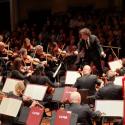
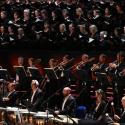
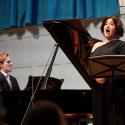
A concert by the National Youth Orchestra is like no other. For one thing, there are 160 of them – you simply don’t get the kind of power and intensity they can create from a normal-sized orchestra.
For another, they play with an enthusiasm and eagerness that even the most committed and devoted professionals would find hard to emulate. They want to share their music: they want you to feel it as they do. And the skill levels are right up there with the best of them, too.
It’s a fact that in theatre or dance those whose bodies are still approaching maturity are necessarily unable to reach the heights of effectiveness – somehow in orchestral music it hardly seems to matter, and technical abilities can be extraordinary.
What’s more, they give of themselves in a way that no others do. There are sections playing in the foyers as you arrive; the percussionists go on stage first, to accompany the others’ entry with a cinematic introduction; and at the end they turn themselves into a very accomplished choir, to sing their goodbyes to piano accompaniment.
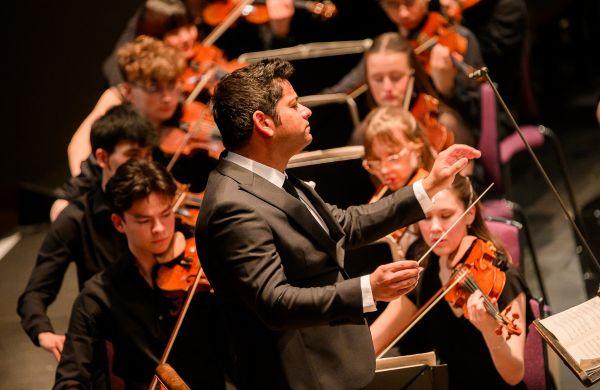
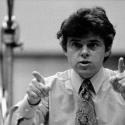
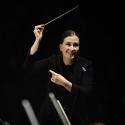
At the helm for the main programme last night was the NYO’s principal conductor and music advisor, Alpesh Chauhan (pictured above, himself a product of the Royal Northern College of Music’s training), whose ability to control large forces and enable them to give a range of expression from tenderness and sensitivity to swagger and panache is never in doubt.
There is inevitably an issue, when almost every role in the orchestra has effectively been enlarged to two or three people at least, of keeping precision and allowing for some soloistic freedom and nuance, but the remarkable thing in this programme was how little it was a problem. The 2026 NYO has some gifted section principals, and there was some beautiful and intimate expression from them. And the ranks of the full sectional brass (12 horns, eight trumpets, 8 trombones – even three tubas) were impressively disciplined. I’m not sure I’ve ever heard a large horn section quite as accurate and clean-cut as this one led by Emma Sandford – and her solos were extraordinarily beautiful.
The concert proper began with music from filmland – written by Joe Hisaishi for the animated fantasy Howl’s Moving Castle. Hisaishi’s concert piece Symphonic Variation “Merry-Go-Round” + Cave of Mind from Howl’s Moving Castle is a short and episodic sequence based on two of the main themes from the soundtrack, beginning with some tricky rhythms for the massed violins (which they, led by Aki Blendis, accomplished with considerable distinction) and culminating in a waltz which under Chauhan was a brisk and precisely mechanical whirl, reflecting the idea of life’s merry-go-round, as intended.
Wagner followed – the programme had love and its emotions as its theme – in the form of the Prelude and Liebestod from Tristan und Isolde. Ever a concert hall standard, the music provided the opportunity to demonstrate the expanse of expression possible from a body of musicians of the NYO’s size and ability: an almost inaudible pianissimo to begin with from the cellos; some highly expressive phrasing and surges of dynamic to follow; a building of momentum (after a while) to a rounded and resonant climax. The bass line came through the texture more effectively than often heard, and all to the good as it keeps the harmony firmly anchored: the rising passions of the Liebestod reached a clearly moulded high spot before its end.
The second part of the evening was given to Chauhan’s own selection of excerpts from Prokofiev’s Romeo and Juliet ballet score (not unlike the one heard from the BBC Philharmonic under Ludovic Morlot in this hall less than a couple of months ago, as it happens – telling the main incidents in Shakespeare’s story, with some scenes in pretty complete form). In its early parts we heard some of the best of the orchestra in its miniature form: the two-desk violins’ quartet, the introduction of Juliet with fast and athletic massed violin playing, plus distinguished solos from principal clarinet, principal flute and principal cello.
The Knights’ Dance (of The Apprentice fame) at the Capulets’ ball was seriously dominating with all those brass players, and there was more opportunity for eloquent solo playing by cornet and oboe. The playing was rhythmically energetic whenever it could be, and the love music delightfully tender (those three tubas showing just how gentle they could be). Alpesh Chauhan was undemonstrative but alert to what his players needed, encouraging their ability to listen to one another and keeping rhythmic discipline when needed.
In the final scene in the tomb there was scope for the big sound the massed NYO strings can make, and telling touches in the texture (such as a brief trombone interjection often smothered), and the percussionists, often required to restrain themselves somewhat despite the size of the rest of the ensemble, were finally given their head, to pretty devastating effect.
- To be repeated at the Royal Festival Hall on 11 April, and the Manchester performance to be broadcast on Radio 3 on 1 July
- More classical reviews on theartsdesk