

“This symphony comprises 11 songs about death and lasts about one hour,” the conductor Mark Wigglesworth declared before a second New York performance of Shostakovich’s Fourteenth – people had left in droves during the first – only to see a swathe of his audience look anxiously at their watches.
I doubt if anyone in an obviously more receptive and surprisingly youthful Barbican audience did that at any point during Gianandrea Noseda’s interpretation at the Barbican last night, which drew focus from start to finish. So did his Beethoven Seventh after the interval in a daring but triumphant programme. The London Symphony Orchestra is clearly on fire right now.
Never has Shostakovich’s song-symphony come more to life as a connected series of contrasted operatic scenes, as if he were still, at the end of his life in the 1970s, channelling the music-theatre more or less forbidden to him after the 1936 attack on Lady Macbeth of Mtsensk. I can’t wait to see soprano Elena Stikhina as “the Lady”, Katerina Izmailova, because her dramatic variousness was peerless last night. Sarcasm, voluptuousness, ghostly pathos – the setting of Apollinaire’s “The Suicide”, with its haunting ‘Three lilies” refrain – hysteria and hallowed depths (in Rilke’s “The Death of the Poet”): all were on parade, but meshed with the stupendous playing of the small string ensemble Shostakovich asks for and the startling percussion interjections. Occasionally the words are lost in the sheer enveloping warmth of tone, but in the big outbursts Stikhina could not have been more vivid. 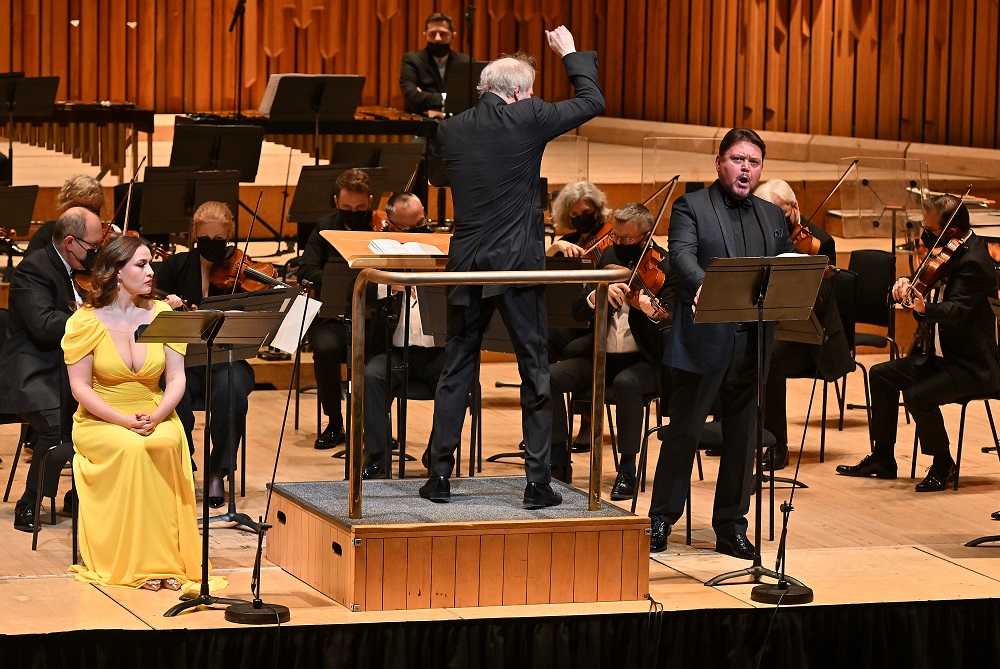 Vitalij Kowaljow (pictured above with Stikhina, Noseda and the LSO) is the true bass needed for the symphony’s heart of darkness, equally terrifying at full pelt, though perhaps a little more warmth would have better matched the weeping cello ensemble, superbly led by David Cohen in the Küchelbecker ode to his departed fellow-poet Delvig, the one moment where a touch of sentimentality, in the positive sense, is allowed to enter Shostakovich’s grim canvas. What a masterpiece this is, though, down to the extraordinary writing the composer gives the two double basses (Lorraine Campet and Patrick Laurence, utterly compelling). It would, incidentally, help the understanding if the translations could be given in supertitling; no-one wants to have head buried in programme when the drama needs watching.
Somehow there was something exultant about the experience, a human victory in mastering the darkest sentiments, rather than the bleak despair you might expect to experience. So the move to the A major light of Beethoven’s Seventh wasn’t such an extreme jolt. The spring in the heel which is one of Noseda’s most engaging characteristics was even there as oboist Olivier Stankiewicz – visibly enjoying every minute made his opening summons, and with textures crystal-clear, the wind capped by Gareth Davis’s blissfully singing flute could always be heard even above the now-large string section. The interpretation uniquely reminded us, too, that Beethoven's quieter moments, so intense here, can be so meaningful in a work which tends to be remembered for its exhiilarating high volume; the crescendos, too, were masterly. The fast pace at which Noseda took the scherzo and finale especially would seem to cry out for a smaller number of players, but maximum articulation was miraculously achieved by the LSO’s glorious strings. Curiously, the last chamber version I heard, with Maxim Emelyanychev conducting the Scottish Chamber Orchestra, felt rushed and even garbled, while here Noseda reminded us that the music is always to be danced. No wonder many of the young people in the audience shot to their feet at the end; there’s no better introduction to orchestral not-too-heavy metal than this. And yes, those final torrents always set the pulses racing. But this was a performance in a thousand, no doubt about it.


