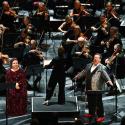
I had been looking forward to last night's concert since it was first announced over a year ago. For a Stravinsky nut the chance to hear pieces whose live performances are vanishingly rare was not one to be missed. And it turns out there are enough other fans of austere late Stravinsky to sell out St John’s Smith Square, which proved a very suitable venue for this programme.
Although presumably only pressed into service because of the ongoing refurbishment of the Queen Elizabeth Hall, a deconsecrated church was the ideal space, both acoustically and atmospherically, for this collection of pieces linked under the heading “faith”. Perhaps the only drawback was in the poor sightlines, given the lack of raking, which restricted the view of everyone downstairs.
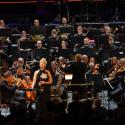
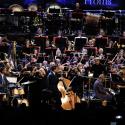
And this is a shame as a lot of thought had gone into the staging of the concert. There was even a director, David Edwards, credited. Since several of the pieces are so short, and in order to conjure up a sense of ritual, everything was run together in a single sequence, with no interval and applause only at the end. The re-setting of the stage between items (which was a complex feat of choreography, efficiently managed) was covered by a hypnotic sound installation of tolling bells, faded seamlessly up and down. On top of all this was big screen at the front for projecting texts and images and an imaginative use of the gallery that made the concert feel fully integrated into the performance space.
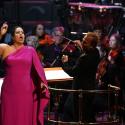
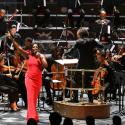
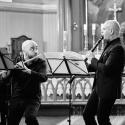
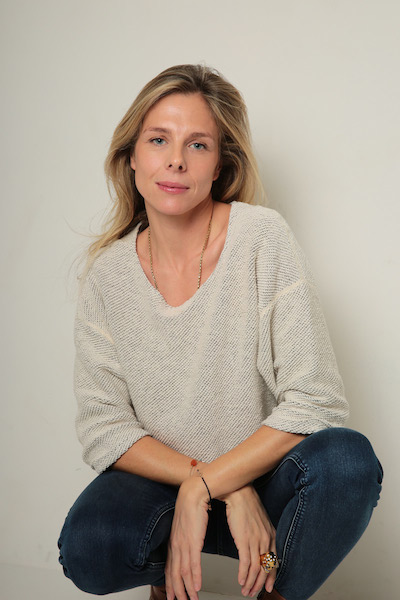 So much for the logistics: what about the music? There were three major items on offer, and three little Stravinskian shards. Of these perhaps the most affecting was the 1964 Elegy for JFK, dedicated to the president who had invited the Stravinskys to dinner at the White House. Scored for soprano – the luminous Hélène Hébrard (pictured right) – and three clarinets, it was a fragile lament floating over the audience from the back of the hall.
The programme had kicked off with Requiem Canticles, Stravinsky’s last major work, later chosen by his widow for performance at his funeral in 1971. Scored for a full orchestra, used extremely sparingly, it is like a kaleidoscopic tour through his earlier works, affording glimpses of The Rite of Spring, Symphony of Psalms, Agon and umpteen others. It is not a requiem in the manner of Verdi – the storm of Stravinsky’s “Dies irae” blows itself out in a few seconds – but neither does it seek to comfort like Brahms or Fauré. The chill of mortality is palpable, most notably in the impersonal aleatoric muttering of the “Libera me”. Only in the final bars, conjuring up the chiming of the end of Les Noces (and, in a different way, Scènes de Ballet) does the music transcend the human business of death, floating into eternity.
The Philharmonia Voices were in sonorous voice here and elsewhere, chilling or consoling as the moment demanded, and David Soar gave a stentorian “Tuba mirum”. Esa-Pekka Salonen controlled proceedings as a presiding priest, overcoming the practical challenges of the occasion with a clear beat and ceremonial calm.
Only in the Mass (composed in 1948, the earliest piece on the programme) were there any issues of ensemble; I also felt Salonen’s tempos here were a bit sluggish. Stravinsky needs to push forward, which this didn’t do till the electrifying “Hosanna”. I must also mention Katherine Nicholson’s contralto solo in the “Gloria”, which was rich and glowing.
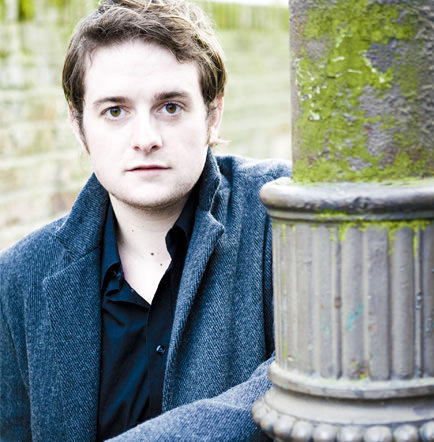
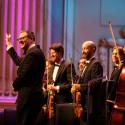
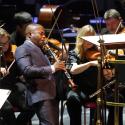
The final work was the Cantata of 1952, completed in the difficult period between the completion of The Rake’s Progress and the later adoption of a serial technique. It could not have had a more persuasive performance, and yet I remain unpersuaded. Allan Clayton (pictured left) never fails to impress (as at the Wigmore Hall last year), and his diction and tuning were exemplary; the women of the Philharmonia Voices were sweetly toned; the ensemble well balanced. And yet – and this hurts me to say – the Cantata is a dud. Devoid of rhythmic interest, harmonically uninteresting, and crammed full of the verbatim repetition that is elsewhere anathema, this is Stravinsky’s low ebb. It makes his late output more of a wonder: that in his 70s he picked himself up and started again, and created pieces that rank with his greatest achievements.