Benjamin Britten died on 4 December 1976. Last night’s Wigmore Hall concert, on the 43rd anniversary of his passing, proved that his real legacy lies not in inert acts of homage but a living engagement both with his work, and the unruly energies that drove it. Although we heard some high-quality Britten performances, from Ailish Tynan, Allan Clayton, Robert Murray and the Aurora Orchestra strings conducted by Brett Dean, the most hopeful pointers to a Brittenesque future came in the world première of Josephine Stephenson’s song cycle Une Saison en Enfer.
The young Franco-British composer’s settings of five sections from Rimbaud’s prose poem followed Britten’s own dazzling youthful response to his Les Illuminations. Like Britten, Stephenson sets the exotic, flamboyant and rainbow-hued French words for solo voice and string orchestra. Tenor Allan Clayton, despite the illness that forced him to withdraw from the concert’s second half, sang the work with a crackling alertness to every shade and tone of the words as Stephenson takes them on a journey almost as richly coloured as Rimbaud’s own lurid psychodrama.
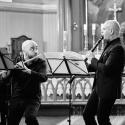
She achieves much more than dutiful post-Britten pastiche, although the echoes – more a matter of the ever-shifting rapport between words and music than quotation or imitation – did sound. Capable of both ethereal loveliness and ominous wildness, Stephenson’s eclectic, attractive sonic landscapes ranged widely. They stretched from the Stravinskyan chug and thump of “Bad Blood” through extraterrestrial glissandi on the highest strings and, in the melodic “Farewell”, a sumptuously lyrical visit to some lost satellite of Planet Mahler (or maybe Strauss). Led by Maia Cabeza, the Aurora players did deep-textured justice to her inventions. And, whatever ailed him, Clayton (pictured below by Sim Canetty-Clarke) and his magisterial tenor shone with its burnished alloy of robustness and refinement.
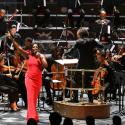
 Stephenson seemed to grasp that Britten – like so many of his mid-century peers – went in search of an art that might mash up the barbaric and the sophisticated, the vernacular and the arcane, the visceral and the cerebral. Hence the widespread fascination with Rimbaud, whose poetry (or whatever it is) had blended that cocktail long before. Before the première, Ailish Tynan sang Les Illuminations in its original, soprano version, rather than the tenor recension forever associated with Peter Pears. Encircled by the Aurora strings, standing up in their tough-looking but mellow-sounding pack, Tynan brought out the feral, even lurid, side of the settings as well as their passages of unearthly transcendence. We heard the rougher, cabaret-style Sprechgesang that inflects Britten’s style here as well as his airier ascents into the upper reaches of the voice’s range that give “Being Beauteous” its aura of unearthly sensuality. Tynan sounded, as she should, like some slightly besmirched angel, flesh and spirit painfully at odds but seeking, in Britten fashion, an elusive heaven of reconciled bliss. The Auroras made “Antique” a droll but sinister neo-classical stomp, with the always-impressive Cabeza a charismatic leader of the dance, and lent a properly demonic frisson to the underworld carnival of “Parade”.
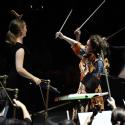
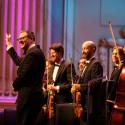
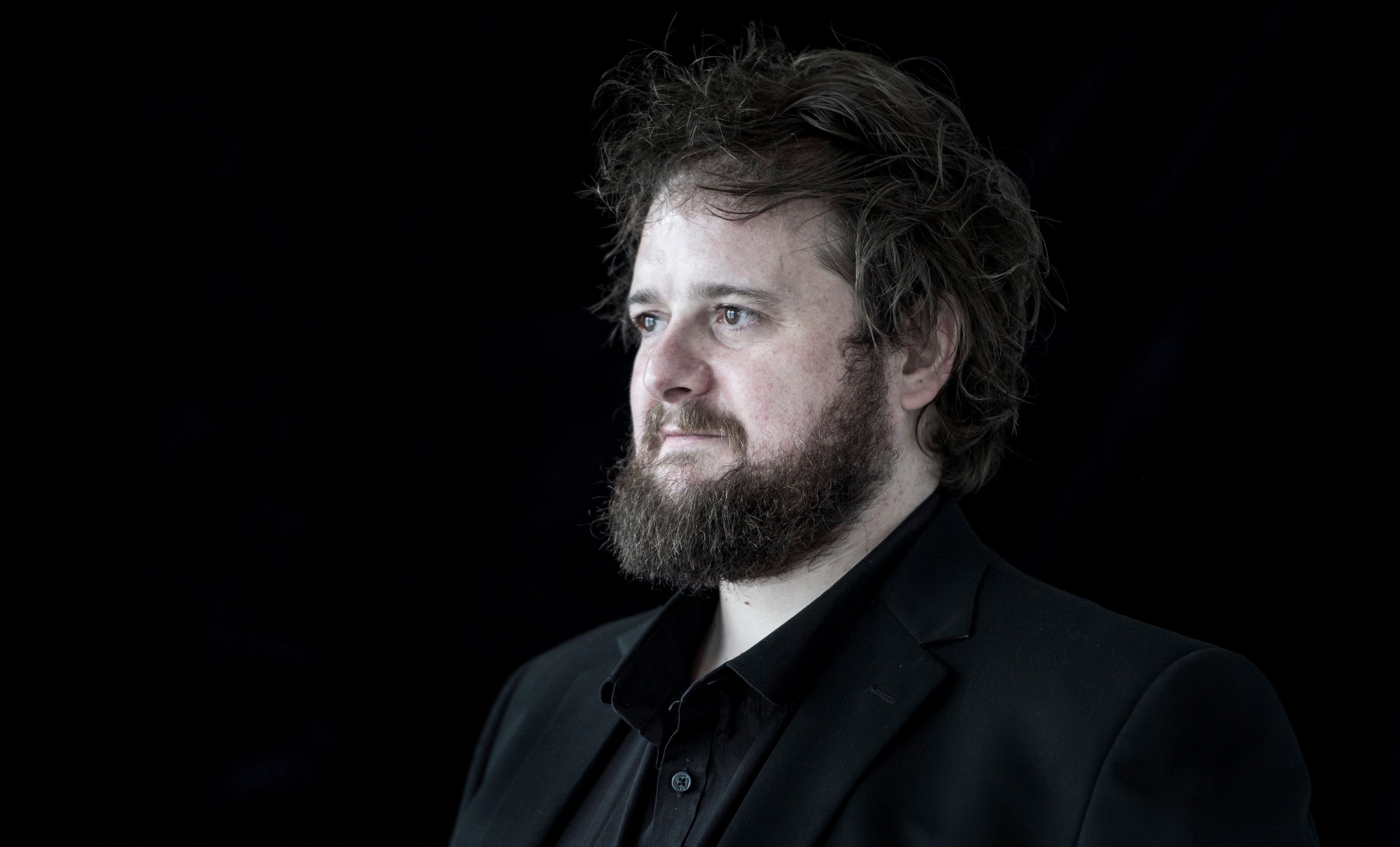
After the break, Arvo Pärt’s Cantus in memoriam Benjamin Britten saw Dean (pictured below by Bettina Stoess) and the Aurora strings summon a mood of hushed elegy via descending Aeolian minor scales that build into a kind of wordless incantation, magically played. A lone bell – which presages the “tintinnabulation” that later became the Estonian's signature technique – tolls in memory of the musical mentor Pärt never met. In a smart, and powerful, coup de théâtre, the bell’s final, hopeful uplift from minor to major was followed without a break by the natural horn notes that introduce Britten’s Serenade for Tenor, Horn and Strings. Those unvalved intervals take us back to some aboriginal bedrock of musical expression, before the six poems Britten sets lead into a more complex, “civilised” domain of nocturnal feelings and impressions. Christopher Parkes, the horn soloist, played throughout with delicate authority and a poised ripeness of tone that effectively enriched the work’s more wistful and shadowed moments.
 Robert Murray, standing in for Clayton now, stepped up with terrific verve and confidence. The poems demand a spectrum of vocal moods, from Cotton’s genial, genteel evening “Pastoral” to the poisoned eroticism of Blake’s “Elegy” and the archaic terrors of “Dirge” – Britten’s skin-prickling interpretation of the medieval "Lyke-Wake Dirge", perhaps the scariest piece ever to come out of Yorkshire. Murray commanded all their many moves, his spooky, sensual response to Keats’s death-haunted “Sonnet” particularly memorable. Meanwhile, the offstage Parkes weighed in with a mesmeric farewell solo. The Serenade had its first performance (with Peter Pears and Dennis Brain) here at the Wigmore in 1943. Last night’s top-notch iteration proved its solid and enduring bones. And this commemoration of Britten’s loss showed just how sturdily his music lives.